
Teatro Romano de Merida and the Roman city beneath the tiers
Published on 09/04/2026 at 18:52 | Editorial responsibility: Rafael Müller, Editor-in-Chief AD HOC NEWS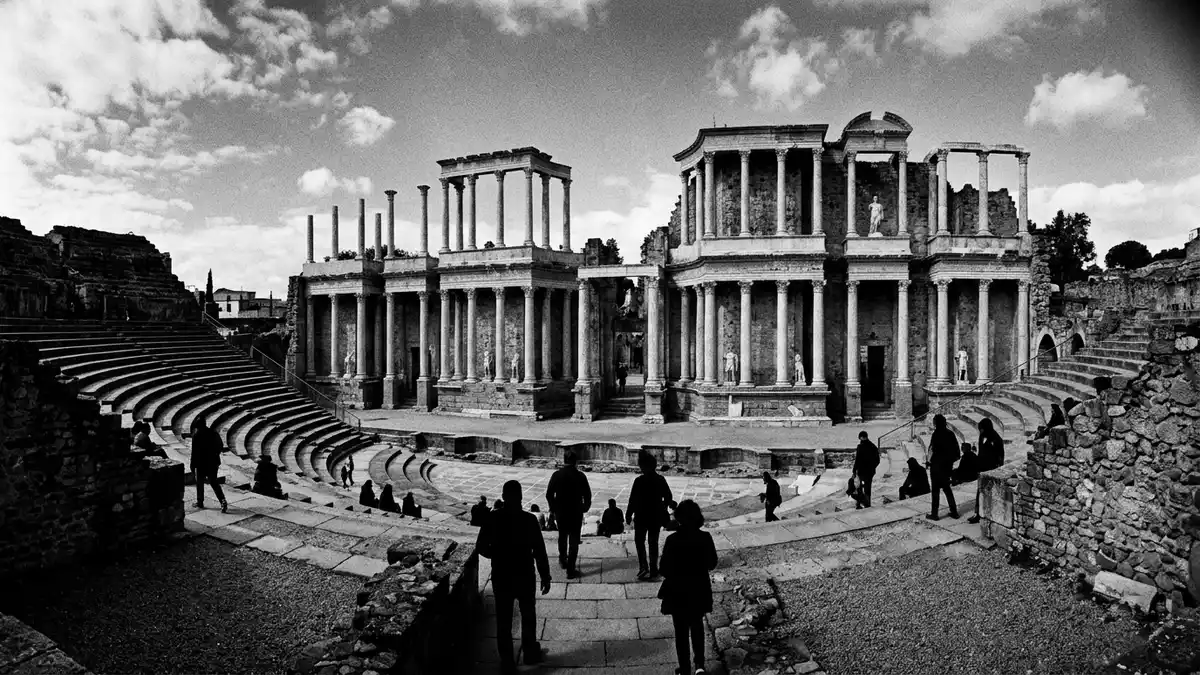
Teatro Romano de Merida in western Spain is a Roman theatre set into a hillside, its stone tiers facing a tall stage front of classical columns and sculpted niches. Built in the first century BC for the colony of Emerita Augusta, it stands as one of the centrepieces of the archaeological ensemble that makes Merida a major Roman site in the Iberian Peninsula.
A theatre carved into the hill of Emerita Augusta
The theatre forms part of the ancient Roman colonia of Emerita Augusta, established in 25 BC under Emperor Augustus as the capital of the province of Lusitania.Emerita Augusta, capital of Lusitania The choice of site uses the slope of the San Albín hill for the cavea, the semi-circular bank of seating rising around the performance space.the slope of the San Albín hill
Construction was promoted by Marcus Vipsanius Agrippa, the powerful Roman consul and son-in-law of Augustus, and the theatre was inaugurated between 16 and 15 BC.built under the patronage of Agrippa between 16 and 15 BC In its Roman phase the cavea held several thousand spectators for tragedies and comedies in Latin, with the tiers divided into zones that reflected social hierarchy.cavea divided into three zones for spectators
Scaenae frons: stone architecture as backdrop
The most striking feature of Teatro Romano de Merida is the scaenae frons, the monumental stage front that still rises behind the orchestra. Its design presents tiers of columns, entablatures and pediments in classical orders, framing niches that once held statues of deities and notable figures from the city.monumental scaenae frons with columns and niches
Below the stage front lies the orchestra, the paved semi-circular area where the chorus stood in Roman performances, separating the cavea from the raised stage platform.orchestra between cavea and stage The diameter of the theatre reaches around 87 m (285 ft), giving a clear sense of the scale that Roman builders achieved in provincial cities.maximum diameter of 87 m Stone, brick and concrete work together in the structure, with radial passages and stairways linking the different seating levels.
From excavation to UNESCO-listed ensemble
After the decline of Roman theatre-going, much of Teatro Romano de Merida lay partially buried for centuries, with the upper parts of the cavea and the scaenae frons gradually covered by earth and reused materials. Systematic excavations in the twentieth century revealed the full outline of the building and allowed careful reconstruction of collapsed elements, bringing the theatre back into readable architectural form.twentieth-century excavations and restorations
Teatro Romano de Merida forms part of the Archaeological Ensemble of Merida, a group of monuments that includes the adjacent Roman amphitheatre, the circus, bridges, houses and public buildings across the city.Archaeological Ensemble of Merida This ensemble was inscribed on the UNESCO World Heritage List in 1993, recognising the density and preservation of Roman remains at Merida and placing the theatre within an international framework of protected heritage.
Visiting Teatro Romano de Merida: what travellers from Western Europe should know
- Teatro Romano de Merida stands in Merida in Extremadura in the south-west of Spain, within the combined Roman theatre and amphitheatre precinct around Plaza Margarita Xirgú.
- The monument incorporates stone seating rising on the hillside and radial stairways; visiting involves walking on uneven ancient surfaces and climbing steps between levels.
- The site lies close to other Roman remains in Merida, including the amphitheatre, the Roman circus and several excavated houses, which are linked through the local heritage consortium.
- Spanish is the official language and the currency is the euro.
Searching for Teatro Romano de Merida on social platforms
These links open searches for Teatro Romano de Merida on each platform.
Frequently asked questions about Teatro Romano de Merida
Where is Teatro Romano de Merida located?
Teatro Romano de Merida is in the city of Merida in Extremadura in western Spain, within the archaeological precinct shared with the Roman amphitheatre.
What can visitors expect when they enter the theatre?
Visitors encounter a broad sweep of stone seating cut into a hill, facing a rebuilt Roman stage front of columns and niches, with walkways that pass through the different levels.
What makes Teatro Romano de Merida distinctive among Roman theatres?
Its combination of a largely intact cavea, an imposing scaenae frons and its role within the UNESCO-listed Archaeological Ensemble of Merida gives the theatre an exceptional sense of Roman urban life.


