
Teatro Romano de Merida and its stone backdrop of empire
Published on 09/12/2026 at 20:15 | Editorial responsibility: Rafael Müller, Editor-in-Chief AD HOC NEWS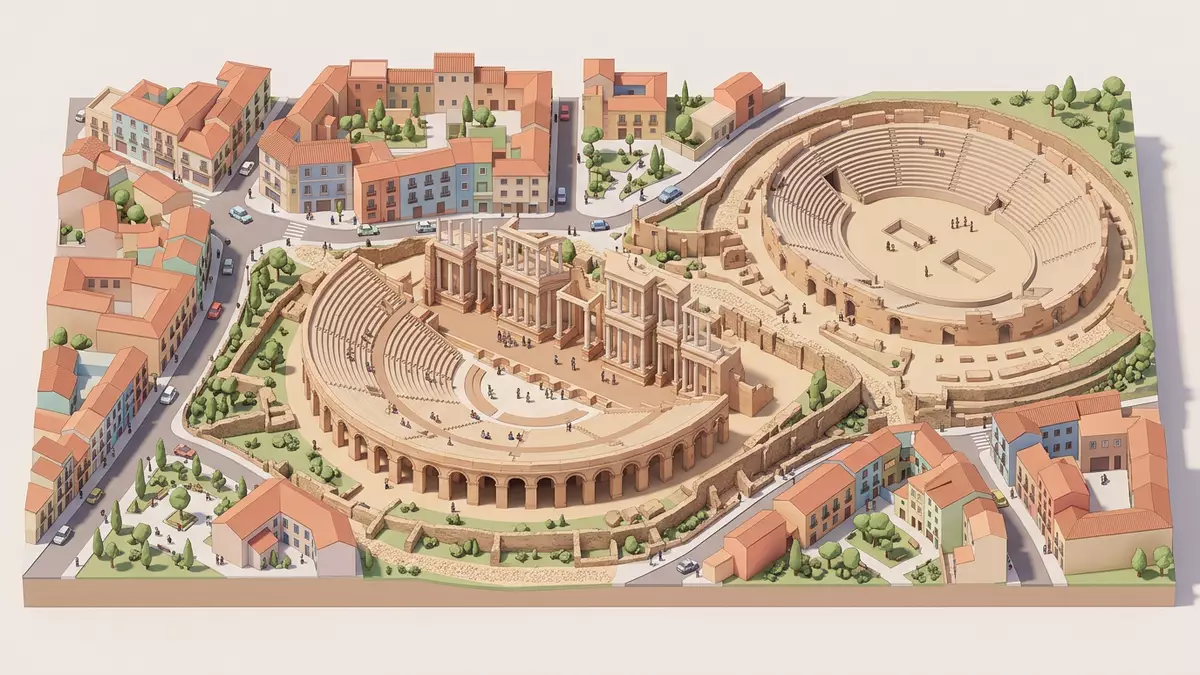
Teatro Romano de Merida in Merida in western Spain is a Roman theatre where stone seating climbs a hillside and faces a tall classical stage front of columns, niches and statuary. Built in the late first century BC as part of the Roman colony of Augusta Emerita under the patronage of Marcus Vipsanius Agrippa, it now stands inside the wider archaeological ensemble that preserves the Roman city in Extremadura.
A Roman theatre carved into the hillside of Augusta Emerita
Teatro Romano de Merida forms part of the ancient city of Augusta Emerita, founded in 25 BC as the capital of the Roman province of Lusitania in what is now Extremadura in south-west Spain.Augusta Emerita, capital of Lusitania The theatre occupies a position near the former city walls, integrated into the slope of the San Albín hill, where its cavea, or seating area, was partly cut into the terrain and partly built up in masonry.the cavea built into the hillside
Construction of the Roman theatre was promoted by Marcus Vipsanius Agrippa, a leading statesman of the Augustan age and son-in-law of Emperor Augustus, and inscriptions date its inauguration to around 16–15 BC.inaugurated around 16–15 BC The theatre was planned together with the adjacent Roman amphitheatre, creating a combined precinct for spectacle and civic gathering that still shapes the archaeological zone around Plaza Margarita Xirgú.planned together with the amphitheatre
Stone tiers, orchestra and the reconstructed stage front
The theatre follows the Roman model described by Vitruvius, combining a semi-circular cavea for spectators, an orchestra at its foot and a raised stage backed by a monumental façade.Roman model of cavea, orchestra and stage In Merida, the cavea is divided into zones separated by radial stairways, and surviving tiers of stone still mark the curvature of the seating that once held several thousand spectators for performances of drama and civic ceremonies.stone seating in several sectors
Behind the stage runs the scaenae frons, a multi-storey architectural backdrop rebuilt using original elements and reconstructed portions to evoke its first-century AD appearance.two-tier stage building of Corinthian columns Tall columns of classical orders support entablatures and pediments, while niches house statues that recall the imperial and divine figures once displayed there; together they form an architectural wall that encloses the view from the cavea and frames the sky above the stage.
Rediscovery, World Heritage status and performances in stone
After the end of antiquity and the spread of Christianity in the Roman Empire, theatrical performances declined and the theatre ceased to serve its original function, with much of its structure buried and concealed by earth and later activity.abandonment and later collapse Archaeological excavations in the early twentieth century, directed by José Ramón Mélida from 1910 onwards, uncovered the seating and stage elements, enabling the theatre to emerge as one of the best-preserved Roman performance spaces on the Iberian Peninsula.excavations led by José Ramón Mélida
Teatro Romano de Merida now forms a core element of the Archaeological Ensemble of Merida, which has been inscribed as a UNESCO World Heritage Site since 1993 in recognition of its Roman monuments.World Heritage Site since 1993 The theatre retains enough of its ancient form to host staged performances, with an annual classical theatre festival established in 1933 bringing actors back onto the ancient stage in front of the stone tiers of Augusta Emerita.Festival Internacional de Teatro Clasico de Merida
Visiting Teatro Romano de Merida: what travellers from Western Europe should know
- Teatro Romano de Merida stands within the combined Roman theatre and amphitheatre precinct near Plaza Margarita Xirgú in Merida in Extremadura in south-west Spain, reachable by rail and road connections to the city.
- The archaeological precinct incorporates stone terraces and stepped approaches around the cavea, so a visit involves walking on uneven surfaces and climbing flights of steps between seating levels and access paths.
- The theatre lies within the wider Archaeological Ensemble of Merida, where other Roman remains such as the amphitheatre, circus and forum structures are spread across the urban area.
- Spain’s official language is Spanish and the currency is the euro.
Searching for Teatro Romano de Merida on social platforms
These links open searches for Teatro Romano de Merida on each platform.
Frequently asked questions about Teatro Romano de Merida
Where is Teatro Romano de Merida and what surrounds it?
Teatro Romano de Merida stands in Merida in Extremadura in south-west Spain, within the archaeological precinct it shares with the Roman amphitheatre and other remains of Augusta Emerita.
What should a visitor expect when entering the theatre?
A visitor encounters a semi-circular stone cavea climbing the hillside, an orchestra at its foot and a reconstructed classical stage façade of columns, niches and statues enclosing the view.
What makes Teatro Romano de Merida distinctive among Roman sites?
Theatre and amphitheatre were built together under Marcus Vipsanius Agrippa, the scaenae frons has been re-erected to near its first-century form, and the theatre functions as part of a World Heritage archaeological ensemble.


