
Teatro Romano de Cartagena and its layered Roman cityscape
Published on 08/28/2026 at 09:47 | Editorial responsibility: Rafael Müller, Editor-in-Chief AD HOC NEWS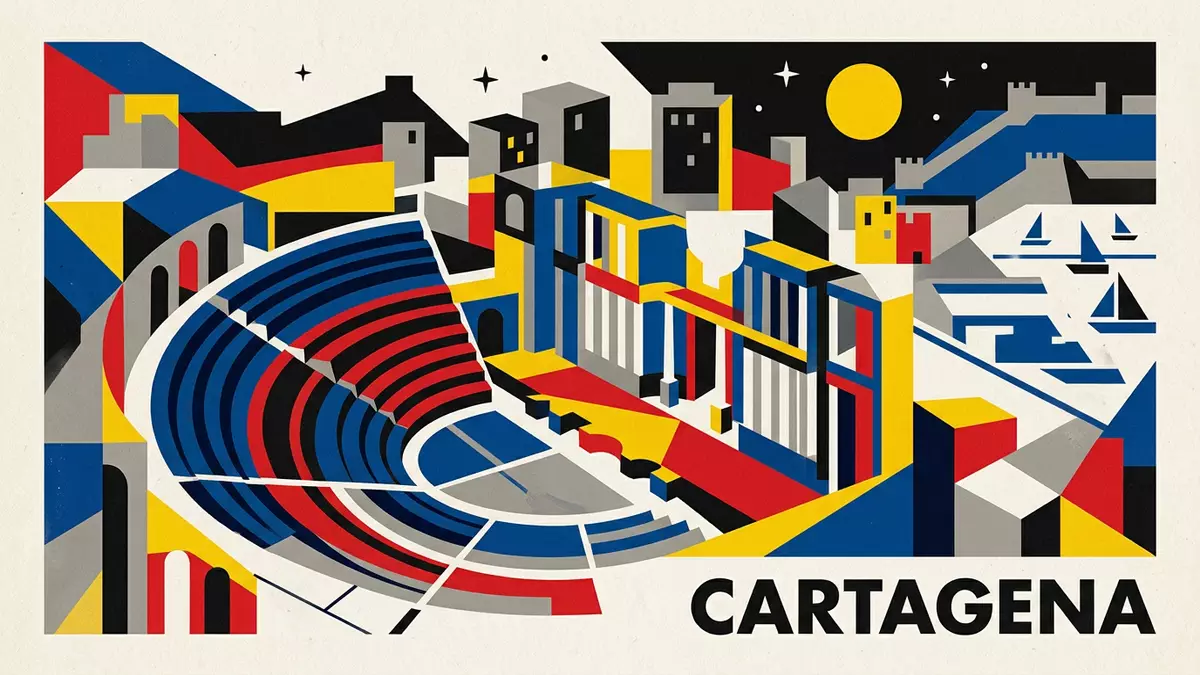
Teatro Romano de Cartagena is a Roman theatre embedded in the historic hillside of Cartagena in south-eastern Spain, where ancient masonry, a medieval cathedral and a contemporary museum form a single stepped ensemble. Built in the Roman colonia of Carthago Nova between 5 and 1 BCE during the reign of Emperor Augustus, it anchors the city’s archaeological story in stone tiers that were hidden for centuries beneath later buildings.Roman Theatre of Cartagena
A Roman theatre rediscovered in the heart of Cartagena
Teatro Romano de Cartagena occupies a slope immediately behind the Old Cathedral of Santa María la Vieja, a position that once concealed its full form from view.Old Cathedral of Santa María la Vieja When construction began between 5 and 1 BCE, Carthago Nova was an important Roman port on the Mediterranean, and the theatre’s scale reflects that status.built between 5 and 1 BCE Its cavea, the semicircular auditorium cut into the hillside, was designed for several thousand spectators and follows Vitruvian principles that balanced geometry and acoustics.
The theatre’s stone seating curves around a central orchestra and faces a stage building that once carried columns and architectural decoration in Roman masonry. Over the centuries the site changed, and by the thirteenth century the Old Cathedral rose over the upper stands, using parts of the ancient structure as foundations.thirteenth century cathedral This layering of Roman theatre and later church left the monument buried within the urban fabric until archaeological work revealed its form and made it possible to walk through the terraces again.
Stone tiers, stage remains and the surrounding urban fabric
The most striking aspect of Teatro Romano de Cartagena is the way its cavea steps rise from the lower city, framed by the surviving walls of the stage and the outlines of circulation passages that once guided audiences to their seats. Rows of restored stone benches climb the hillside, interrupted by radial stairways that divide the seating into sectors and offer long views over the rooftops of Cartagena and towards the port. At ground level, the orchestra and stage area show the footprint of the scaenae frons, where decorative elements and columns once formed the backdrop for performances.
Beyond the theatre itself, the surrounding archaeological zone preserves fragments of later phases of occupation, including remains of commercial structures from late antiquity and the footprint of the Old Cathedral directly above the cavea.later commercial district These layers underline how the hillside shifted from performance space to market quarter and ecclesiastical precinct while the Roman masonry remained beneath. Walking through the site, the visible relationship between theatre, cathedral and neighbouring streets demonstrates how Cartagena’s built fabric has reused and adapted the same slope for different purposes across many centuries.
The Roman Theatre Museum and the route through the monument
The Roman Theatre Museum, Museo del Teatro Romano de Cartagena, forms the contemporary entrance sequence to the monument and begins in the restored Palacio Pascual del Riquelme on Plaza del Ayuntamiento.Museo del Teatro Romano de Cartagena Designed by architect Rafael Moneo, the museum unfolds through a series of interior galleries that display inscriptions, sculpture, architectural fragments and everyday objects uncovered during excavations.project to restore the Roman Theatre The layout leads visitors gradually towards the theatre, turning the monument into the culminating space of the museum route.
Inside the museum, exhibition rooms trace the history of Carthago Nova, the construction of the theatre under Augustus and its later transformations. Models and reconstructions help visualise the original appearance of the stage architecture and seating, while glass cases present carved stone, decorative cornices and recovered ceramics. From the final galleries, passages and stairways cut through the rock and masonry bring visitors out into the open air of the cavea, where the Roman tiers appear at full scale against the skyline of Cartagena.Cartagena Roman Theatre Museum
Visiting Teatro Romano de Cartagena: what travellers from Western Europe should know
- Teatro Romano de Cartagena stands in Cartagena in the Region of Murcia, with the museum entrance in the Palacio Pascual del Riquelme on Plaza del Ayuntamiento, a short walk from the waterfront and main streets.
- The approach from the museum to the theatre involves stairways and sloping passages through the hillside, and the cavea itself is formed of stepped stone seating with radial staircases.
- Cartagena lies on Spain’s Mediterranean coast in the south-east of the Iberian Peninsula and is served by regional rail services and road links connecting it with Murcia and other cities.
- The official language is Spanish and the currency is the euro.
Searching for Teatro Romano de Cartagena on social platforms
These links open searches for Teatro Romano de Cartagena on each platform.
Frequently asked questions about Teatro Romano de Cartagena
Where is Teatro Romano de Cartagena located?
Teatro Romano de Cartagena is on a hillside behind the Old Cathedral of Santa María la Vieja in Cartagena, in Spain’s Region of Murcia, with access through the Roman Theatre Museum on Plaza del Ayuntamiento.
What can visitors expect when they visit the site?
Visitors pass through museum galleries in the Palacio Pascual del Riquelme, viewing artefacts and models, before emerging into the open-air Roman theatre with its restored stone seating and stage remains.
What makes Teatro Romano de Cartagena distinctive among Roman theatres?
Teatro Romano de Cartagena combines a substantial Augustan-era theatre, a thirteenth-century cathedral built over its seating and a modern museum by Rafael Moneo, creating a rare combination of Roman, medieval and contemporary architecture on one slope.


