
Teatro Romano de Cartagena and its layered Roman-cityscape setting
Published on 08/17/2026 at 13:07 | Editorial responsibility: Rafael Müller, Editor-in-Chief AD HOC NEWS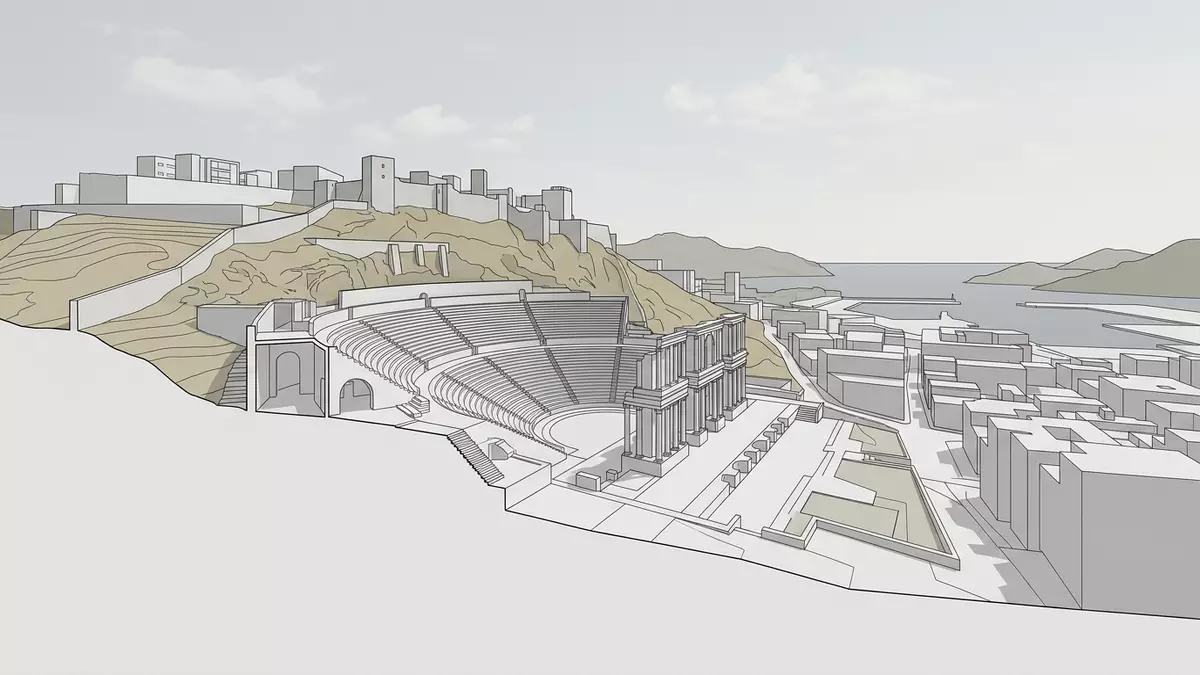
Teatro Romano de Cartagena is a Roman theatre embedded in the historic centre of Cartagena in Spain, with its stone tiers climbing the slope behind the streets of the city. Built in the late first century BC during the reign of Augustus, it forms part of the story of Carthago Nova, the Roman colony that occupied this Mediterranean harbour.
A Roman theatre revealed behind Cartagena’s streets
The Roman theatre stands in the old urban core of Cartagena, close to the town hall and the harbour front, but its main seating rises on the hillside above, giving the monument a split presence between the street level and the slope. The site belongs to the ancient city of Carthago Nova, whose foundations lie beneath much of the present-day centre. Construction of the theatre took place between 5 and 1 BCE under Emperor Augustus, as confirmed by inscriptions dedicating the building to Gaius and Lucius Caesar, his grandsons.Construction between 5 and 1 BCE The remains uncovered in the cavea and stage buildings show the characteristic organisation of a Roman theatre, with semicircular seating facing a stage backdrop and orchestra.
For centuries the theatre lay concealed beneath later structures and the altered topography of the hill. Its outlines were brought to light in 1988, when archaeological work during a building project revealed the first traces of the cavea and related architectural elements.Discovery in 1988 during excavations Subsequent excavations extended across the slope, recovering major portions of the seating, the orchestra and the stage area. Restoration work continued into the early twenty-first century, allowing visitors to see how the Roman layout fits into the present-day hillside.
From Roman performances to a museum route through the monument
In its Roman phase the theatre served as an entertainment venue within the colony, with its cavea designed to hold several thousand spectators for theatrical performances and public occasions.Capacity for 6,000 spectators The stone tiers follow the standard Roman pattern of lower, middle and upper seating bands, stepped to suit the gradient of the hill. The orchestra forms a paved space between the stage front and the first rows of seats, while the scaenae frons, the high architectural screen at the back of the stage, once carried columns and niches framing statues and decorative reliefs. These elements survive in fragmentary form, with reconstructed portions giving a sense of the original height and rhythm.
Today the theatre is integrated into a museum route that begins in a restored palace at street level and leads visitors inward towards the monument. The Museum of the Roman Theatre of Cartagena occupies the Palacio Pascual del Riquelme on Plaza del Ayuntamiento, an historic building adapted to house galleries of artefacts and interpretive displays.Museum of the Roman Theatre of Cartagena The architect Rafael Moneo designed the museum spaces and circulation so that the sequence of rooms eventually opens directly onto the excavated theatre, turning the Roman structure itself into the culminating space of the visit.Museum conception by Rafael Moneo
Stone, hillside and cathedral: a layered cityscape
The material fabric of Teatro Romano de Cartagena reflects the geology around Cartagena and the building traditions of the Roman colony. The cavea and supporting structures use local stone, with dressed blocks forming the seating bands and retaining walls. Marble elements, now largely fragmentary, once enriched the stage architecture and flooring. The theatre rises on the slope beneath the ruins of the Old Cathedral of Santa María la Vieja, which was built in the thirteenth century over the upper seating area, reusing parts of the Roman structure as foundations.Thirteenth-century cathedral above the cavea This superimposition of a medieval church on a Roman theatre gives the site a distinct vertical layering, with remains from different periods visible in one view.
Walking around the monument, the visitor encounters corridors, staircases and vaulted spaces built into the hillside to support the cavea and manage circulation, as well as open terraces where the seating has been reconstructed. From vantage points such as Parque Cornisa and the terraces on the hill of the Concepción, the Roman theatre can be seen in relation to the harbour, the cathedral ruins and the surrounding urban fabric.Views from nearby park areas The result is a cityscape in which Roman, medieval and modern layers align along the slope, with the theatre forming one of the principal ancient monuments of Cartagena and carrying a formal designation as a monument of cultural interest.
Visiting Teatro Romano de Cartagena: what travellers from Western Europe should know
- Teatro Romano de Cartagena stands in the historic centre of Cartagena in south-eastern Spain, close to Plaza del Ayuntamiento and within walking distance of the harbour.
- The theatre occupies a hillside site behind the streets, and a visit involves walking through the museum route and climbing flights of steps and sloping paths across the seating terraces.
- Cartagena lies in the Region of Murcia in Spain; the official language is Spanish and the currency is the euro.
Searching for Teatro Romano de Cartagena on social platforms
These links open searches for Teatro Romano de Cartagena on each platform.
Frequently asked questions about Teatro Romano de Cartagena
Where is Teatro Romano de Cartagena located?
Teatro Romano de Cartagena is located in the historic centre of Cartagena in the Region of Murcia in south-eastern Spain, close to Plaza del Ayuntamiento.
What should visitors expect on a visit?
Visitors follow a museum route through an historic palace with galleries of artefacts and information before emerging into the excavated Roman theatre with its stone seating and hillside setting.
What makes Teatro Romano de Cartagena distinctive?
The theatre combines a substantial Roman monument with the remains of a medieval cathedral above its seating, creating a layered view of Cartagena’s history on one slope beside the harbour.


