
Teatro Colon in Buenos Aires and its grand horseshoe of opera
Published on 08/31/2026 at 14:27 | Editorial responsibility: Rafael Müller, Editor-in-Chief AD HOC NEWS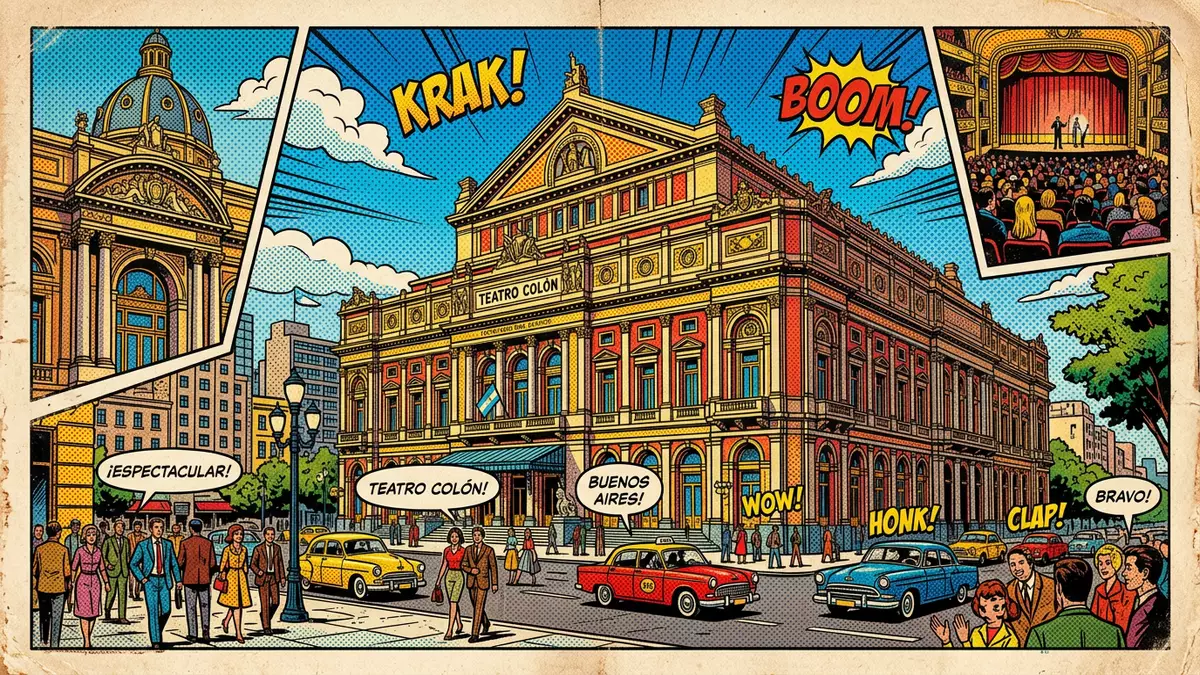
Teatro Colon in Buenos Aires is a monumental opera house whose horse?shoe auditorium, layered decoration and long construction history make it one of the defining cultural buildings of Argentina. Opened in 1908 in front of Plaza Lavalle, it stands as a physical record of the city’s turn?of?the?century ambition and of the European architectural influences that shaped its centre.
A tale of two theatres and a long build
The name Teatro Colon belongs to two different buildings that together trace more than half a century of Buenos Aires history. The original theatre opened in 1857 near Plaza de Mayo, designed by the architect Charles Henri Pellegrini, and served as the city’s main opera venue for over thirty years.original theatre opened in 1857 After that first building closed in 1888, the institution moved to a new site on the edge of what is now Avenida 9 de Julio, facing Plaza Lavalle, where the present Teatro Colon took shape over roughly two decades of construction.stood on its current location since 1908
The current opera house was constructed between the late nineteenth century and 1908 under three successive European architects: the Italian Francesco Tamburini prepared the initial scheme, Víctor Meano developed the design further, and the Belgian Jules Dormal oversaw the final stages and completion.work of Tamburini, Meano and Dormal The theatre was inaugurated on 25 May 1908 with Giuseppe Verdi’s opera “Aida”, a date that tied the opening to Argentina’s national celebrations and signalled the building’s status within the country’s cultural life.inaugurated on 25 May 1908 with Aida
An eclectic opera house shaped like a horseshoe
From the outside, Teatro Colon presents an eclectic classical composition characteristic of the turn of the twentieth century, combining Italian and French influences in its façades and interior decoration.grand and eclectic interpretation of classical architecture The building occupies a prominent block facing Plaza Lavalle, with stone and masonry elevations, projecting cornices and sculptural elements that align it with European opera houses of the same era. Inside, public circulation runs through foyers, staircases and halls that connect the street entrance with the main auditorium and the upper tiers.
The heart of Teatro Colon is its great auditorium, laid out in a horseshoe plan that reflects nineteenth?century Italian opera design and places the stage at one end with stacked galleries rising around the curve.horse-shoe shaped theatre Within this volume, rows of seats, private boxes and balconies are arranged to frame the proscenium and offer views down into the orchestra and up towards the painted ceiling. Decorative finishes draw on marble, gilding, textiles and sculpture, giving the interior a layered richness that connects it to the wider European tradition of opera architecture while anchoring it firmly in Buenos Aires.
Heritage status and the wider complex
Teatro Colon has long been recognised as a major historical monument within Argentina. In 1989 the building was formally declared a National Historic Monument, a status that reflects both its architectural significance and its role in the country’s performance history.declared a Historic National Monument in 1989 Behind the main façades, the complex includes rehearsal rooms and workshop spaces added in phases, with later extensions respecting the original architectural language of the early twentieth century.later additions including workshop and rehearsal spaces
Over the twentieth century the theatre’s stage has hosted conductors, singers and dancers from Argentina and abroad, reinforcing Buenos Aires’ position within the international opera circuit.host some of the most important conductors, singers and dancers The combination of formal opera seasons, ballet performances and concerts has given the building a continuous institutional life, while its heritage designation has helped frame conservation projects carried out by Argentine specialists to maintain both structure and decoration.
Visiting Teatro Colon: what travellers from Western Europe should know
- Teatro Colon stands on the western side of Plaza Lavalle in central Buenos Aires, with its main entrance on Libertad street and nearby access from the broad Avenida 9 de Julio.
- The building’s public areas and auditorium are reached by staircases and corridors that rise through several levels, and visits involve walking across polished floors and up and down internal steps.
- The theatre lies within the dense grid of central Buenos Aires, close to other civic buildings and squares, so the immediate surroundings combine traffic, urban park space and historic architecture.
Searching for Teatro Colon on social platforms
These links open searches for Teatro Colon on each platform.
Frequently asked questions about Teatro Colon
Where is Teatro Colon located in Buenos Aires?
Teatro Colon stands in central Buenos Aires on Libertad street beside Plaza Lavalle, close to Avenida 9 de Julio and other civic buildings.
What can visitors expect inside Teatro Colon?
Visitors encounter a grand sequence of foyers, staircases and halls leading to a large horseshoe?shaped auditorium with tiers of seating and ornate decoration.
What makes Teatro Colon distinctive among opera houses?
The combination of its prolonged construction history, early twentieth?century eclectic architecture, horseshoe auditorium and status as a National Historic Monument gives Teatro Colon a distinctive place in Argentina’s cultural landscape.


