
Teatro Colon in Buenos Aires and its grand horseshoe of opera
Published on 08/29/2026 at 07:25 | Editorial responsibility: Rafael Müller, Editor-in-Chief AD HOC NEWS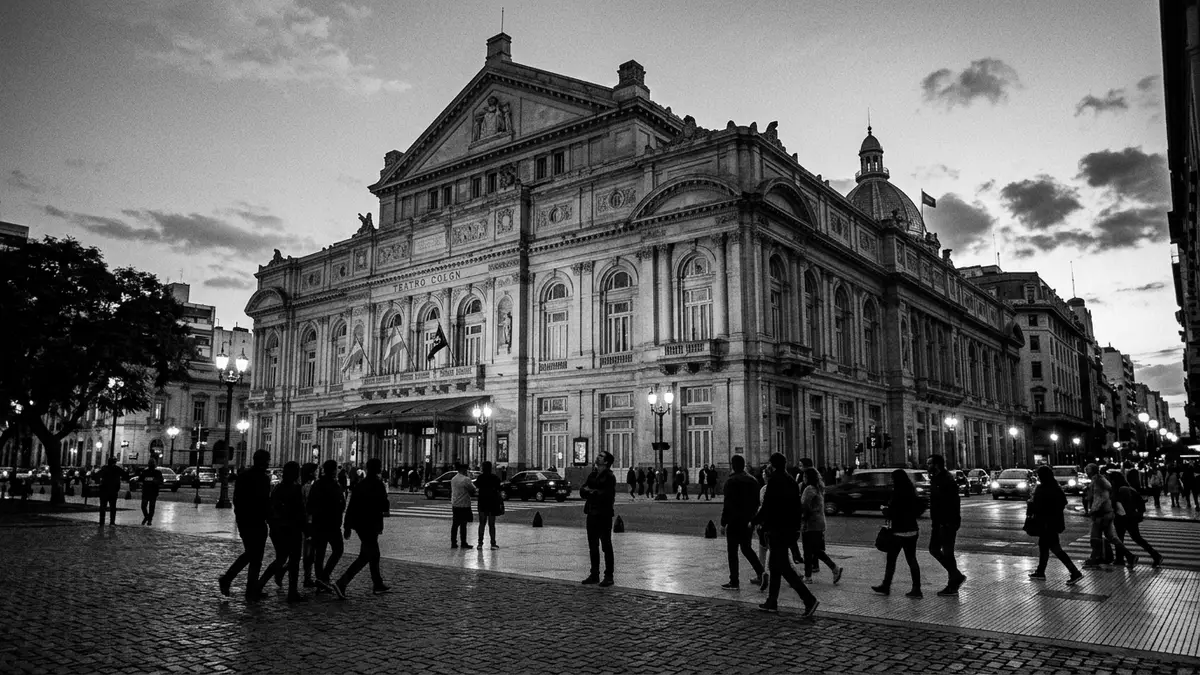
Teatro Colon in Buenos Aires is an opera house where Italianate horseshoe geometry, French-influenced decoration and Argentine history come together in a single, carefully composed interior. Opened on 25 May 1908 and declared a National Historic Monument in 1989, it carries the imprint of several generations of architects and audiences across more than a century of performance.
A horseshoe of sound and sight
The present Teatro Colon occupies a city block by Plaza Lavalle in central Buenos Aires, its main auditorium set out in a pronounced horseshoe plan that recalls nineteenth-century Italian opera houses such as Teatro di San Carlo in Naples.horseshoe plan The auditorium rises in stacked galleries and boxes around a parqueted parterre, concentrating the audience close to the stage and giving the room a clear visual focus.
Architects Francesco Tamburini, Víctor Meano and Jules Dormal, all trained in Europe, steered the design over two decades, leaving an eclectic mix of Italian Renaissance revival and French decorative elements.Francesco Tamburini, Victor Meano and Jules Dormal The auditorium’s ceiling carries a painted dome, while gilt ornament, red textiles and carved balustrades frame the stage opening in a way that emphasises symmetry and layered depth.
From nineteenth-century plans to a 1908 inauguration
The story of Teatro Colon spans two buildings and more than half a century of Argentine history. The first theatre with this name opened in 1857 near Plaza de Mayo under architect Charles Henri Pellegrini and operated there for over thirty years.earlier opera house opened in 1857 As Buenos Aires expanded, the decision was taken to construct a new venue on a different site closer to what became 9 de Julio Avenue.
Construction of the current building began in the late nineteenth century, extended over roughly twenty years and culminated in an inauguration on 25 May 1908 with Giuseppe Verdi’s “Aida”.opened on 25 May 1908 with Verdi’s Aida Tamburini prepared the initial scheme, Meano developed it further, and Dormal brought the project to completion after both of his predecessors had died, a sequence that gives the theatre its layered architectural authorship.constructed between 1885 and 1908
Architecture, materials and working spaces
From outside, Teatro Colon reads as a neoclassical and Renaissance-inspired volume with ordered façades, pilasters and sculptural details set above a high base course.neoclassical, Renaissance The stone and masonry massing is relatively low compared with neighbouring high-rise buildings, but the structure extends deep into the block, accommodating rehearsal rooms, workshops and service spaces behind the public foyers and auditorium.workshops and rehearsal spaces
Inside, the circulation sequence moves through grand staircases and foyers lined with marble, mirrors and decorative ceilings before reaching the auditorium doors. The design dates to the turn of the twentieth century and combines Italian structural traditions with French-influenced interior finishes, a mixture visible in the contrast between robust masonry walls and delicate stuccowork.
Visiting Teatro Colon: what travellers from Western Europe should know
- Teatro Colon stands beside Plaza Lavalle in central Buenos Aires, bordered by streets including Avenida 9 de Julio and Tucumán Street, and is reached on foot or by city transport.
- The interior route from the entrance to the upper galleries involves staircases with long flights of steps rather than lifts, which gives the visit a vertical dimension.
- Back-of-house areas such as workshops and rehearsal rooms sit behind the stage within the same block, so guided visits can include transitions between public foyers and working spaces.
- The official language is Spanish and the currency is the Argentine peso.
- Entry requirements depend on your nationality; UK travellers can check the FCDO travel advice at gov.uk/foreign-travel-advice, Irish travellers the Department of Foreign Affairs at ireland.ie.
Searching for Teatro Colon on social platforms
These links open searches for Teatro Colon on each platform.
Frequently asked questions about Teatro Colon
Where is Teatro Colon located?
Teatro Colon stands by Plaza Lavalle in central Buenos Aires, Argentina, on a block framed by major streets including Avenida 9 de Julio.
What can visitors expect inside Teatro Colon?
Visitors encounter grand foyers with marble and decorative ceilings, followed by a horseshoe-shaped auditorium with multiple galleries arranged around the stage.
What makes Teatro Colon distinctive among opera houses?
The combination of Italian-style horseshoe layout, neoclassical and Renaissance-inspired architecture and a construction history involving Tamburini, Meano and Dormal gives it a particular character.


