
Teatro Antico di Taormina and its stage above sea and stone
Published on 09/16/2026 at 07:12 | Editorial responsibility: Rafael Müller, Editor-in-Chief AD HOC NEWS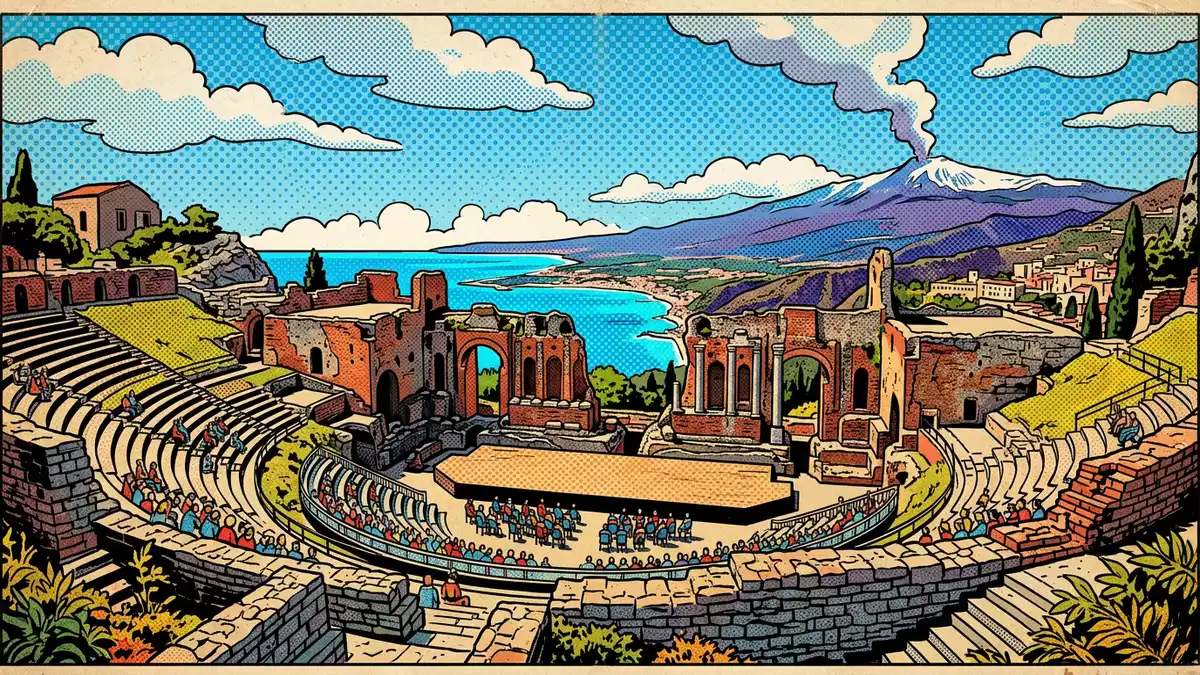
Teatro Antico di Taormina rises on a rocky terrace above Taormina in Sicily, an ancient theatre where Greek foundations and Roman rebuilding share the same dramatic curve of stone and sky. Built in the Hellenistic period and reshaped under the Roman Empire, it frames views across the Ionian Sea and towards Mount Etna through the broken walls of its stage building.
An ancient theatre between Tauromenion and Rome
The theatre stands within the former Greek city of Tauromenion, on the eastern coast of Sicily, and is widely identified as a Hellenistic foundation of the third century BC, when Greek settlers and rulers organised the hillside into terraces for civic life and performance.ancient theatre of Taormina Archaeological traces of an earlier structure, including masonry in carefully cut blocks and inscribed seating, indicate a Greek layout beneath the stone tiers that visitors see.
Under the Roman Empire the theatre was rebuilt on a larger scale, with interventions documented particularly in the first half of the second century AD under emperors such as Trajan and Hadrian.Roman restructuring in the second century AD The orchestra, the space immediately in front of the stage, was later adapted into an arena with an annular corridor and underground rooms, reflecting the shift from Greek drama to Roman spectacles.
Stone tiers, stage wall and coastal panorama
Teatro Antico di Taormina is laid out in the classic tripartite form of stage building, orchestra and cavea, the semicircular seating hollow cut into the slope. The cavea was carved partly into the natural rock and partly built up, creating radiating rows of limestone steps that rise above the performance area.Greek theatre on the hillside The overall diameter of the auditorium reaches about 109 m (357 ft), placing it among the largest ancient theatres in Sicily after the theatre of Syracuse.109 m diameter auditorium
The stage building itself survives mainly as brick walls, arches and column fragments, reconstructed in part during nineteenth-century works that re-erected marble and granite columns facing the cavea.reconstructed stage facade Through the openings in this ruin, the hillside drops towards the Ionian Sea, with the coastal plain and Mount Etna forming a backdrop that has become part of the theatre’s character as much as its masonry.
Change of use from drama to spectacle and heritage
In its Greek phase the theatre served as a venue for tragedies and comedies written for a circular orchestra and modest skene, reflecting the broader theatrical culture of Magna Graecia. Roman control in Sicily brought a new entertainment repertoire, and the building was modified so that the orchestra became an arena enclosed by a parapet, with access corridors and underground spaces designed for the movement of gladiators and animals.transformation into Roman arena These changes sit visibly within the fabric, where Greek rock-cut seating meets later brickwork.
After the decline of Roman authority the theatre gradually fell out of organised use, and parts of the structure were reused as dwellings and quarried for stone during the medieval period.medieval reuse and partial reconstruction Systematic archaeological excavation began in the nineteenth century, and the reconstructed stage wall and cleared seating now form both a monument of classical architecture and a setting where performances continue, using ancient masonry as a frame for contemporary stage technology.
Visiting Teatro Antico di Taormina: what travellers from Western Europe should know
- Teatro Antico di Taormina stands on a terrace above the historic centre of Taormina, on the eastern coast of Sicily, reached on foot along Via Teatro Greco from the town’s streets.
- The site is cut into a hillside of rock, with multiple flights of stone steps rising through the cavea; walking around the auditorium involves uneven surfaces and level changes.
- The theatre lies close to other Taormina landmarks, including viewpoints over the Ionian Sea and streets of the old town, so a visit easily combines with short walks through the surrounding district.
- Italien is part of the European Union; the official language is Italian and the currency is the euro.
Searching for Teatro Antico di Taormina on social platforms
These links open searches for Teatro Antico di Taormina on each platform.
Frequently asked questions about Teatro Antico di Taormina
Where is Teatro Antico di Taormina located?
Teatro Antico di Taormina is on a hillside terrace above the town of Taormina in north-eastern Sicily, overlooking the Ionian Sea and the surrounding coastline.
What should visitors expect during a visit?
Visitors encounter a large stone auditorium carved into the slope, ruins of a Roman stage wall and expansive views through the ancient masonry towards the sea and Mount Etna.
What makes Teatro Antico di Taormina distinctive among ancient theatres?
Its combination of Greek and Roman building phases, substantial diameter of around 109 m (357 ft) and its placement on a coastal terrace with long views give it a particular character among classical theatres.


