
Te Puia’s geothermal valley and living M?ori arts centre
Published on 09/18/2026 at 14:31 | Editorial responsibility: Rafael Müller, Editor-in-Chief AD HOC NEWS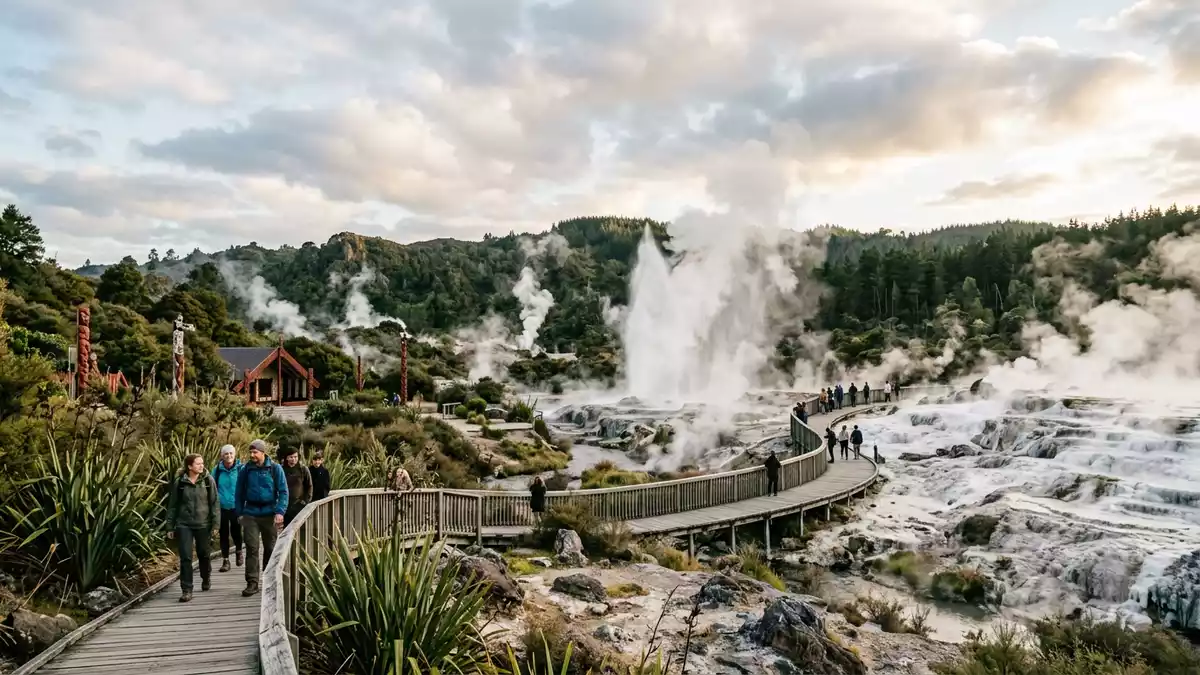
Te Puia in Rotorua is both a geothermal valley and a centre for living M?ori arts, where erupting geysers share the landscape with carving workshops and weaving schools. Set within Te Whakarewarewa Geothermal Valley on New Zealand’s North Island, it combines natural forces and cultural practice in a single, walkable site.
Geysers, mud pools and a restless landscape at Te Puia
Te Puia sits in the heart of Te Whakarewarewa Geothermal Valley, an area of steaming ground, fumaroles and mud pools shaped by volcanic forces beneath the Taup? Volcanic Zone.Te Whakarewarewa Geothermal Valley Walkways lead across terraces of mineral deposits and pockets of native bush, with viewpoints over the geothermal field and its distinctive colours.
The valley’s most prominent feature is the P?hutu Geyser, which rises from a cluster of vents above a deep ravine and sends columns of water and steam into the air.P?hutu Geyser Around it lie pools of bubbling mud and smaller geysers, together forming one of the most concentrated geothermal areas in New Zealand.one of the most active geothermal areas The routes stay on solid surfaces, but sections of the ground still vent steam and hot water at close range, making the geothermal activity visible along much of the walk.
M?ori Arts and Crafts Institute: carving, weaving and stone work
Alongside the geothermal field, Te Puia houses the New Zealand M?ori Arts and Crafts Institute, a national training centre for traditional carving and weaving.New Zealand M?ori Arts and Crafts Institute The institute was established in 1963 to support the continuation of M?ori visual arts, and its workshops remain active within the valley.established in 1963
Several schools operate under the institute’s umbrella, including Te W?nanga Whakairo R?kau, the National Wood Carving School, and Te Rito o Rotowhio, the National Weaving School.National Wood Carving School Visitors can see carvers working on panels and figures, and weavers preparing fibre and textiles, giving the valley a workshop character as well as a scenic one. Meeting houses and other structures around the institute display completed carvings and woven panels, showing how the skills taught here are applied to architecture and ceremonial spaces.
Living M?ori heritage and the history of Whakarewarewa
Te Puia forms part of a much older M?ori presence in Whakarewarewa, where communities have used the geothermal field for cooking, bathing and heating over generations.used for cooking and heating The wider area’s full name, Te Whakarewarewatanga O Te Ope Taua A Wahiao, refers to its role as a gathering place for warriors under the ancestor Wahiao.Te Whakarewarewatanga O Te Ope Taua A Wahiao
Historical accounts record a fortress of Te Puia on this site, first occupied around 1325 and known as an impenetrable stronghold.first occupied around 1325 M?ori have lived in the valley since that period, connecting the thermal features with everyday life and with the carving and weaving traditions now taught at the institute. The attraction is operated by Te Arawa, the iwi of the Rotorua region, linking the management of the site directly to the local community.operated by Te Arawa
Visiting Te Puia: what travellers from Western Europe should know
- Te Puia stands on Hemo Road in the Whakarewarewa area of Rotorua on New Zealand’s North Island, reached by road from the city’s central districts.
Tour coaches and local transport services include Te Puia on their routes, and car parks serve the main entrance on the valley edge. - The geothermal paths cross uneven ground with sections of raised boardwalk and steps, and the air can carry steam from vents near the walkways.
Footwear suitable for hot surfaces and occasional moisture is advisable, and some viewing points are reached by short climbs. - Rotorua lies among lakes in the Bay of Plenty region of New Zealand, with other geothermal fields and M?ori heritage sites, including further areas of Whakarewarewa, close to Te Puia.
The official language is English and the currency is the New Zealand dollar. - Entry requirements depend on your nationality; UK travellers can check the FCDO travel advice at gov.uk/foreign-travel-advice, Irish travellers the Department of Foreign Affairs at ireland.ie.
Searching for Te Puia on social platforms
These links open searches for Te Puia on each platform.
Frequently asked questions about Te Puia
Where is Te Puia located?
Te Puia is in Rotorua on New Zealand’s North Island, in the Te Whakarewarewa Geothermal Valley beside Hemo Road.
What can visitors expect during a visit?
A visit combines boardwalks through a geothermal field, views of geysers and mud pools, and time around active M?ori carving and weaving schools.
What makes Te Puia distinctive among geothermal sites?
Te Puia stands out for its combination of the P?hutu Geyser and a national M?ori arts institute, set within a valley inhabited by M?ori communities since the fourteenth century.


