
Tazumal’s layered Maya pyramids in Chalchuapa
Published on 09/19/2026 at 13:23 | Editorial responsibility: Rafael Müller, Editor-in-Chief AD HOC NEWS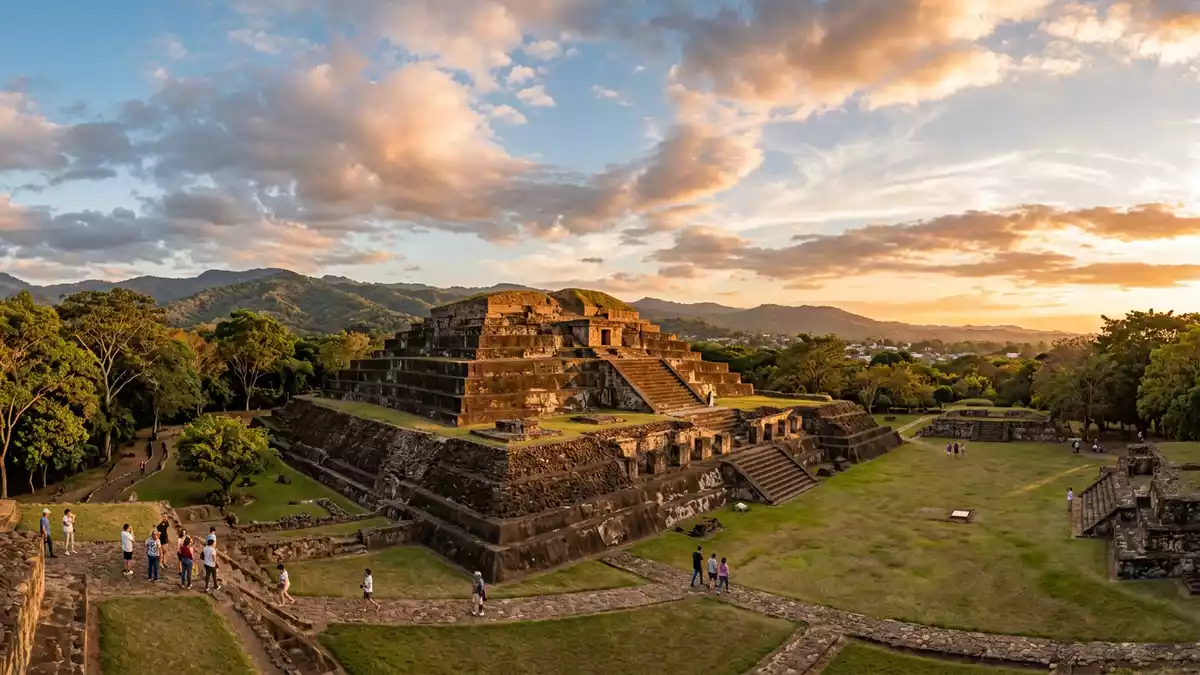
Tazumal in Chalchuapa is a compact Maya archaeological complex made up of stepped stone platforms and pyramidal forms. Its best-known remains belong to the Classic period, and the place belongs to the wider ancient city of Chalchuapa.
Tazumal and the ancient city of Chalchuapa
The site forms part of the Chalchuapa archaeological zone in western El Salvador, in the department of Santa Ana. It is linked with long occupation across the Late Preclassic, Classic and Early Postclassic periods, and with the work of Stanley Boggs in the twentieth century.
The masonry surfaces, terraces and raised platforms give Tazumal its strong vertical profile. Classic period remains dominate the complex, while the broader settlement history reaches across more than one cultural phase.
Stone platforms, pyramids and ceremonial space
The main structures rise in layers, with broad stair-stepped faces and a clear ceremonial centre. The complex also includes smaller platforms and associated finds that point to repeated use over generations.
One widely noted structure reaches 24 metres and is linked with the excavation campaigns carried out by Stanley Boggs. The site has also yielded burials and artefacts such as jade objects, pyrite mirrors and ceramics, which help define its archaeological importance.24 metres
Excavation, protection and the modern site
Tazumal is known through excavation and restoration work that began in the 1940s under Stanley Boggs. The remains were declared a National Historic Monument in 1947, and the place occupies a protected archaeological zone within Chalchuapa.Stanley Boggs
The complex is valued for the sequence of occupation it preserves, from early settlement through later ceremonial use. Its stone mass, stepped profile and surviving structures make that sequence visible across the site.
Visiting Tazumal: what travellers from Western Europe should know
- The site is in Chalchuapa, western El Salvador, within the archaeological zone of the ancient city. It is reached from the town rather than from a remote landscape.
- The complex is built on raised stone platforms and stepped masonry. Walking the site means moving across uneven ground and level changes.
- English is not the official language. The official language is Spanish and the currency is the United States dollar.
- The National Museum of Anthropology in San Salvador is a useful companion stop for artefacts and context.
Searching for Tazumal on social platforms
These links open searches for Tazumal on each platform.
Frequently asked questions about Tazumal
Where is Tazumal?
Tazumal is in Chalchuapa, in western El Salvador, within the broader Chalchuapa archaeological zone. The place sits in a town setting rather than an isolated countryside site.
What does a visit involve?
The visit centres on stone platforms, stepped construction and the remains of a Maya ceremonial complex. The terrain is uneven, with changes in level across the archaeological area.
What makes Tazumal distinctive?
Its layered masonry, Classic-period structures and long occupation history give it a strong archaeological character. The combination of pyramidal form and excavated remains makes the complex easy to recognise.


