
Taman Negara’s ancient rainforest gateway at Kuala Tahan
Published on 09/19/2026 at 20:07 | Editorial responsibility: Rafael Müller, Editor-in-Chief AD HOC NEWS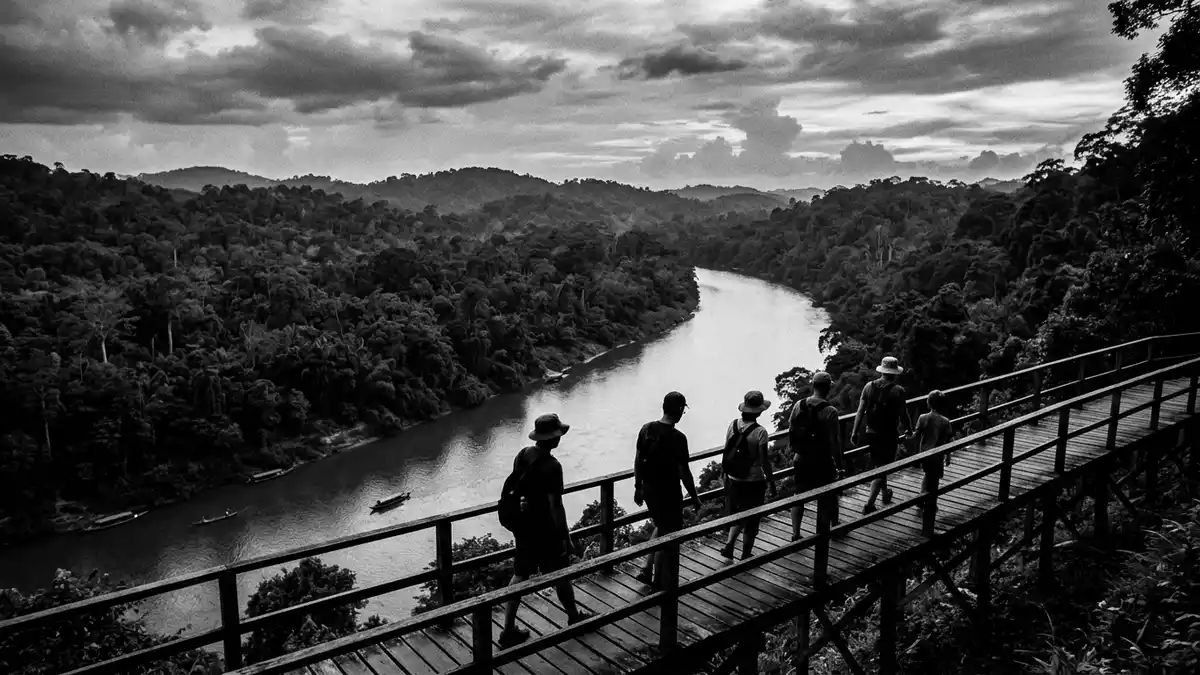
Taman Negara in Malaysia is a vast protected rainforest landscape centred on the riverside settlement of Kuala Tahan in the interior of Peninsular Malaysia. It preserves an ancient tropical forest environment that has remained continuously humid and forested since at least the age of the dinosaurs, giving visitors a rare window into a tropical ecosystem that has developed over well over 100 million years.
An ancient rainforest across three Malaysian states
Taman Negara is Malaysia’s first formally designated national park, established in the late 1930s under British colonial administration as King George V National Park before being renamed after independence in 1957.King George V National Park The park occupies a large area of central Peninsular Malaysia, spanning land in Pahang, Kelantan and Terengganu, and forming the peninsula’s single largest protected tract of tropical rainforest.National Park of Peninsular Malaysia
The protected area covers about 4,343 km² (1,677 sq mi), much of it still guarded by dense lowland and hill rainforest that has never been cleared on an industrial scale.4,343 square kilometres Within this broad zone rise the ridges of the Titiwangsa Range and Mount Tahan, which at 2,187 m (7,175 ft) is the highest peak in Peninsular Malaysia and a long-established goal for experienced climbers and trekkers.Gunung Tahan 2,187 metres Rivers such as the Tembeling and the Tahan carve through the forest, forming natural corridors that link plateaus, valleys and limestone outcrops within the park.
Kuala Tahan: village at the forest’s edge
Kuala Tahan, in Pahang state, sits on the southern bank of the Tembeling River at the point where it meets the Tahan River, and functions as the best-established gateway settlement for entering Taman Negara.Kuala Tahan at the Tembeling On the opposite bank, the park headquarters for Pahang and a cluster of visitor facilities mark the beginning of the protected forest, with boat crossings linking the village side to the national park bank.
From the main entrance near Kuala Tahan, paths and river routes lead deeper into the forest towards features such as the rapids on the Tahan River and limestone caves including Gua Telinga, a known cave system within Taman Negara.Gua Telinga and Lata Berkoh A forest canopy walkway near the headquarters area gives a high-level view into the treetops, offering a sense of the vertical structure of the rainforest, while hides and trails are arranged to bring visitors into contact with river scenery and the layered vegetation without leaving the protected zone.
Landscape, wildlife and the age of the forest
The landscape inside Taman Negara ranges from low river terraces to steep hill slopes and the high plateau areas around Mount Tahan, with soils and rock types that support different forest communities. Parts of the park include areas of limestone outcrop where caves have formed, while other sections are dominated by ancient hardwood trees rising above a dense understorey of palms, lianas and smaller shrubs.plateau and limestone outcroppings Rivers provide habitat for freshwater fish and riverine wildlife, and sandy or rocky banks appear along curves where the water slows.
The tropical rainforest preserved in Taman Negara is estimated to be around 130 million years old, making it one of the oldest continuously existing rainforests on Earth and substantially older than many other named tropical forest regions.around 130 million years old This age reflects the long geological stability of central Peninsular Malaysia, where the forest has not been reset by large-scale glaciation or volcanic events. As a result, the biodiversity within the park includes plant and animal lineages that have evolved over very long periods, with complex ecological relationships in which forest giants, understory species, insects, birds and mammals share the same space.
Visiting Taman Negara: what travellers from Western Europe should know
- Taman Negara lies in central Peninsular Malaysia, with Kuala Tahan in Pahang serving as the main access point on the Tembeling River; travellers commonly approach via the town of Jerantut before continuing towards the river and the headquarters area on the far bank.
- The terrain around Kuala Tahan and the park entrance includes riverbanks, forest paths and, on longer excursions, steep hill trails; approaches to higher ground such as routes towards Mount Tahan involve prolonged ascent on foot over uneven natural surfaces.
- The national park spans Pahang, Kelantan and Terengganu, and within its boundaries rise the summit of Mount Tahan and other ridges of the Titiwangsa Range, so longer treks can encounter significant altitude and remote forest conditions.
- Malaysia’s official language is Malay and the currency is the Malaysian ringgit.
- Entry requirements depend on your nationality; UK travellers can check the FCDO travel advice at gov.uk/foreign-travel-advice, Irish travellers the Department of Foreign Affairs at ireland.ie.
Searching for Taman Negara on social platforms
These links open searches for Taman Negara on each platform.Frequently asked questions about Taman Negara
Where is Taman Negara and how is Kuala Tahan involved?
Taman Negara is a large national park in central Peninsular Malaysia, spanning Pahang, Kelantan and Terengganu, with Kuala Tahan in Pahang acting as the main gateway village beside the Tembeling River.
What kind of landscape should visitors expect on a visit?
Visitors encounter tropical rainforest, river corridors, hill slopes and plateau areas, with access to features such as forest canopy walkways, river rapids like those on the Tahan River and limestone caves including Gua Telinga.
What makes Taman Negara distinctive among rainforest parks?
Taman Negara combines a protected area of 4,343 km² that includes Peninsular Malaysia’s highest peak, Mount Tahan, with an estimated rainforest age of around 130 million years, offering insight into a very ancient tropical ecosystem.


