
Taman Nasional Komodo and its islands of volcanic contrast
Published on 09/23/2026 at 06:12 | Editorial responsibility: Rafael Müller, Editor-in-Chief AD HOC NEWS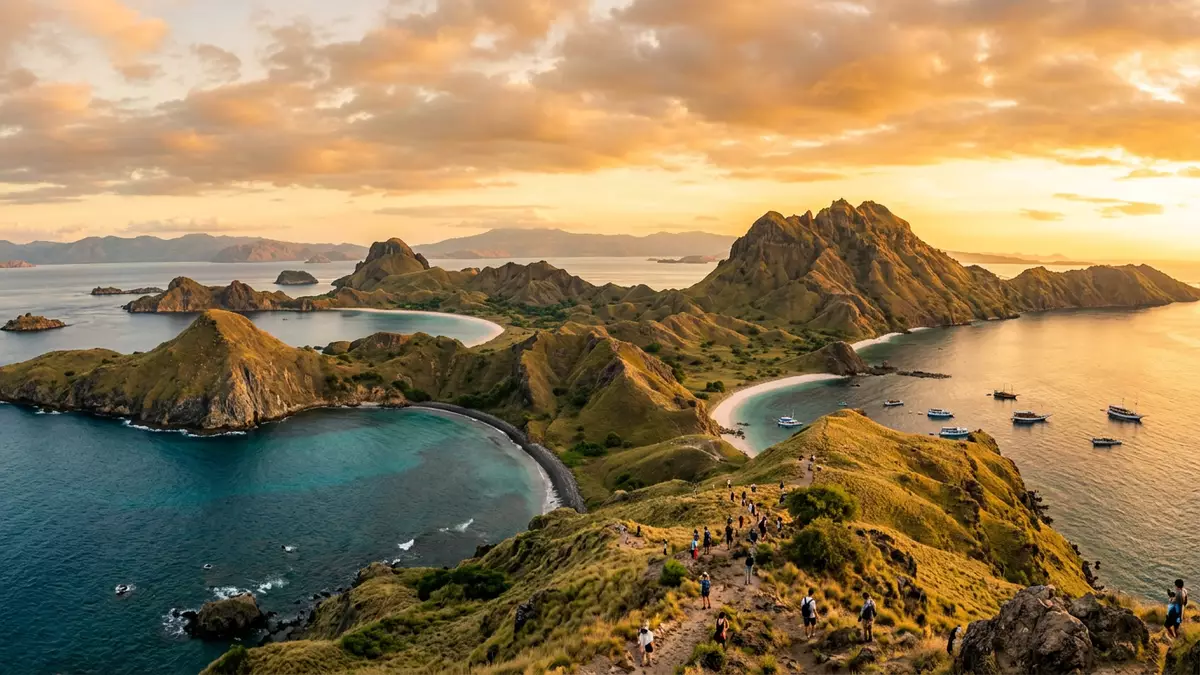
Taman Nasional Komodo is an island park where dry, grass-covered hills meet bays, reefs and open sea. Its principal islands are Komodo, Rinca and Padar, positioned between Flores and Sumbawa in Indonesia. The landscape belongs to Wallacea, the biogeographical region between Asian and Australian ecosystems, and the park’s most recognisable inhabitant is the Komodo dragon.
Volcanic islands between Flores and Sumbawa
Taman Nasional Komodo lies in the centre of the Indonesian archipelago, between the islands of Flores and Sumbawa. Komodo, Rinca and Padar form the park’s principal landmasses, accompanied by smaller islands and surrounding marine areas. Their volcanic origin appears in steep ridges, folded coastlines, exposed slopes and narrow inlets.
The protected area covers 219,322 hectares, including land and sea. The park’s World Heritage profile records its position between two continental plates and places it within Wallacea. This setting brings terrestrial and marine environments into one protected landscape.
Komodo dragons in a dry island landscape
The Komodo dragon, Varanus komodoensis, is a large monitor lizard associated with Komodo, Rinca and neighbouring islands. Its habitat includes open savannah, woodland, monsoon forest, beaches and rocky ground. The animal’s presence gives the park a clear zoological identity, while the surrounding habitats support other reptiles, birds and mammals.
Protection of the area reaches back to 1938, when parts of the island group became nature reserves. Taman Nasional Komodo was established in 1980, and the protected area received UNESCO World Heritage status in 1991. The UNESCO biosphere record describes the reserve as habitat for about 5,000 Komodo dragons.
From savannah ridges to coral gardens
The park’s land and sea form a continuous sequence of contrasting habitats. Hills rise above irregular coastlines, where bays and beaches alternate with headlands and cliffs. Dry vegetation covers many slopes, while mangroves, seagrass beds and coral reefs occupy sections of the coastal zone.
Marine life includes reef fish, sea turtles, dolphins and dugongs, alongside corals and other reef organisms. The waters also belong to the wider Coral Triangle, a region known for rich tropical marine biodiversity. The park’s island-and-reef setting links savannah, monsoon forest, coral, seagrass and mangrove habitats.
Padar is recognised for its elevated ridges and divided coastal bays. Komodo and Rinca contain broad terrestrial habitats associated with the dragon. Across the archipelago, the visible relationship between volcanic landforms and marine ecosystems remains the defining feature.
Visiting Taman Nasional Komodo: what travellers from Western Europe should know
- Location and getting there: Labuan Bajo on Flores is the principal mainland gateway to Taman Nasional Komodo. Boats cross the surrounding seas to the park’s islands.
- What the terrain demands: The islands contain steep hills, exposed rock, uneven ground and dry savannah slopes. Shorelines include beaches, coves and rugged coastal sections.
- Landscape and season: The islands have a pronounced dry landscape, while monsoon forest and greener vegetation occur in other habitats. Marine conditions vary across the channels and bays.
- Language and currency: The official language is Indonesian and the currency is the Indonesian rupiah.
- Entry requirements depend on your nationality; UK travellers can check the FCDO travel advice at gov.uk/foreign-travel-advice, Irish travellers the Department of Foreign Affairs at ireland.ie.
Searching for Taman Nasional Komodo on social platforms
These links open searches for Taman Nasional Komodo on each platform.
Frequently asked questions about Taman Nasional Komodo
Where is Taman Nasional Komodo?
The park lies between Flores and Sumbawa in Indonesia. Labuan Bajo on Flores is the principal mainland gateway.
What can visitors expect in the park?
The landscape includes volcanic hills, savannah, forest, beaches, reefs, seagrass and mangroves. Uneven ground and steep slopes occur on the islands.
What makes Taman Nasional Komodo distinctive?
The park combines the habitat of the Komodo dragon with extensive terrestrial and marine ecosystems. Its volcanic islands form the visible centre of this contrast.


