
Taj Mahal: white marble geometry on the Yamuna
Published on 08/30/2026 at 12:58 | Editorial responsibility: Rafael Müller, Editor-in-Chief AD HOC NEWS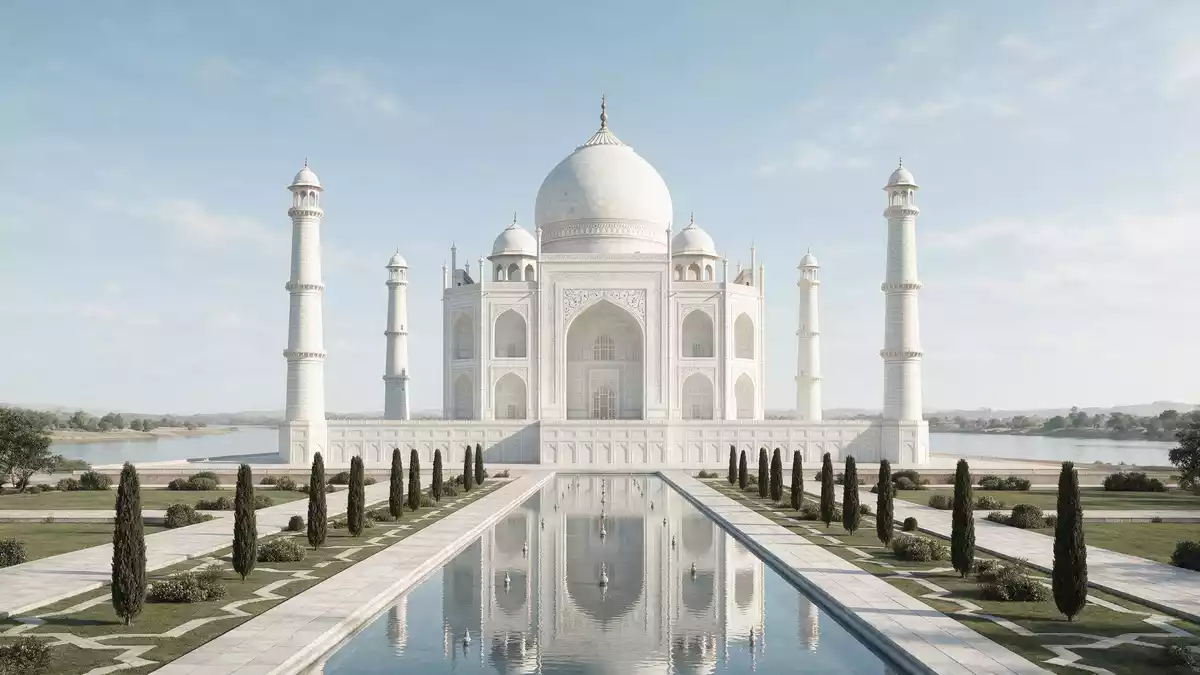
The Taj Mahal in Agra is a seventeenth-century Mughal mausoleum of white marble, set on a terrace above the Yamuna River and framed by a formal garden. Built under the rule of Shah Jahan between 1631 and 1648, it was conceived as the resting place of Mumtaz Mahal and later became the emperor’s own tomb as well.Built in Agra between 1631 and 1648
Marble, symmetry and the Mughal tomb
The core of the Taj Mahal complex is the mausoleum itself, a tall, cubic volume crowned by a great dome and flanked by four slender minarets that stand on a marble platform at the northern edge of the garden.Mausoleum complex in Agra The building is clad in fine white marble from Rajasthan, carefully jointed and polished so that its surfaces read as continuous planes rather than separate blocks.Made of fine white marble quarried at Makrana
From a distance the marble appears monochrome, but close up it carries an intricate skin of floral reliefs and inlaid stone. Semi-precious materials such as lapis lazuli, jade and cornelian are set into the marble in pietra dura panels, forming stylised flowers and vines that repeat along doorways and plinths.Intricate floral and geometric patterns Calligraphic bands in contrasting stone run around the main arches, carrying verses from the Qur’an and framing the entrances with dark script against pale stone.Black marble calligraphy of inscriptions
A riverside garden aligned on a single axis
The Taj Mahal stands on the right bank of the Yamuna River in the Agra District of Uttar Pradesh, on a site organised as a large walled garden of about 17 hectares.Located on the right bank of the Yamuna River in a vast Mughal garden A straight processional route runs through the complex: visitors enter through a monumental gateway on the southern side, pass into the garden with its straight watercourses and lawns, and walk towards the mausoleum raised on its marble terrace at the far end.Located in a walled garden with a central reflecting pool
The garden follows the charbagh pattern associated with Islamic representations of paradise, with its quadrants divided by water channels and paths. Alongside the tomb stand two matching structures on the terrace: a mosque to the west and a building of similar outline to the east, creating a symmetrical composition that balances religious function with architectural harmony.Mosque and jawab flank the tomb Beyond the main enclosure, further courtyards and gateways extend the axis southwards, but the visual focus remains the alignment between water, garden and marble volume on the river’s edge.
Shah Jahan’s seventeenth-century project
The Taj Mahal belongs to the high period of the Mughal Empire. Shah Jahan took the throne in 1628, and in 1631 his wife Mumtaz Mahal died in childbirth, prompting the commissioning of the mausoleum soon afterwards.Mumtaz Mahal died in 1631 Construction on the riverbank began around 1632, and the main tomb structure was substantially complete by the late 1630s, with work on its subsidiary buildings and decorative schemes continuing into the 1640s.Construction began in 1632 and was substantially complete by 1648
The wider complex, including the mosque, guest house and main southern gateway, reached completion by 1653, creating an ensemble of buildings, courtyards and waterways that occupied decades of labour.Outer courtyard and cloisters completed in 1653 In 1983 the site was inscribed on the UNESCO World Heritage List as a seventeenth-century white marble mausoleum exemplifying Mughal art, underscoring its status as a formally recognised cultural property of global significance.Year of inscription 1983
Visiting Taj Mahal: what travellers from Western Europe should know
- The Taj Mahal complex stands on the eastern side of Agra, beside the Yamuna River in the northern Indian state of Uttar Pradesh, reached by road and rail connections through the city.
- The main approach runs through a large garden with straight paths and water channels, followed by a climb onto the marble terrace that carries the mausoleum and its flanking mosque and guest house.
- The official language is Hindi and the currency is the Indian rupee.
- Entry requirements depend on your nationality; UK travellers can check the FCDO travel advice at gov.uk/foreign-travel-advice, Irish travellers the Department of Foreign Affairs at ireland.ie.
Searching for Taj Mahal on social platforms
These links open searches for Taj Mahal on each platform.Frequently asked questions about Taj Mahal
Where is the Taj Mahal?
The Taj Mahal stands in Agra in the Indian state of Uttar Pradesh, on the right bank of the Yamuna River within a large Mughal garden.
What should visitors expect inside the complex?
Visitors pass through a monumental gateway into a formal garden with straight water channels, then reach the marble terrace with the mausoleum, mosque and corresponding eastern building.
What makes the Taj Mahal distinctive among Mughal sites?
Its combination of white marble cladding, precise symmetry, inlaid stone decoration and alignment with a charbagh garden on the riverbank marks it out within Mughal funerary architecture.


