
Taj Mahal and the geometry of white marble in Agra
Published on 09/22/2026 at 21:26 | Editorial responsibility: Rafael Müller, Editor-in-Chief AD HOC NEWS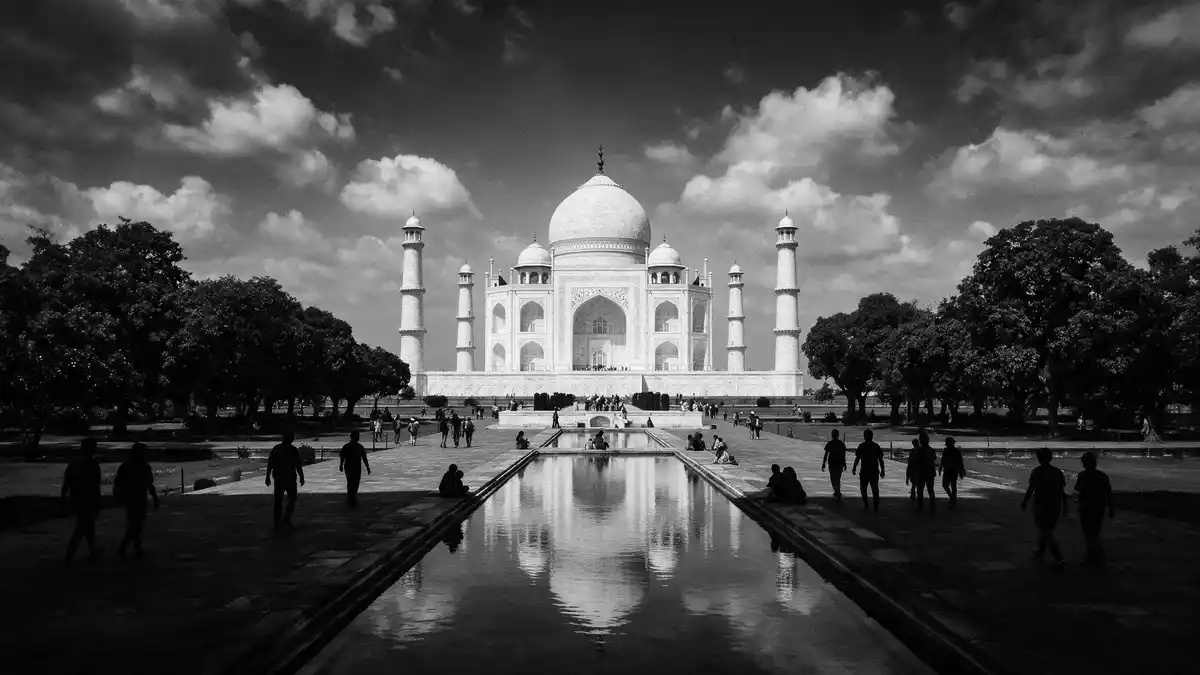
Taj Mahal is a white-marble mausoleum in Agra, set beside the Yamuna River within a formal Mughal garden. Shah Jahan commissioned the complex in memory of Mumtaz Mahal, and construction took place between 1631 and 1648. From the southern gateway, the garden axis, water channels, red sandstone buildings and central tomb form a carefully ordered sequence.
Taj Mahal: a white marble tomb beside the Yamuna
The complex occupies the river’s right bank in Uttar Pradesh. Its principal building stands at the northern end of the garden, on an elevated square platform facing the Yamuna. The surrounding grounds include the main gateway, the garden, a mosque and the matching jaw?b, a companion building on the opposite side.
The material contrast is immediate. The mausoleum is faced with white Makrana marble, while red sandstone marks the gateway and adjoining buildings. Makrana marble and sandstone belong to the complex’s visible architectural language, alongside brickwork beneath the marble surface.
Shah Jahan, Mumtaz Mahal and the Mughal period
Shah Jahan ruled the Mughal Empire from 1628 to 1658. Mumtaz Mahal, his wife, died in 1631, and the mausoleum became her burial place. The name links her title with the Persian expression for a palace or royal residence.
The building belongs to Mughal architecture, a style combining Persian, Indian and Islamic elements. Calligraphy, carved marble and pietra dura inlay cover parts of the structure. Semi-precious stones, including lapis lazuli, jade and cornelian, appear in floral and geometric decoration. floral and geometric inlay forms a detailed surface against the pale stone.
The complex entered the UNESCO World Heritage List in 1983. Its formal status belongs to the whole monument and setting, not only to the central tomb. The garden, gateways, mosque, jaw?b and river-edge position are part of the architectural composition.
The dome, minarets and garden axis
The central building rises above the platform beneath a large marble dome. Smaller domed pavilions surround it, while free-standing minarets mark the platform’s corners. Arched recesses, screened openings and bands of calligraphy divide the exterior into repeated panels.
The garden is arranged as a char-bagh, a four-part garden tradition associated with Persianate landscape design. Raised water channels cross the planting areas, and a reflecting tank lies on the central route towards the mausoleum. The long axis places the gateway, garden, tomb and river within one connected spatial arrangement.
White marble also carries the building’s surface decoration. Inlaid stone creates leaves, flowers and scrolling patterns, while carved details interrupt the broad walls. the UNESCO World Heritage listing records the monument as a white-marble mausoleum built in Agra between 1631 and 1648.
Visiting Taj Mahal: what travellers from Western Europe should know
- Taj Mahal stands in eastern Agra on the right bank of the Yamuna River. Agra Cantonment, Raja-ki-Mandi and Agra Fort are the city’s named railway stations.
- The approach crosses a large formal garden before reaching the raised marble platform. Steps lead from the garden level onto the mausoleum terrace.
- The complex combines open garden paths with enclosed architectural spaces. The mosque, jaw?b, gateway and mausoleum occupy separate parts of the same planned setting.
- The official language is Hindi and the currency is the Indian rupee.
- Entry requirements depend on your nationality; UK travellers can check the FCDO travel advice at gov.uk/foreign-travel-advice, Irish travellers the Department of Foreign Affairs at ireland.ie.
Searching for Taj Mahal on social platforms
These links open searches for Taj Mahal on each platform.Frequently asked questions about Taj Mahal
Where is Taj Mahal?
Taj Mahal is in Agra, in the Indian state of Uttar Pradesh. The complex occupies the right bank of the Yamuna River, within a Mughal garden.
What can travellers expect from the visit?
The route includes a gateway, planted garden, water channels, companion buildings, the mosque and the raised marble mausoleum. Steps connect the garden level with the main platform.
What makes Taj Mahal distinctive?
Its identity rests on the combination of white Makrana marble, a central dome, free-standing minarets, stone inlay and a formal char-bagh garden. Shah Jahan commissioned the complex in the seventeenth century for Mumtaz Mahal.


