
Taj Mahal and its marble geometry on the Yamuna
Published on 09/07/2026 at 13:53 | Editorial responsibility: Rafael Müller, Editor-in-Chief AD HOC NEWS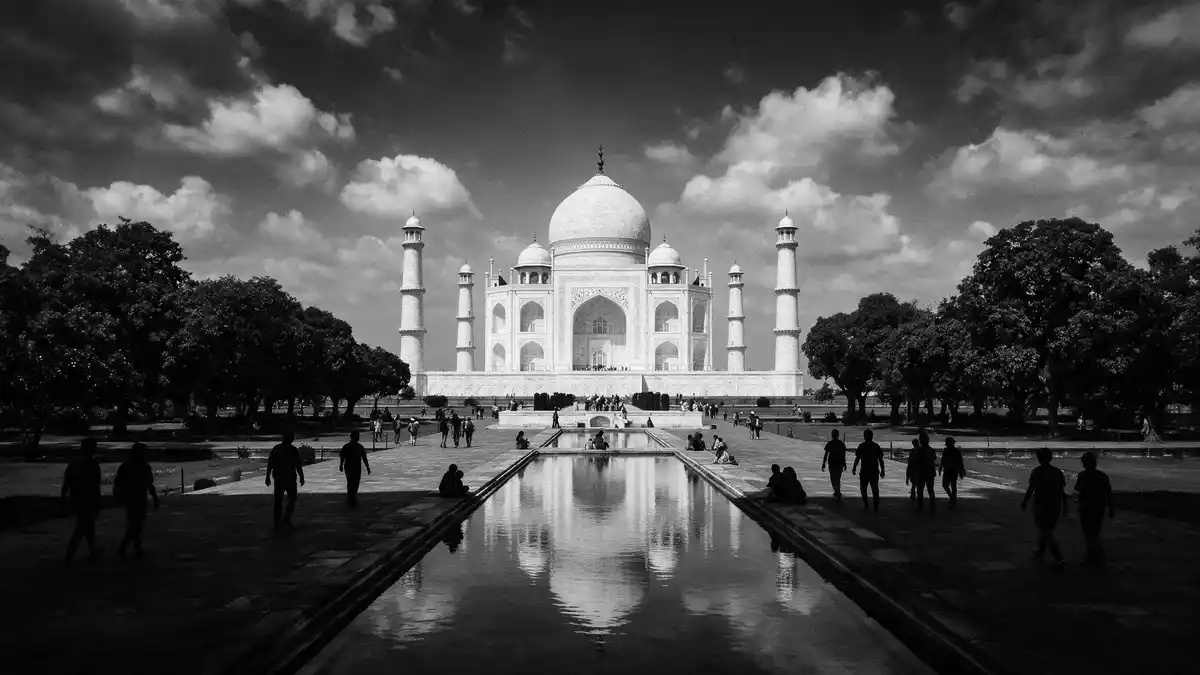
Rising above the right bank of the Yamuna River at Agra, the Taj Mahal is a seventeenth?century white marble mausoleum set within a formal Mughal garden. Built under the Mughal emperor Shah Jahan as a tomb for his wife Mumtaz Mahal, it anchors a walled riverside complex of symmetrical buildings and waterways.
Marble, scale and symmetry
The Taj Mahal is part of a mausoleum complex laid out as an immense rectangle beside the Yamuna, with the tomb itself placed at the head of a long garden axis. The main building is clad in white marble and rises from a square plan, its surfaces inlaid with floral and geometric patterns formed from semi?precious stones such as lapis lazuli, jade and cornelian.semi?precious stone inlay That square base supports a prominent marble dome and is flanked by slender minarets that mark the corners of the tomb platform.
The height of the mausoleum reaches over 60 m (about 200 ft), making it the tallest Mughal tomb in India.tallest Mughal tomb Each minaret rises to more than 40 m (around 130 ft) and stands free from the main building, reinforcing the sense of balance without touching the central mass.dimensions of minarets and mausoleum From a distance the dome and its finial appear almost equal in height to the body of the building, so that the tomb reads as a single composed volume rather than a base and a separate roof.
A seventeenth?century Mughal garden on the Yamuna
The Taj Mahal complex occupies about 17 hectares of land on the river’s right bank, enclosed by walls and centred on a Mughal garden known as a charbagh.17?hectare Mughal garden Water channels divide the garden into four main quadrants, with additional paths, planting and terraces laid out on a strict axis between the main gateway and the mausoleum terrace. The river itself forms the outer edge of the complex, beyond the garden and tomb platform, so that water appears both in the channels and in the natural course of the Yamuna.
The garden and buildings belong to the architectural tradition known as Mughal architecture, which blends Persian, Indian and Islamic forms.Mughal architecture blend This heritage status was recognised internationally in 1983, when the Taj Mahal was inscribed as a UNESCO World Heritage Site for its artistic and architectural value.UNESCO inscription in 1983 The position of the mausoleum at the far end of the garden, rather than at its centre, gives views that draw the eye along the water channels towards the tomb and onward to the river beyond.
Construction, craftsmanship and the wider complex
Shah Jahan, the fifth Mughal emperor, commissioned the Taj Mahal in 1631 following the death of Mumtaz Mahal that year, and building work began around 1632.commission and start of construction The principal mausoleum was completed by 1648, while the surrounding mosque, guest house, main gateway and outer courtyard followed and were finished by 1653.completion dates for components Thousands of artisans and labourers worked on the complex over more than two decades, turning finely carved marble panels, lattice screens and inlaid ornament into an integrated composition.
The architect most often associated with the Taj Mahal is Ustad Ahmad Lahori, named in later accounts as the chief designer of the mausoleum.Ustad Ahmad Lahori as architect Within the larger complex, the marble tomb stands on a raised terrace that also carries a red sandstone mosque on one side and a matching building known as the jawab on the other, both echoing the central form. The main gateway to the south, built in sandstone with marble detailing, leads from the outer court into the garden, framing the first view of the mausoleum along the central watercourse.
Visiting Taj Mahal: what travellers from Western Europe should know
- The Taj Mahal stands in Agra in the Indian state of Uttar Pradesh, on the right bank of the Yamuna River, reached by road and rail from other Indian cities.
- Within the complex, approaches to the mausoleum terrace involve walking across the charbagh garden and climbing stairways to the elevated platform that carries the marble tomb.
- The official language is Hindi and the currency is the Indian rupee.
- Entry requirements depend on your nationality; UK travellers can check the FCDO travel advice at gov.uk/foreign-travel-advice, Irish travellers the Department of Foreign Affairs at ireland.ie.
Searching for Taj Mahal on social platforms
These links open searches for Taj Mahal on each platform.Frequently asked questions about Taj Mahal
Where is the Taj Mahal situated?
The Taj Mahal stands on the right bank of the Yamuna River in the city of Agra in the Indian state of Uttar Pradesh.
What can visitors expect inside the complex?
Visitors encounter a sequence of spaces: a main gateway, outer courtyard, the charbagh garden with water channels, and the raised terrace carrying the marble mausoleum, mosque and jawab.
What makes the Taj Mahal distinctive among Mughal monuments?
The Taj Mahal combines large?scale white marble construction, refined stone inlay and a riverside garden setting, forming a mausoleum complex that has been recognised as a UNESCO World Heritage Site for its architectural significance.


