
Tai Shan, sacred summit above Tai'an
Published on 08/27/2026 at 06:54 | Editorial responsibility: Rafael Müller, Editor-in-Chief AD HOC NEWS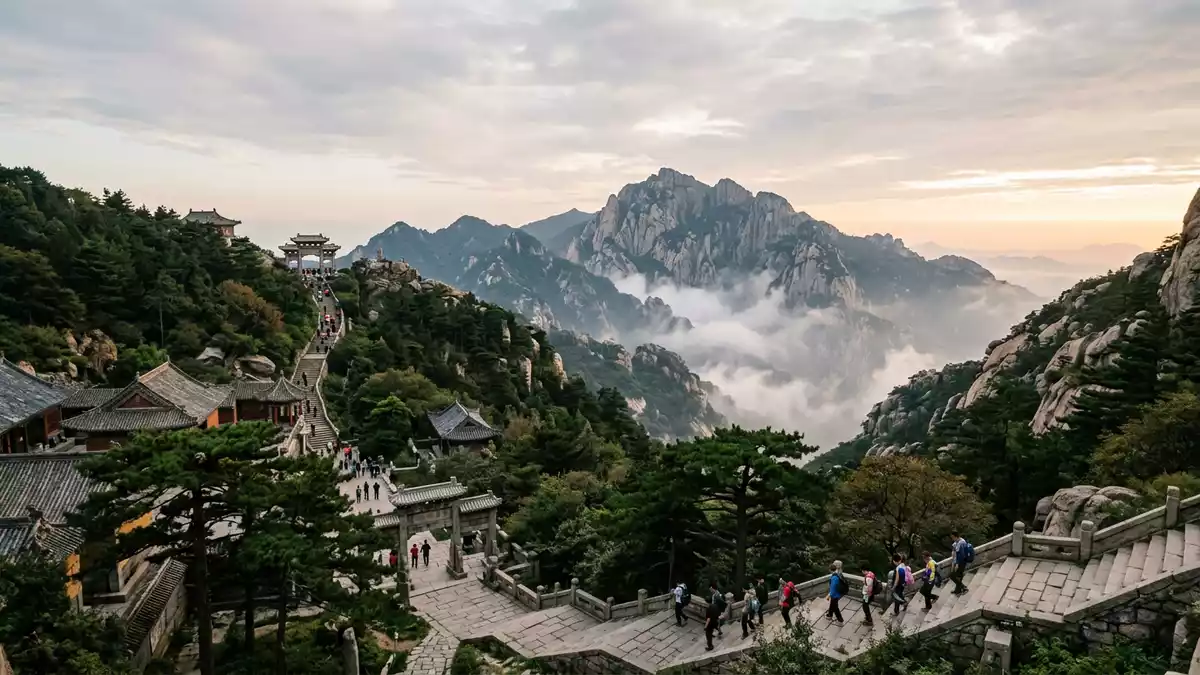
On the northern edge of Tai’an in eastern China, Tai Shan rises as a broad stone massif threaded with paths, temples and historic inscriptions that climb towards its main summit. Recognised as Mount Taishan on the UNESCO World Heritage List since 1987, it is a sacred mountain that has anchored imperial ritual and everyday devotion for millennia.
Stone mountain, sacred peak
Tai Shan forms a substantial mountain mass in Shandong province, its slopes running roughly from south-west to north-east above the plains around Tai’an. The mountain’s highest point is known as Jade Emperor Peak, a summit that reaches about 1,545 m (5,069 ft) above sea level, making it the highest point in Shandong and the culminating focus of the ascent.Jade Emperor Peak The mountain’s base and surrounding ridges together cover a broad area of about 426 km², giving Tai Shan a presence that dominates the landscape around Tai’an.area of 426 km²
In Chinese tradition Tai Shan is counted among the Five Sacred Mountains associated with Daoism, and it has long been linked with the eastern direction and the rising sun.five sacred mountains of Daoism Over centuries it became a place where imperial authority was expressed through ceremonies at the summit and where countless visitors left carved records on rock faces and stelae. The combination of religious importance, political symbolism and dense layers of inscription gives the mountain a cultural depth that underpins its protected status.protected status
Paths, gates and temple precincts on the ascent
The approach to Tai Shan from Tai’an leads into a system of paths and stairways that climb from the lower temples towards the upper plateau and final summit. One of the traditional starting points is the Red Gate near the city, where the ascent begins through built gateways and stone steps that soon leave the urban streets behind.Red Gate near the city As the path rises, it passes a sequence of named gate structures, including the First, Second and Third Heaven Gates, which mark stages on the climb and frame views back over the plains and forward towards higher ridges.Heaven Gates on the climb
Temples and halls sit beside the main staircase and on terraces cut into the mountain, forming precincts where incense, courtyards and monumental gateways meet exposed bedrock. Many of these structures preserve carved tablets and stone panels bearing inscriptions from different dynasties, so that walking the route involves moving through successive historical layers. The ascent itself is marked by thousands of stone steps, and in places the stairway narrows between rocks and walls, with mountain vegetation rising on either side. Cable cars serve some sections of the route and connect intermediate stations such as Zhongtianmen with higher areas, but the stepped paths remain a defining feature of Tai Shan’s experience as a sacred mountain approached on foot.cable cars and stepped paths
World Heritage landscape of rock, vegetation and inscription
Tai Shan’s designation as a mixed cultural and natural World Heritage Site reflects the way rock formations, forest cover and built structures combine across the mountain. The massif consists largely of resistant rock that rises steeply from the surrounding plateau, creating cliffs, gullies and broad slopes that host dense vegetation.mixed cultural and natural Within this landscape, temple complexes, stone gateways and ritual platforms stand on ledges or gentler ground, tied together by staircases and paths that follow natural contours and saddle points. The overall impression is of a mountain where human structures sit directly on the rock rather than being separated from it.
Inscriptions are a characteristic feature of Tai Shan. Rock faces along the main routes carry large carved characters naming places, recording visits or celebrating imperial ceremonies, and stelae in temple courtyards bear more detailed texts. These inscriptions range across many centuries and contribute to the mountain’s reputation as a repository of calligraphy and historical record.inscriptions across centuries Together with the long continuity of ritual use, they support Tai Shan’s status as a landscape where geology, vegetation, architecture and written culture overlap in a single, extended composition.
Visiting Tai Shan: what travellers from Western Europe should know
- Tai Shan rises just north of Tai’an in Shandong province in eastern China, and is reached from the city via approaches that lead towards the Red Gate and other lower entrances.
- The main ascent follows long stone stairways with many steps, including steep sections and narrow passages between rocks and buildings, so the route demands sustained climbing on foot.
- The mountain lies between Tai’an and Jinan in Shandong, with rail connections serving Tai’an and a station named Tai Shan in the urban area that provides a starting point for the journey towards the mountain.
- The official language is Chinese and the currency is the Chinese yuan.
- Entry requirements depend on your nationality; UK travellers can check the FCDO travel advice at gov.uk/foreign-travel-advice, Irish travellers the Department of Foreign Affairs at ireland.ie.
Searching for Tai Shan on social platforms
These links open searches for Tai Shan on each platform.
Frequently asked questions about Tai Shan
Where is Tai Shan located?
Tai Shan is a mountain in Shandong province in eastern China, rising just north of the city of Tai’an and lying south of the provincial capital Jinan.
What should visitors expect on a visit to Tai Shan?
A visit centres on climbing long stone stairways past gates, temples and inscriptions, with the option of using cable cars on some sections and continuing on foot towards the summit.
What makes Tai Shan distinctive among Chinese mountains?
Tai Shan combines the scale of a broad rock massif with dense temple precincts and centuries of carved inscriptions, and its recognised World Heritage status reflects this mixture of natural and cultural significance.


