
Tafelberg, the flat-topped mountain above Kapstadt
Published on 08/30/2026 at 14:21 | Editorial responsibility: Rafael Müller, Editor-in-Chief AD HOC NEWS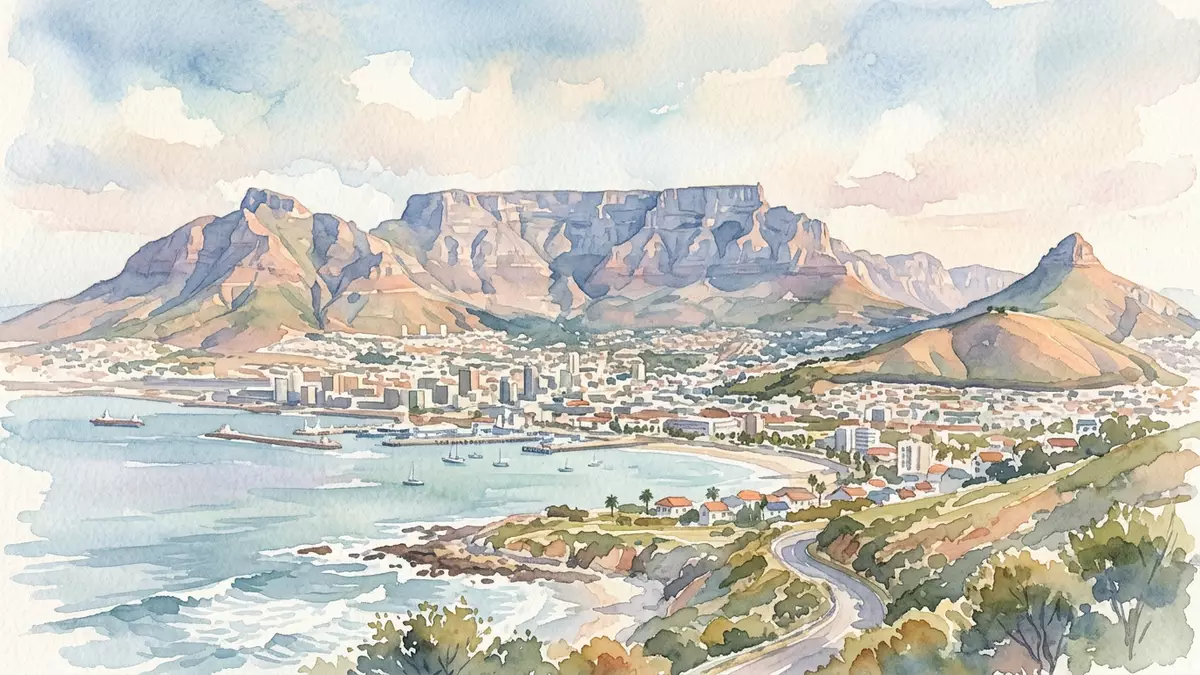
Tafelberg, better known internationally as Table Mountain, forms a flat-topped sandstone plateau above Kapstadt and Table Bay, giving the city its distinctive backdrop and skyline in South Africa.
The sandstone plateau above the city
Seen from Kapstadt’s central districts and the waterfront, Tafelberg appears as a steep wall of pale rock crowned by a broad plateau, its flat summit stretching across the northern end of the Cape Peninsula. The mountain overlooks the city and Table Bay, with the plateau rising to over 1,000 m (3,281 ft) above sea level at its highest point.flat-topped mountain The cliff faces are carved from resistant quartzitic sandstone, part of the Table Mountain Group, which gives the summit its tabular form as softer surrounding rocks have eroded away.sandstones of the Table Mountain Group
The plateau itself runs for several kilometres, forming a broad, gently undulating surface rather than a single peak, with Maclear’s Beacon marking the highest point on the main table.Maclear’s Beacon On either side of the central massif, subsidiary summits such as Devil’s Peak and Lion’s Head frame the table, extending the line of the mountain around the city bowl and creating a natural amphitheatre around Kapstadt’s older neighbourhoods.Devil’s Peak on one side and Lion’s Head on the other
Deep geological time written in rock
The rock layers of Tafelberg record a geological story that stretches back hundreds of millions of years, from ancient seabeds to continental collision. At the base lie older formations of metamorphic rock, the Malmesbury Group, intruded by Cape granite that cooled deep underground and later formed a hard foundation for the Cape Peninsula ranges.Malmesbury Group and Cape granite Above these sit the sedimentary rocks of the Table Mountain Group, deposited between roughly 500 and 330 million years ago when the region lay beneath seas and large bodies of water on the Gondwana supercontinent.sedimentary rocks deposited between 500 and 330 million years ago
The cliff-forming Peninsula Formation, a very hard quartzitic sandstone, makes up the bulk of the visible mountain and the summit plateau, sitting above the reddish layers of the Graafwater Formation and relics of glacial deposits near Maclear’s Beacon.Peninsula Formation and Graafwater Formation During the Cape Fold Belt orogeny, compressional forces crumpled these sedimentary layers and raised them into the mountain ranges of the Western and Southern Cape, leaving Tafelberg as a remnant of folded and uplifted strata that now stand high above Kapstadt and the coastal plain.Cape Fold Mountain Range
A landmark woven into Kapstadt’s setting
Tafelberg dominates the northern end of the Cape Peninsula, with its sandstone mass rising sharply behind the compact city bowl districts and the harbour. The mountain forms the backdrop to central Kapstadt and to neighbourhoods climbing its lower slopes, and its broad summit edge is visible from many vantage points around Table Bay.overlooking the city of Cape Town The contrast between the flat summit and the steep, broken cliffs below gives the mountain a clear profile against the sky, and the adjoining peaks extend its outline across the landscape.
The wider massif continues southwards along the Cape Peninsula, forming part of a chain of rugged sandstone hills and ridges that separate the Atlantic and False Bay coasts.part of the Cape Peninsula range At lower elevations around the base, fynbos vegetation characteristic of the Cape Floristic Region grows among boulders and rocky slopes, while the higher plateau offers wide views across Kapstadt, Robben Island in Table Bay and the distant mountains inland.
Visiting Tafelberg: what travellers from Western Europe should know
- Tafelberg rises directly behind Kapstadt’s central districts and Table Bay; road approaches run from the city up towards the lower cableway station and various hiking trailheads on the mountain’s flanks.
- The mountain consists of steep sandstone slopes and cliff faces with rocky paths, and higher areas stand at over 1,000 m (3,281 ft), so ascents on foot involve sustained gradients and extended sections on uneven stone.
- Devil’s Peak and Lion’s Head lie close to the main table, forming neighbouring summits that are visible from Kapstadt and offer additional viewpoints across the city bowl and the surrounding bays.
- The official language is Afrikaans and English is widely used; the national currency is the South African rand.
- Entry requirements depend on your nationality; UK travellers can check the FCDO travel advice at gov.uk/foreign-travel-advice, Irish travellers the Department of Foreign Affairs at ireland.ie.
Searching for Tafelberg on social platforms
These links open searches for Tafelberg on each platform.
Frequently asked questions about Tafelberg
Where is Tafelberg located in relation to Kapstadt?
Tafelberg stands at the northern end of the Cape Peninsula, rising immediately behind Kapstadt’s central city bowl and overlooking Table Bay and the harbour.
What should visitors expect when spending time on Tafelberg?
Visitors encounter steep sandstone slopes, rocky paths and a broad summit plateau, with extensive viewpoints over Kapstadt, surrounding bays and inland ranges from the higher areas.
What makes Tafelberg distinctive among South African mountains?
Tafelberg is distinctive for its flat sandstone summit, its position above Kapstadt and Table Bay, and its role as part of the Cape Peninsula’s rugged chain of quartzitic peaks.


