
Tad Fane: twin waterfalls above Laos’s Bolaven Plateau
Published on 09/14/2026 at 16:01 | Editorial responsibility: Rafael Müller, Editor-in-Chief AD HOC NEWS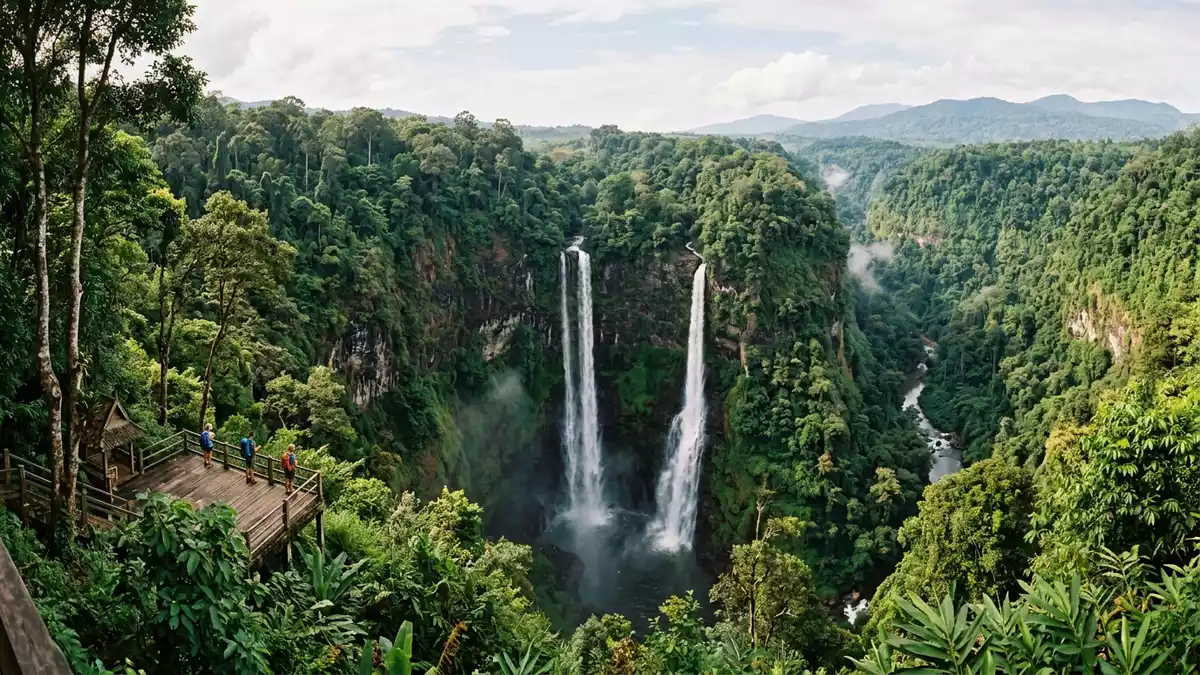
Tad Fane near Pakse in southern Laos is a twin waterfall where two rivers plunge side by side from the Bolaven Plateau into a forested gorge. The site lies in Champasak Province within the Dong Hua Sao National Protected Area, a highland region known for coffee and tea plantations as well as dense rainforest.
The twin drop into a hidden canyon
The defining sight at Tad Fane is the pair of narrow streams falling together from the lip of the Bolaven Plateau into a steep canyon far below. Seen from the official viewpoint, the water appears as two pale bands dropping past the surrounding trees before disappearing into mist at the gorge floor.twin waterfall on the Bolaven Plateau The plunge is widely described as being in the order of 120 m (394 ft) or more, creating one of the more dramatic vertical drops in this part of Laos.nearly 120 metre drops
The two streams are formed where the Champi and Pak Koot rivers meet the plateau edge and spill over together into the gorge. Their confluence above the cliff gives Tad Fane its characteristic twin form, with the flows remaining distinct throughout most of the fall before joining in the valley.Champi and Phak Koot rivers Visitors look across the canyon from a viewpoint on the plateau rim rather than approaching the base, so the experience is shaped by the long view over treetops and the sense of depth below.
Bolaven Plateau setting and protected landscape
Tad Fane sits on the western side of the Bolaven Plateau, a volcanic highland in southern Laos that rises above the Mekong plains around Pakse. The plateau’s elevation brings cooler air and frequent rainfall, supporting rainforest and long-established coffee and tea estates around the protected area.rainforest and plantations Dong Hua Sao National Protected Area, which includes Tad Fane, is recorded as habitat for species such as hornbills, monkeys, and larger mammals including leopards and elephants, though wildlife is more often heard in the surrounding forest than seen at the viewpoint.Dong Hua Sao National Park wildlife
The approach to the waterfall runs along the main road between Pakse and Paksong on the plateau, then turns off at a marked junction around kilometre 38. From there, an access road leads through plantation landscape and secondary forest to the Tad Fane viewpoint area.signed turnoff at kilometre 38 The setting combines cultivated fields and protected jungle, so the view from the rim takes in both the managed plateau surface and the untouched canyon cut into its edge.
Viewing platforms, trails and adventure activities
Most visitors experience Tad Fane from the main viewing platform on the plateau rim, set near a small resort complex and surrounded by forest. From here the twin falls are seen obliquely across the gorge, framed by the canopy and by the plateau edge itself.Tad Fane viewing point and resort Trails in the area offer longer walks through the surrounding woodland and plantation landscape, with guided treks bringing visitors closer to viewpoints along the gorge, though the base of the falls is generally not approached.
An additional way to experience the site is an over-the-gorge zipline course that has been installed near the viewpoint. This line runs high above the canyon, giving participants an aerial view of the twin streams and the dense vegetation surrounding them.zipline course above the gorge Because of the steep terrain and the lack of direct riverside access, Tad Fane is regarded as a place for viewing rather than swimming; the falls are observed from safe vantage points on the plateau rather than from the water’s edge.
Visiting Tad Fane: what travellers from Western Europe should know
- Tad Fane lies east of Pakse on the Bolaven Plateau in Champasak Province, reached by road towards Paksong with a signed turnoff near kilometre 38 leading to the viewpoint area.
- The terrain around the viewpoint is uneven, with dirt tracks, short slopes and steps; footwear suited to natural paths is advisable and those with limited mobility may find some sections challenging.
- The surrounding plateau carries coffee and tea plantations alongside forest, so journeys to Tad Fane combine stretches of paved highway with plantation access roads that may be rough in places.
- The official language is Lao and the currency is the Lao kip.
- Entry requirements depend on your nationality; UK travellers can check the FCDO travel advice at gov.uk/foreign-travel-advice, Irish travellers the Department of Foreign Affairs at ireland.ie.
Searching for Tad Fane on social platforms
These links open searches for Tad Fane on each platform.
Frequently asked questions about Tad Fane
Where is Tad Fane located?
Tad Fane is in Champasak Province in southern Laos, on the Bolaven Plateau east of Pakse within the Dong Hua Sao National Protected Area.
What should visitors expect on a visit to Tad Fane?
Visitors can expect a viewpoint overlooking twin waterfalls dropping into a deep jungle gorge, reached by plateau roads and short walks on uneven natural paths.
What makes Tad Fane distinctive among Laos waterfalls?
The combination of two rivers forming parallel cascades over a single high cliff into a forested canyon, viewed from the plateau rim, makes Tad Fane distinctive.


