
Tad Fane in Laos: twin waterfalls above a jungle gorge
Published on 09/17/2026 at 06:55 | Editorial responsibility: Rafael Müller, Editor-in-Chief AD HOC NEWS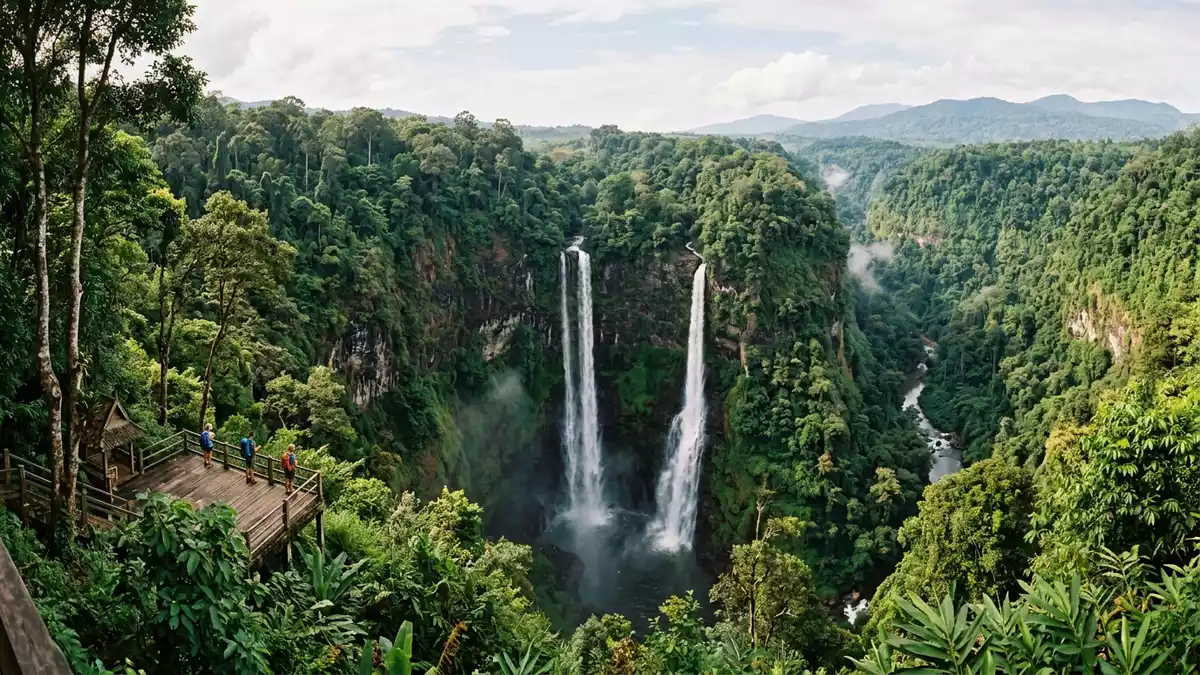
Tad Fane is a twin waterfall on the Bolaven Plateau east of Pakse in southern Laos, where two rivers drop side by side into a steep forested gorge. Rising from a highland landscape of coffee and tea plantations, the falls form one of Champasak Province’s most striking viewpoints and a classic stop on journeys through southern Laos in the twenty-first century.
Twin streams over the edge of the Bolaven Plateau
The defining feature of Tad Fane is the way two separate streams plunge in parallel over the plateau rim into a deep canyon. At this point the Champi River and the Pak Koot River flow close together before tipping over a high cliff and falling for more than 100 m (328 ft) into the gorge below, forming a vertical pair of narrow cascades framed by dense vegetation.Champi River and Pak Koot River From the official viewpoint on the plateau edge, visitors look across the canyon towards the waterfalls, seeing the white water drop past the treetops and disappear into spray before the river becomes visible again.
Tad Fane lies within the Dong Hua Sao National Protected Area, a forest reserve where streams cut down from the plateau into thickly wooded valleys.Dong Hua Sao National Park on the Bolaven Plateau The gorge beneath the falls is steep and enclosed, so the experience at Tad Fane is primarily about the long-distance view from above rather than direct access to the base of the cascades.
A highland setting of forest and coffee
The Bolaven Plateau itself is a broad highland region in Champasak Province, elevated above the Mekong lowlands and known for its cooler climate and rich volcanic soils. Around Tad Fane the plateau is covered by rainforest patches and agricultural estates, with coffee and tea plantations lining the road and forming a contrast to the wild forest in the protected area beyond.rainforest and tea and coffee plantations The waterfall viewpoint stands near a small resort complex on the plateau edge, where paths lead to terraces and platforms overlooking the canyon.
The drop of Tad Fane is frequently described as being in the region of 120 m (394 ft), giving the waterfalls a pronounced vertical scale against the forest walls of the gorge.approximately 120 metres Because the Champi and Pak Koot rivers fall together, the two strands of water appear like twin white lines drawn down the face of the cliff, with mist rising from the impact zone far below the viewing platforms.
Viewing terraces and high-wire perspectives
Facilities at Tad Fane focus on viewing rather than direct contact with the river, and the main marked paths take visitors to the edge of the plateau for clear perspectives into the gorge. A series of terraces and simple railings mark out the viewing area, where the twin falls can be seen against the backdrop of forest that fills the canyon and reaches up almost to the lip of the cliff.official viewpoint on the plateaurand The position of the viewpoint means the waterfalls are observed from across the gorge rather than from above the drop itself.
For those seeking a more elevated perspective, Tad Fane is associated with a high zipline installation that crosses part of the valley at considerable height. Reports describe a cable stretching hundreds of metres, suspended above the river level and aligned with the canyon, giving riders an airborne view of the twin cascades and the surrounding forest walls.Tad Fane zipline Alongside the viewpoint and high-wire route, walking trails in the vicinity of the resort lead through plateau vegetation and towards other vantage points on the edge of the protected forest.
Visiting Tad Fane: what travellers from Western Europe should know
- Tad Fane is reached on the Bolaven Plateau east of Pakse, along the road towards Paksong, with an access road signposted near kilometre 38 leading to the viewing area.
- The terrain around the viewpoint includes uneven paths and short climbs on soil and stone, with railings near the terraces but unfenced sections close to the forest edge.
- Tad Fane lies within Dong Hua Sao National Protected Area in Champasak Province, and the surrounding landscape combines forest with coffee and tea plantations on the plateau.
- The official language is Lao and the currency is the Lao kip.
- Entry requirements depend on your nationality; UK travellers can check the FCDO travel advice at gov.uk/foreign-travel-advice, Irish travellers the Department of Foreign Affairs at ireland.ie.
Searching for Tad Fane on social platforms
These links open searches for Tad Fane on each platform.Frequently asked questions about Tad Fane
Where is Tad Fane located in Laos?
Tad Fane is on the Bolaven Plateau in Champasak Province, east of Pakse, with access from the road towards Paksong and a spur leading to the viewpoint.
What should visitors expect when they arrive at Tad Fane?
Visitors encounter a series of viewing terraces on the edge of a forested gorge, paths through plateau vegetation and distant views of twin waterfalls dropping into the canyon.
What makes Tad Fane distinctive among waterfalls in southern Laos?
Tad Fane is characterised by its paired cascades from the Champi and Pak Koot rivers, its high drop into an enclosed gorge and its position within a protected forest area on the plateau.


