
Ta Prohm where stone and trees share the same temple
Published on 09/14/2026 at 14:54 | Editorial responsibility: Rafael Müller, Editor-in-Chief AD HOC NEWS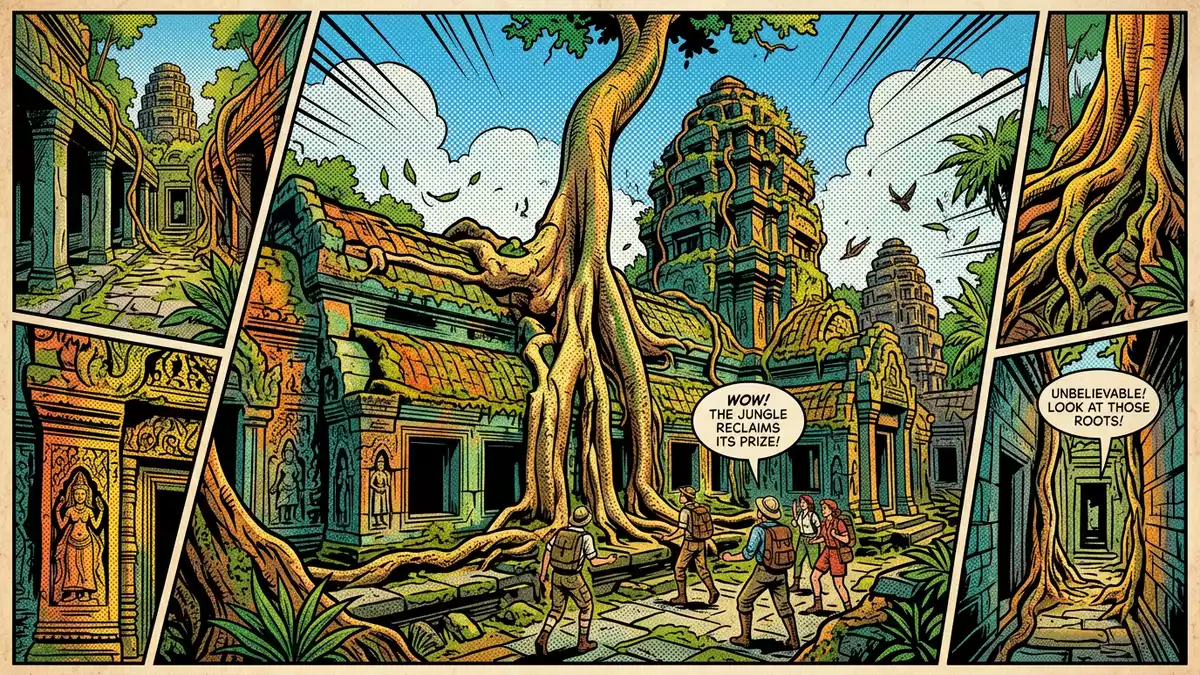
Ta Prohm in the Angkor Archaeological Park near Siem Reap is a Mahayana Buddhist temple complex from the late twelfth and early thirteenth centuries, where later jungle trees and historic masonry now appear to grow as one. Built under the Khmer king Jayavarman VII and consecrated in 1186 as the royal monastery Rajavihara, it forms part of the dense constellation of Angkor-period monuments across this region of Cambodia.
Jayavarman VII’s forest monastery
Ta Prohm stands on the southern edge of the East Baray, east of Angkor Thom, and belongs to the cluster of Angkor-period temples commissioned by Jayavarman VII, the Mahayana Buddhist ruler who reshaped the capital in the late twelfth century.The temple is described as a Bayon-style foundation of this period. Its original name, Rajavihara, literally “royal monastery”, placed it among the key religious institutions of the empire.Inscriptions and later summaries preserve this name.
The consecration of Ta Prohm in 1186 is linked with Jayavarman VII’s family: the principal cult image represented Prajnaparamita, the personification of wisdom, associated with the king’s mother.Khmer and Sanskrit inscriptions describe the dedication in detail. The temple formed a loose pair with Preah Khan, another Jayavarman VII foundation dedicated in 1191 and associated with his father, giving this corner of Angkor a network of royal monasteries linked by dynastic themes rather than military triumphs.
A planned monastic city in stone
Although today Ta Prohm is approached as a ruin, the ground plan reveals a carefully organised monastic complex built in the Bayon style, with concentric enclosures, gopura gateways and long galleries framing courtyards.Descriptions of the layout emphasise its axial arrangement and multiple halls. Sandstone sanctuaries sit on laterite foundations, with towers, libraries and causeways aligned along the main east–west axis.
The foundation stele of Ta Prohm lists thousands of residents and attendants, transforming the temple into a kind of planned village bound to the monastery through service and ritual.Recorded dependants include priests, officials, assistants and dancers. Reliefs carved into the sandstone show both Buddhist and Hindu imagery, including scenes from the Ramayana and figures such as Vishnu and Krishna, reflecting the complex religious environment of the Khmer Empire even within a Buddhist royal foundation.
Where jungle trees and towers interweave
After the decline of Angkor as a royal capital in the fifteenth century, Ta Prohm was left without large-scale maintenance, and in the centuries that followed, trees rooted themselves in masonry joints and courtyards.Descriptions of Ta Prohm emphasise this long period of neglect and natural overgrowth. The result is a landscape where later tree trunks flow over gallery roofs and stone walls, and roots wrap around carved doorways and towers.
Some of the most photographed views show massive tree roots cascading down over entrance halls and cloister walls, while the stonework beneath retains delicate carvings of devatas, apsaras and floral motifs.Guides to the site underline the contrast between finely worked sandstone and later vegetation. In some courtyards, trunks rise directly from collapsed blocks, creating dense tangles that blur the boundary between architecture and forest and make Ta Prohm one of the most visually distinctive parts of the Angkor landscape.
Visiting Ta Prohm: what travellers from Western Europe should know
- Ta Prohm lies within the Angkor Archaeological Park north of Siem Reap and is reached along the same access roads that lead to Angkor Wat and Angkor Thom.
- The temple stands on largely level ground, but movement through the complex involves uneven stone paving, corridors with scattered blocks and sections of rough, root-crossed paths.
- In Cambodia the official language is Khmer and the currency is the riel, although US dollars circulate alongside it in many transactions.
- Entry requirements depend on your nationality; UK travellers can check the FCDO travel advice at gov.uk/foreign-travel-advice, Irish travellers the Department of Foreign Affairs at ireland.ie.
Searching for Ta Prohm on social platforms
These links open searches for Ta Prohm on each platform.
Frequently asked questions about Ta Prohm
Where is Ta Prohm and what kind of site is it?
Ta Prohm is a Mahayana Buddhist temple complex within the Angkor Archaeological Park near Siem Reap in Cambodia, built in the late twelfth and early thirteenth centuries.
What should visitors expect when exploring Ta Prohm?
Visitors encounter a stone monastic complex with galleries, towers and courtyards where later jungle trees have grown over the walls, creating a dense interplay of roots and masonry.
What makes Ta Prohm distinctive among the Angkor temples?
Ta Prohm combines a Bayon-style royal monastery planned by Jayavarman VII with long-neglected structures where tree trunks and roots visibly entwine with carved sandstone reliefs and collapsed blocks.


