
Ta Prohm where stone and trees share a temple
Published on 09/07/2026 at 09:25 | Editorial responsibility: Rafael Müller, Editor-in-Chief AD HOC NEWS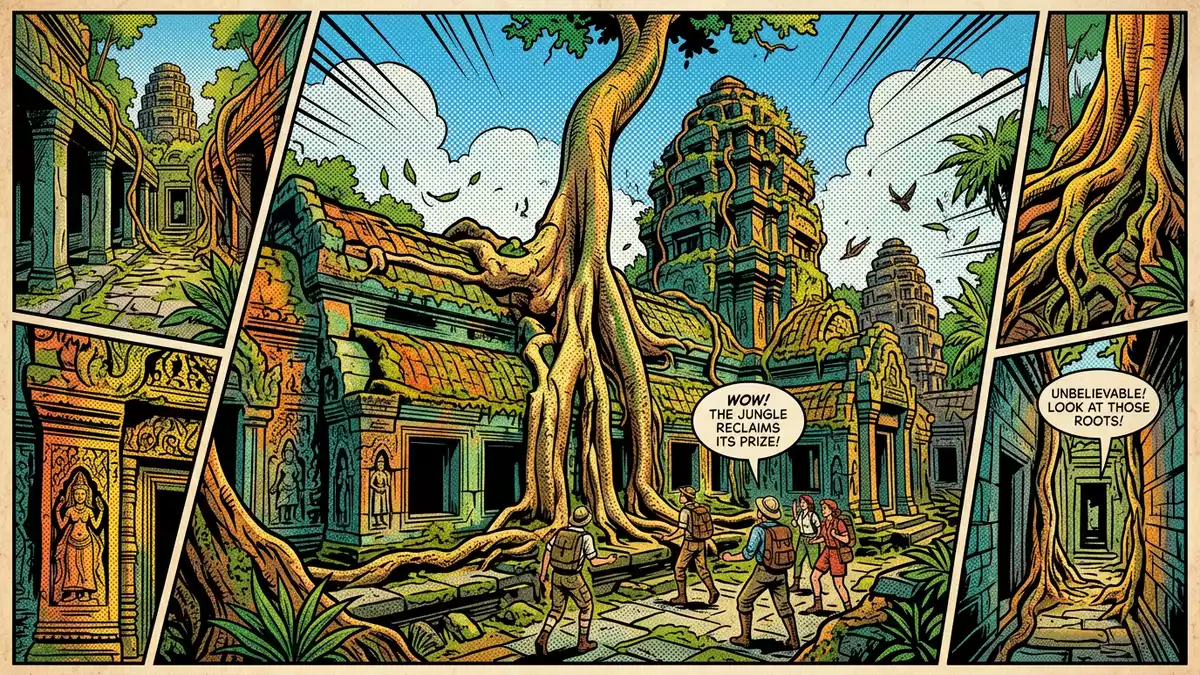
Hidden among the forests of Angkor near Siem Reap, Ta Prohm is a Buddhist temple complex where centuries-old stonework and jungle trees occupy the same space, their roots clasping galleries and courtyards in a slow, visible embrace. Built in the late twelfth century under the Khmer king Jayavarman VII and originally known as Rajavihara, it stands as one of the most atmospheric sites within the Angkor Archaeological Park.
Rajavihara: a royal monastery in Jayavarman VII’s Angkor
Ta Prohm began life as Rajavihara, “Monastery of the King”, a large Mahayana Buddhist monastic complex commissioned by Jayavarman VII and dedicated to his mother Jayarajachudamani and his teacher Jayamangalartha.Rajavihara, a Buddhist monastery Construction is recorded in 1186, placing the temple among the earliest major works of Jayavarman VII’s programme that reshaped Angkor in the late twelfth century.Completed in 1186 The complex sits within the wider Angkor ensemble as a separate temple from Angkor Wat, linked instead to the Bayon style that marks Jayavarman VII’s reign.
The plan of Ta Prohm reflects its monastic origin. Concentric enclosures surround a central sanctuary, with long galleries forming cloister-like corridors around courtyards. Reliefs and carvings along the sandstone walls show Buddhist iconography and inscriptions that once recorded the temple’s endowments. Over time, as state religion in Cambodia shifted, active monastic life here faded, leaving the built fabric to weather gradually in the forest climate.
A temple shared by stone and trees
Ta Prohm’s distinctive character comes from the decision to leave much of the vegetation that had colonised the structure in place, rather than clearing it entirely.Stone galleries and tree roots Tall trees rise from terraces and courtyards, their roots extending over doorways and along walls, in some places draping the stone like thick ropes and in others running as broad, sinuous bands down the sides of towers. The effect is not a single dramatic point but a recurring encounter, as almost every turn in the inner enclosures reveals another junction between built surface and living trunk.
Architecturally, the temple displays the Bayon style in its towers and reliefs: faces and figures carved into stone blocks, galleries framed by columns, and doorways leading through successive spaces from the outer grounds towards the sanctuary at the centre.Bayon-style temple at Angkor In several places, collapsed roof sections and fallen stones lie where they dropped, while stabilising work holds other parts in place. The combination of partially open sky above, rooted trunks and weathered sandstone gives Ta Prohm a layered appearance: not a ruin abandoned to collapse, but a structure held in a particular state where forest and temple remain visibly intertwined.
Ta Prohm within the Angkor landscape
Ta Prohm stands inside Angkor Archaeological Park in Siem Reap Province, on the southern edge of the historic East Baray reservoir and around 3 km north-east of Angkor Wat.Southern edge of the East Baray It lies just east of Angkor Thom, near the small circuit road that links several of the park’s major temples, including Ta Keo and Banteay Kdei.Inside Angkor Archaeological Park Approaching from the road, visitors typically follow a path through light forest before reaching the outer enclosure and its entrance gopura.
Within the temple grounds the terrain alternates between packed earth, stone paving and areas where blocks have shifted or settled over time. Moving through the galleries involves steps up and down between levels, and in places narrow passageways give way to wider courtyards where trees dominate the view. The surrounding landscape is relatively flat, but the built tiers and lingering traces of water-management works around Angkor place Ta Prohm within a man-made environment that was once closely organised around reservoirs, causeways and axial routes.
Visiting Ta Prohm: what travellers from Western Europe should know
- Ta Prohm lies inside Angkor Archaeological Park in Cambodia, east of Angkor Thom and north-east of Angkor Wat, reached by road from Siem Reap and then on foot through forest paths.
- Within the temple, movement involves uneven stone surfaces, short staircases and passageways where tree roots and fallen blocks narrow the route, so walking demands attention to footing.
- The surrounding area is lowland forest, with shaded sections inside the enclosures and more open areas near the entrances and outer walls.
- The official language is Khmer and the currency is the Cambodian riel.
- Entry requirements depend on your nationality; UK travellers can check the FCDO travel advice at gov.uk/foreign-travel-advice, Irish travellers the Department of Foreign Affairs at ireland.ie.
Searching for Ta Prohm on social platforms
These links open searches for Ta Prohm on each platform.
Frequently asked questions about Ta Prohm
Where is Ta Prohm located?
Ta Prohm is a temple within Angkor Archaeological Park near Siem Reap in Cambodia, east of Angkor Thom and north-east of Angkor Wat.
What should visitors expect on a visit?
Visitors can expect a series of sandstone galleries, courtyards and towers where tree roots and trunks are intertwined with the structure, with uneven surfaces and short staircases.
What makes Ta Prohm distinctive among Angkor’s temples?
Ta Prohm is distinctive for the way its Bayon-style stone architecture and the surrounding forest meet directly, with large trees rooted in and around the temple’s walls and terraces.


