
Sydney Opera House and the sweep of a harbour front
Published on 09/08/2026 at 15:55 | Editorial responsibility: Rafael Müller, Editor-in-Chief AD HOC NEWS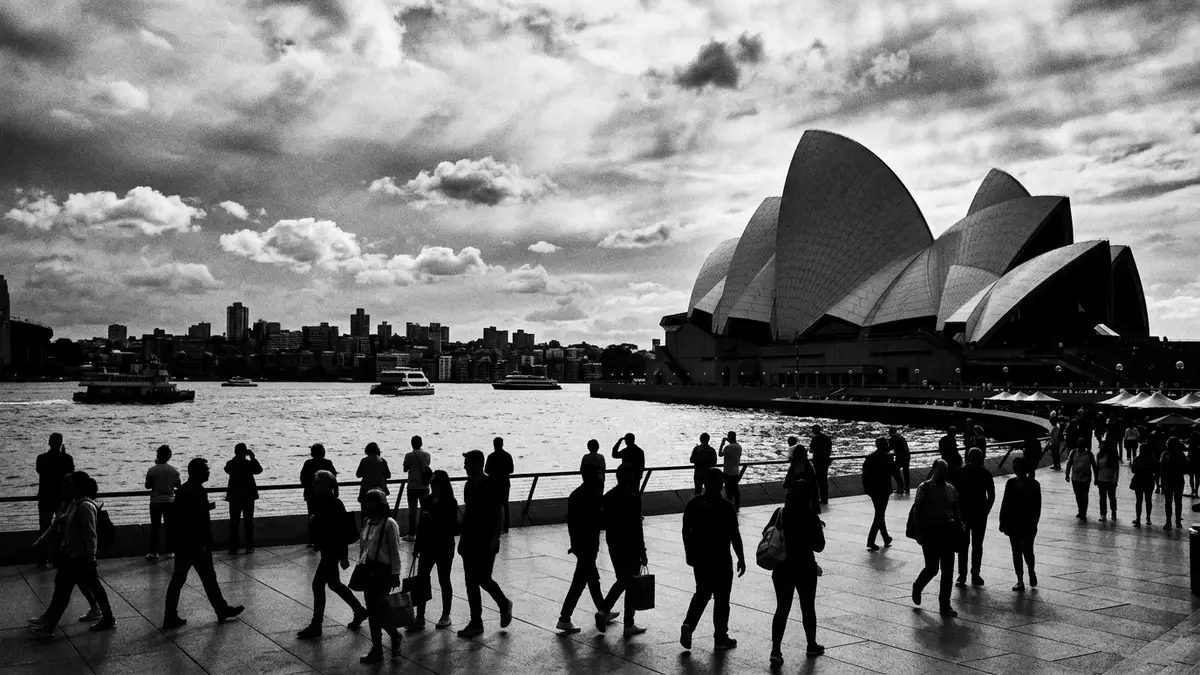
Sydney Opera House rises on Bennelong Point in Sydney Harbour, with a profile made of white shell-like roofs and a broad podium. Designed by the Danish architect Jørn Utzon, it opened in 1973 and is a UNESCO World Heritage Site.
Jørn Utzon’s harbour landmark
The building is one of the clearest examples of late modern architecture in Australia, and its form remains easy to read from the water and the shoreline. The white roof segments sit above a heavy base, creating a strong contrast between mass and lift. Designed by the Danish architect and World Heritage masterpiece are facts that define the place as much as its setting.
The site belongs to the city’s cultural edge, where the harbour, the headland and the man-made platform meet in a single view. The building’s most recognisable feature is its layered roofscape, which reads as a sequence of curved forms rather than a single roof plane.
From competition to completion
The story of the building begins with the international design competition won by Jørn Utzon in 1957, a date that anchors its modern identity. 1957 and opened by Queen Elizabeth II remain the two dates most closely tied to its public history. The building was formally opened on 20 October 1973.
Its completion brought an Australian performance venue into a form that had already become familiar through photographs and drawings. The shell-like roofs, the podium and the harbour-edge sit together as a composition that belongs equally to architecture and to the cityscape around it.
Heritage status and cultural role
Sydney Opera House was included on the UNESCO World Heritage List in 2007, and that designation places it among the major cultural works of the twentieth century. World Heritage List and late modern architecture are the terms most often used in official descriptions of its standing.
The building is a performing arts venue, and that function sits naturally within its broad public presence. Its public image rests on a recognisable combination of geometry, harbour setting and civic scale.
Visiting Sydney Opera House: what travellers from Western Europe should know
- The building stands on Bennelong Point, beside Circular Quay. Ferries, trains and buses all serve the surrounding transport hub.
- The approach includes open paved areas, steps and sloping ground around the podium. The harbour edge and the forecourt are part of the experience.
- The official language is English and the currency is the Australian dollar.
- Conditions on the mountain change with the seasons; the local cable-car operators and alpine clubs provide information.
Searching for Sydney Opera House on social platforms
These links open searches for Sydney Opera House on each platform.
Frequently asked questions about Sydney Opera House
Where is Sydney Opera House?
It stands on Bennelong Point in Sydney Harbour, close to Circular Quay. The setting places the building between the water and the city centre.
What does a visit involve?
The site is a large public building with surrounding forecourt spaces, steps and harbour views. Its exterior is as important as its performance role.
What makes it distinctive?
Its white roof forms, podium and harbour-side position create a profile that is immediately recognisable. The association with Jørn Utzon and the 1973 opening adds historical weight.


