
Sydney Opera House and its sculpted harbour sails
Published on 09/18/2026 at 11:22 | Editorial responsibility: Rafael Müller, Editor-in-Chief AD HOC NEWS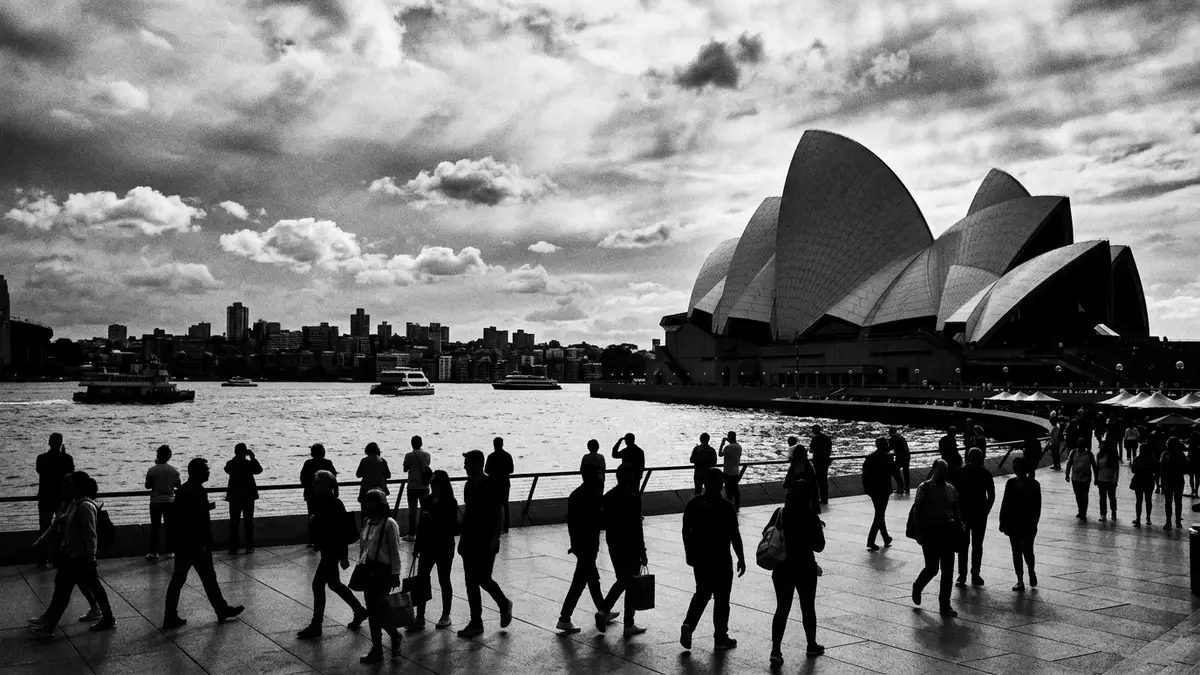
Sydney Opera House stands on Bennelong Point in Sydney Harbour, its cluster of pale shells turning a performing arts centre into a sculptural landmark above the water. Designed by Danish architect Jørn Utzon in the mid-twentieth century and opened in 1973, the building combines expressive concrete geometry with a layered interior of halls and foyers.
Harbour setting and the sculpted shell roof
The site of Sydney Opera House projects into Port Jackson, on the south side of the harbour just east of Sydney Harbour Bridge, giving the building clear views across the water and back towards the city’s high-rises.Situated on Bennelong Point, the podium steps down from the forecourt towards the harbour edge, with broad terraces that frame the shells above.
The form of the roof is built from a series of interlocking concrete shells, derived from the surface of a sphere and arranged in groups above the main performance spaces.Utzon’s spherical geometry produces a repeating family of curved panels, which sit on a monumental base and give the building its distinctive silhouette. The shells are clad with more than one million ceramic tiles, manufactured in Sweden, that catch changing light across their surfaces while reading as a pale, cohesive skin from a distance.The tiled roof surface covers an extensive area above the structure.
From competition to World Heritage architecture
The origins of Sydney Opera House lie in an international design competition launched in the 1950s for a new venue for opera, ballet and concerts on Bennelong Point.Jørn Utzon’s winning scheme was selected in 1957, setting in motion a long construction process that began in 1959 and ran through the 1960s. The building was opened by Queen Elizabeth II on 20 October 1973, marking the completion of a project that had transformed an ambitious competition entry into a concrete, steel and ceramic landmark.The formal opening in 1973 defined its place in late twentieth-century architecture.
Sydney Opera House is recognised as a major work of Expressionist architecture, combining structural innovation with sculptural effect across its roof and podium.Its inscription on the UNESCO World Heritage List in 2007 formalised its status as a masterpiece of modern architecture. The building is associated with other figures as well as Utzon: Australian architect Peter Hall led the team that completed the project after Utzon’s resignation, shaping the interiors that visitors pass through on the way to performances.The modern expressionist design reflects the combined efforts of designers, engineers and builders over many years.
Inside the podium: halls, foyers and structure
Beneath the shells, Sydney Opera House contains several distinct performance venues, including the Concert Hall and the Joan Sutherland Theatre, arranged within a shared structural envelope.The complex of halls is supported by a vast concrete podium that was among the largest structures of its kind in the southern hemisphere when poured.The podium’s concrete mass anchors the building to the rock of Bennelong Point and creates the broad exterior terraces.
The interior foyers rise in layers under the shells, with glazed walls overlooking the harbour and staircases connecting different levels of the podium. Structural piers extend below sea level to support the load of the roof and the enclosed volumes above.Concrete piers sunk deep below the waterline carry the weight of the building. Behind the public spaces, workshops, rehearsal rooms and technical areas support daily performance operations, making the complex a working theatre hub as well as a harbour landmark.
Visiting Sydney Opera House: what travellers from Western Europe should know
- Sydney Opera House stands on Bennelong Point in central Sydney, on the eastern side of Circular Quay, and is reached by city rail and ferry services from other districts.
- The approach from Circular Quay runs across a broad forecourt and up wide exterior steps, with further staircases inside the podium linking foyers and performance levels.
- The surrounding harbour edge is paved, with level promenades around the base of the podium and open terraces that are exposed to sun, wind and rain.
- For visitors from Western Europe, the official language is English and the currency is the Australian dollar.
- Entry requirements depend on your nationality; UK travellers can check the FCDO travel advice at gov.uk/foreign-travel-advice, Irish travellers the Department of Foreign Affairs at ireland.ie.
Searching for Sydney Opera House on social platforms
These links open searches for Sydney Opera House on each platform.Frequently asked questions about Sydney Opera House
Where is Sydney Opera House located?
Sydney Opera House stands on Bennelong Point on Sydney Harbour, on the south side of Port Jackson near Sydney Harbour Bridge and Circular Quay.
What can visitors expect inside the building?
Visitors encounter a layered podium with foyers, staircases and several performance halls, including a large concert venue and an opera theatre beneath the curved shells.
What makes Sydney Opera House distinctive among theatres?
The combination of spherical concrete shells, tiled roof surfaces and its projecting harbour site gives Sydney Opera House a sculptural presence that has become strongly associated with Sydney and Australia.


