
Sydney Opera House and its sculpted harbour sails
Published on 09/16/2026 at 19:57 | Editorial responsibility: Rafael Müller, Editor-in-Chief AD HOC NEWS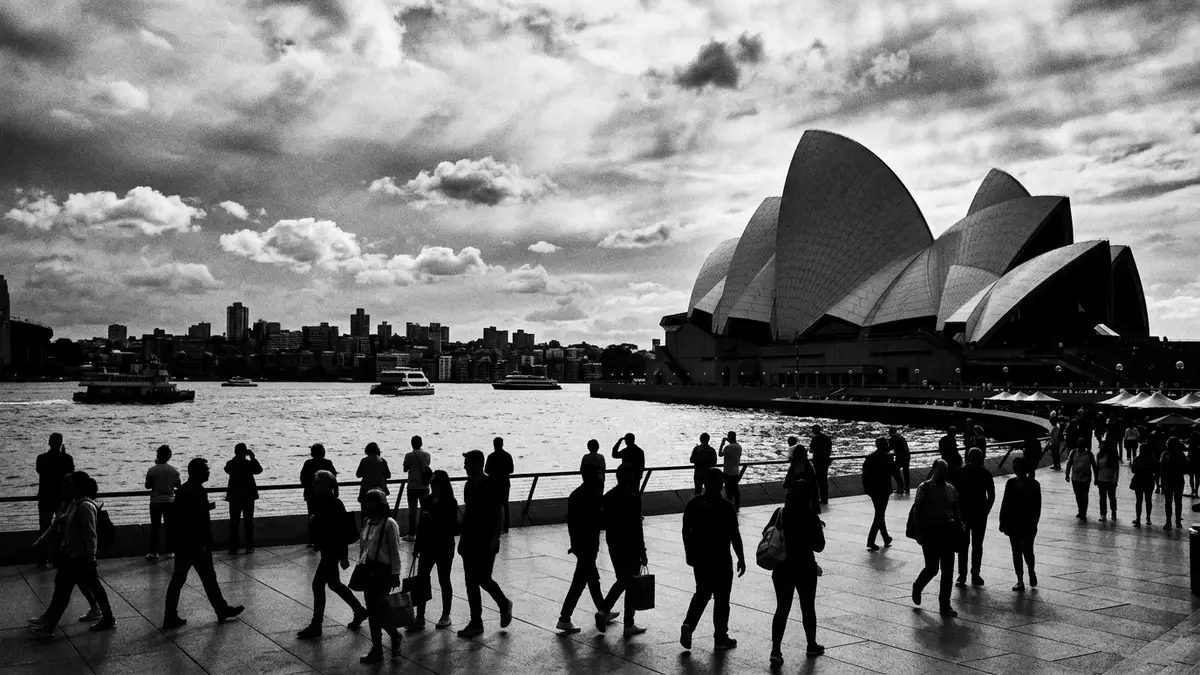
On the edge of Sydney Harbour, Sydney Opera House lifts a cluster of pale, tiled roofs from a broad podium, giving the city an instantly recognisable silhouette. Designed by Danish architect Jørn Utzon, whose competition-winning scheme was announced in 1957, the building was officially opened on 20 October 1973 by Queen Elizabeth II, marking the end of a fourteen-year construction period that began in 1959.Designed by Danish architect Jørn Utzon Standing on Bennelong Point, a rocky promontory projecting into Port Jackson, it has become a shorthand image for both Sydney and Australia.Situated on Bennelong Point on Sydney Harbour
Shells, podium and harbour setting
The most striking aspect of Sydney Opera House is the group of roof forms that suggest billowing sails or stacked seashells above the harbour water. These roofs are made from large precast concrete sections, each derived from a single underlying sphere, and arranged in interlocking groups over the performance spaces.Series of precast concrete shells from a common sphere The shells rise to a height of around 67 m (220 ft) above sea level, comparable to a multi-storey tower, and are clad in more than one million ceramic tiles manufactured in Sweden, which give the surfaces a subtle pattern when viewed up close.More than one million roof tiles made in Sweden
Beneath the swept roofs, the building sits on a broad stepped podium of reinforced concrete that extends over roughly 1.8 hectares (4.4 acres) and is supported by hundreds of piles driven deep below the waterline.Podium of 1.8 hectares supported by concrete piles From the upper terraces the view opens to the harbour, with the steel arch of Sydney Harbour Bridge to one side and the city’s central business district rising behind. The podium’s flights of steps and open platforms act as outdoor gathering spaces, so that the complex reads as both a performing-arts venue and a civic terrace extending into the water.
An opera house as twentieth-century architecture
Although its sculptural form often dominates attention, Sydney Opera House is also a layered cultural project of the mid-twentieth century. Utzon’s concept was selected through an international competition launched in 1956, and its execution required close collaboration between architects and engineers, including the firm Ove Arup & Partners, to resolve the geometry and structural behaviour of the shells.Collaboration with Ove Arup & Partners on engineering The building has been described as modern expressionist in character, with structural concrete and geometry used as principal expressive tools rather than hidden behind traditional façades.Modern expressionist design using concrete shells
In 2007 Sydney Opera House was inscribed on the UNESCO World Heritage List under cultural criterion (i), recognising it as an outstanding architectural work of the twentieth century.World Heritage listing under cultural criterion (i) The listing emphasises the building’s combination of bold sculptural roof forms, innovative structural engineering and its prominent harbour setting. Since its opening in 1973 it has been associated with the evolution of Sydney’s identity, appearing in representations of the city ranging from postage stamps to international cultural campaigns.A defining twentieth-century building linked with Sydney’s image
Inside the performance spaces
Behind the tiled shells, the complex contains several distinct performance venues arranged along and around the central axis of the building. The largest is the Concert Hall, designed for symphonic music and other large-scale performances, and there is an opera theatre named in honour of Australian soprano Joan Sutherland, as well as smaller drama and flexible-format spaces.Concert Hall and Joan Sutherland Theatre among several venues These halls are stacked and offset within the structural frame, so that each rises beneath its own cluster of shells, creating a visual link between the external forms and the internal rooms.
Access to the interiors is organised through foyers lined with glazing, concrete and timber, where staircases and ramps connect the podium to the auditorium entrances. From many of these circulation spaces, visitors can see out to the harbour or back to the city skyline, while inside the halls the focus tightens onto the stage and seating. The building’s arrangement of venues within a single sculptural envelope means that an evening performance is framed by the same harbour terraces that attract visitors in daylight, tying everyday waterfront life to the routines of concerts, opera and theatre.
Visiting Sydney Opera House: what travellers from Western Europe should know
- Sydney Opera House stands on Bennelong Point on the southern side of Sydney Harbour, a short walk from Circular Quay, which is served by suburban trains and ferries.
- The complex rises above a stepped concrete podium with broad exterior terraces and multiple flights of stairs, so reaching the upper levels involves walking up significant steps.
- Nearby landmarks include Sydney Harbour Bridge to the north-west and the Royal Botanic Garden, which wraps around the eastern side of Bennelong Point and offers further harbour views.
- The official language is English and the currency is the Australian dollar.
- Entry requirements depend on your nationality; UK travellers can check the FCDO travel advice at gov.uk/foreign-travel-advice, Irish travellers the Department of Foreign Affairs at ireland.ie.
Searching for Sydney Opera House on social platforms
These links open searches for Sydney Opera House on each platform.Frequently asked questions about Sydney Opera House
Where is Sydney Opera House located?
Sydney Opera House stands on Bennelong Point on the southern shore of Sydney Harbour, just east of Sydney Harbour Bridge and close to Circular Quay.
What can visitors expect on a visit?
Visitors encounter broad harbour terraces, stepped approaches and glazed foyers beneath the tiled shells, with access to multiple performance spaces and extensive views of the harbour and city.
What makes Sydney Opera House distinctive?
The building combines interlocking concrete shells, a large podium over the water and a prominent harbour setting, and has been recognised as a World Heritage Site for its twentieth-century architectural significance.


