
Sydney Opera House and its sculpted harbour sails
Published on 09/14/2026 at 19:04 | Editorial responsibility: Rafael Müller, Editor-in-Chief AD HOC NEWS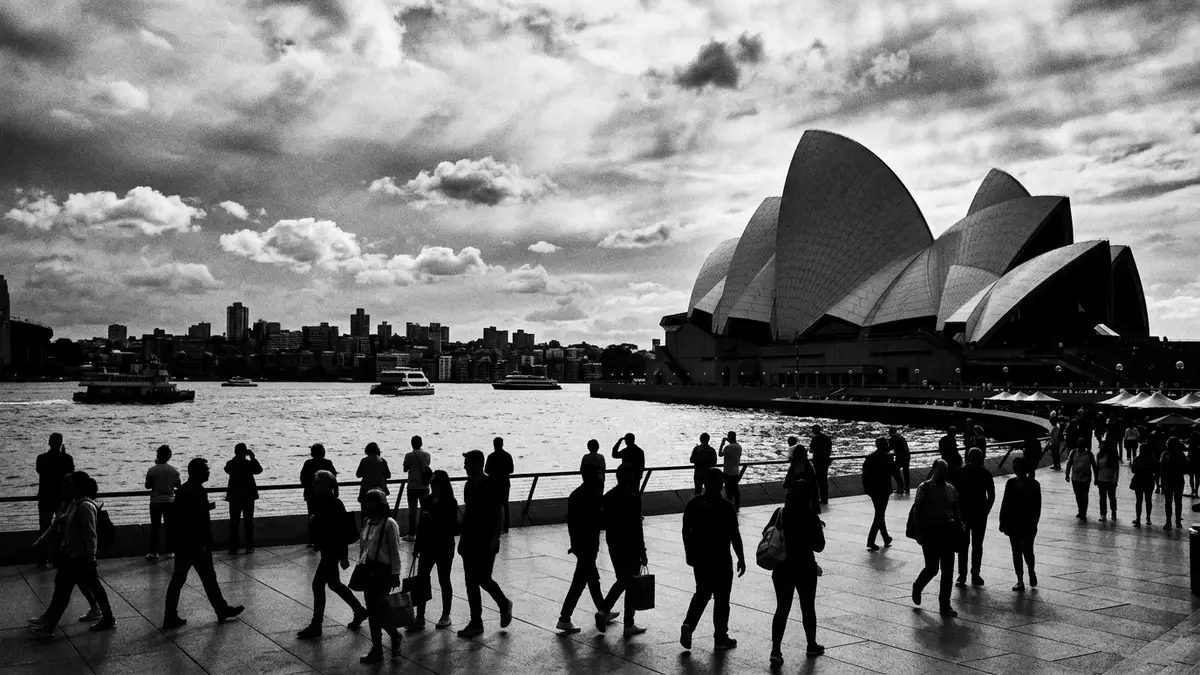
Few buildings transform their setting as completely as Sydney Opera House, where white-tiled roof forms rise above Sydney Harbour like a cluster of vast sails and give the waterfront a distinct silhouette. Set on Bennelong Point in Sydney, Australia, the performing arts complex was designed by Danish architect Jørn Utzon and opened in 1973, anchoring the eastern edge of Circular Quay with a monumental podium and interlocking roof structures.
Harbour setting and sculptural form
The location on Bennelong Point places Sydney Opera House on a narrow promontory projecting into Sydney Harbour, with water on several sides and views back to the city and across to the Harbour Bridge.Bennelong Point in Sydney Harbour From the water, the building reads as a broad granite podium carrying a constellation of vaulted roof shells, an arrangement that turns the whole site into a kind of urban sculpture.great urban sculpture carefully set in a waterscape
The roof shells are made from precast concrete units, each section derived from a common spherical geometry and assembled into groups that lean and intersect over the main halls.series of precast concrete shells Their exterior surface is covered with ceramic tiles that give the shells a pale, slightly textured finish that changes with the light – bright in full sun, softer under cloud or against the evening sky.more than 1 million roof tiles
Design, construction and World Heritage status
Jørn Utzon’s design for Sydney Opera House was selected in 1957 from hundreds of entries in an international competition, introducing a bold combination of sculptural roofs and a broad harbour-facing podium.international design competition held in 1956 Construction began in 1959 and extended into the early 1970s as engineers and builders worked through the challenges of realising the shell geometry and supporting structure on a confined waterfront site.construction period from 1959 to 1973
The building was formally opened on 20 October 1973 by Queen Elizabeth II, marking the completion of one of the twentieth century’s most recognisable pieces of architecture.opened by Queen Elizabeth II on 20 October 1973 In 2007 it was inscribed on the UNESCO World Heritage List for its architectural and engineering significance, recognised as a masterpiece of modern design that combines daring structural innovation with an expressive relationship to its harbour setting.World Heritage Site inscribed in 2007
Interiors, venues and the podium
Behind the tiled shells, Sydney Opera House contains several performance spaces, including a large Concert Hall and the Joan Sutherland Theatre, each housed beneath its own cluster of roof vaults.Concert Hall and Joan Sutherland Theatre The interiors combine timber, concrete and made-to-order glass to create auditoria, foyers and circulation areas that follow the geometry of the exterior and maintain views to the harbour through broad glazed walls.made-to-order glass and extensive cabling
The podium, built as a vast concrete platform, supports the shell structures and defines terraces, promenades and stairs that step down towards the water.monumental podium with granite cladding From these outdoor spaces, the building’s layered roofs, the harbour and the city skyline are all visible, making the site both a working performing arts centre and a public place where people can walk, sit and look out across Sydney Harbour.
Visiting Sydney Opera House: what travellers from Western Europe should know
- Sydney Opera House stands on Bennelong Point on the eastern side of Circular Quay, reached on foot from central Sydney and served by ferries and city rail services.
- The approach from Circular Quay involves broad outdoor steps and inclined walkways up to the podium, so visitors spend part of the visit moving across open, elevated terraces.
- The building stands directly beside Sydney Harbour, with promenades at water level and higher terraces offering open views across the bay and towards the Harbour Bridge.
- The official language is English and the currency is the Australian dollar.
- Entry requirements depend on your nationality; UK travellers can check the FCDO travel advice at gov.uk/foreign-travel-advice, Irish travellers the Department of Foreign Affairs at ireland.ie.
Searching for Sydney Opera House on social platforms
These links open searches for Sydney Opera House on each platform.Frequently asked questions about Sydney Opera House
Where is Sydney Opera House located?
Sydney Opera House stands on Bennelong Point at the eastern end of Circular Quay in Sydney, projecting into Sydney Harbour with water on several sides.
What can visitors expect inside the building?
Visitors find multiple performance venues, foyers with broad glazing facing the harbour, and interior finishes of timber, concrete and glass arranged beneath the roof shells.
What makes Sydney Opera House distinctive among performing arts centres?
Its combination of harbourfront podium, tiled concrete shells and integrated outdoor terraces creates a sculptural complex that serves both as a major performing arts venue and as a public waterfront landmark.


