
Sydney Harbour Bridge and its great steel arch
Published on 09/23/2026 at 17:27 | Editorial responsibility: Rafael Müller, Editor-in-Chief AD HOC NEWS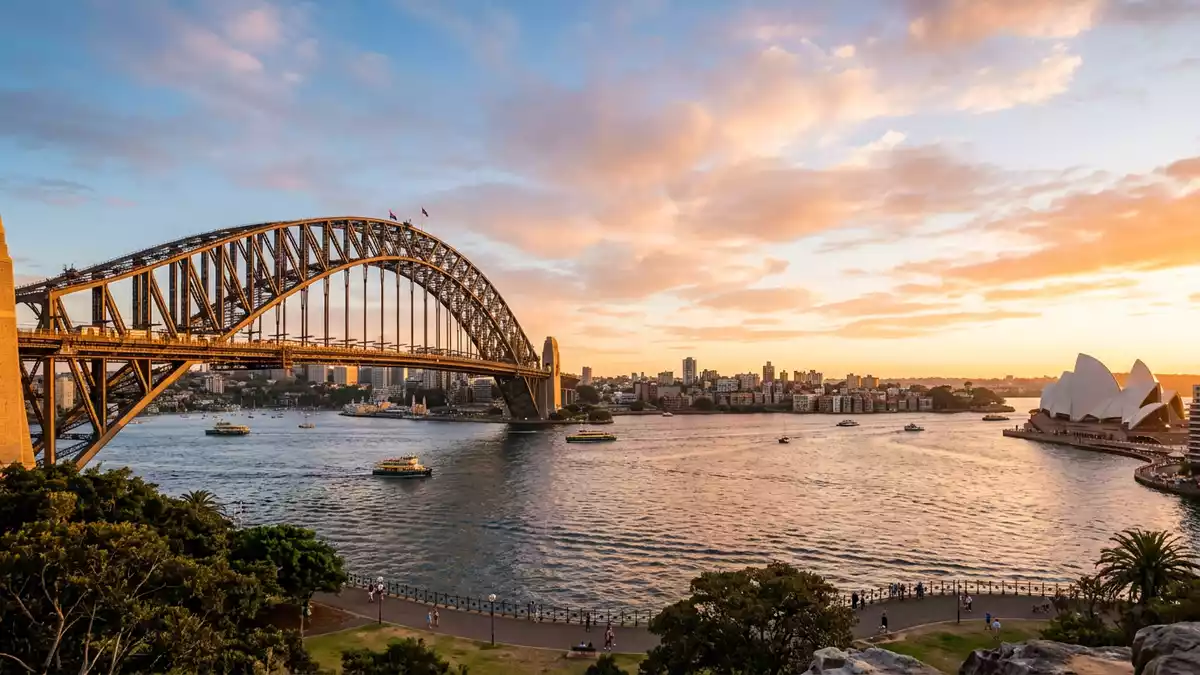
Sydney Harbour Bridge crosses Sydney Harbour as a broad steel arch between Dawes Point and Milsons Point. Its dark metal outline rises above the water, carrying road traffic, railway lines, pedestrians and cyclists across a single landmark structure.
The bridge opened on 19 March 1932. Its arch spans 503 metres, while the summit reaches 134 metres above sea level, giving Sydney Harbour Bridge a clearly measurable presence within the city.
A steel arch across Sydney Harbour
The bridge joins Sydney’s southern shore with the North Shore. Its main structure is formed by two steel arches that meet above the harbour, with the deck suspended between them.
The span measures 503 metres, and the complete bridge extends across approach sections as well as the central arch. The deck carries several forms of transport in parallel, with footways and cycle routes beside the main roadway.
The steelwork gives the bridge its familiar nickname, “the Coathanger”. The comparison comes from the visible outline of the arch, which curves above the deck and frames the harbour beneath it.
John Bradfield and the bridge of 1932
Engineer John Bradfield presented plans for a harbour crossing in the early twentieth century. The New South Wales Government passed the Sydney Harbour Bridge Act in 1922, and construction began in 1923.
The detailed design involved the English company Dorman Long & Co. and engineer Sir Ralph Freeman. Work on the two sides of the arch advanced from the harbour shores, and the sections met in August 1930.
The completed bridge opened on 19 March 1932, during the premiership of Jack Lang. The opening connected the transport networks on both sides of the harbour and gave Sydney a permanent steel landmark.
From transport crossing to city symbol
Sydney Harbour Bridge remains a working transport route rather than a monument separated from daily movement. Trains, motor vehicles, pedestrians and cyclists use the crossing, while the arch and deck remain visible from many parts of the harbour.
The bridge’s dimensions explain its strong visual character. The summit stands 134 metres above sea level, while the arch stretches 503 metres across the water. the 1932 harbour crossing belongs to the transport history of Sydney as well as its architectural history.
Its setting places historic engineering beside the waterfront districts of Sydney and North Sydney. The bridge is also associated with the approaches around The Rocks, Dawes Point, Milsons Point and the harbour’s surrounding shoreline.
The formal opening is recorded on 19 March 1932. The date links the visible steel structure to a specific moment in Sydney’s twentieth-century development.
Visiting Sydney Harbour Bridge: what travellers from Western Europe should know
- The bridge crosses Sydney Harbour between Dawes Point on the southern shore and Milsons Point on the northern shore. Railway stations serve both sides of the crossing.
- The pedestrian routes include stairs and elevated sections. The bridge deck sits high above the water, and the approaches involve urban streets, crossings and changes in level.
- The bridge connects with The Rocks, Circular Quay and North Sydney. The harbour, waterfront paths and city streets surround the structure on both sides.
- The official language is English and the currency is the Australian dollar.
Searching for Sydney Harbour Bridge on social platforms
These links open searches for Sydney Harbour Bridge on each platform.
Frequently asked questions about Sydney Harbour Bridge
Where is Sydney Harbour Bridge?
Sydney Harbour Bridge crosses Sydney Harbour between Dawes Point and Milsons Point. It links the city centre with Sydney’s northern shore.
What can visitors expect on the bridge?
The crossing includes pedestrian and cycle routes beside railway lines and road traffic. The approaches contain stairs, elevated paths and urban streets.
What makes the bridge distinctive?
Its defining feature is the 503-metre steel arch above the harbour. The summit reaches 134 metres above sea level, creating a large visible frame around the transport deck.


