
Sydney Harbour Bridge and its great steel arch over the harbour
Published on 09/12/2026 at 17:38 | Editorial responsibility: Rafael Müller, Editor-in-Chief AD HOC NEWS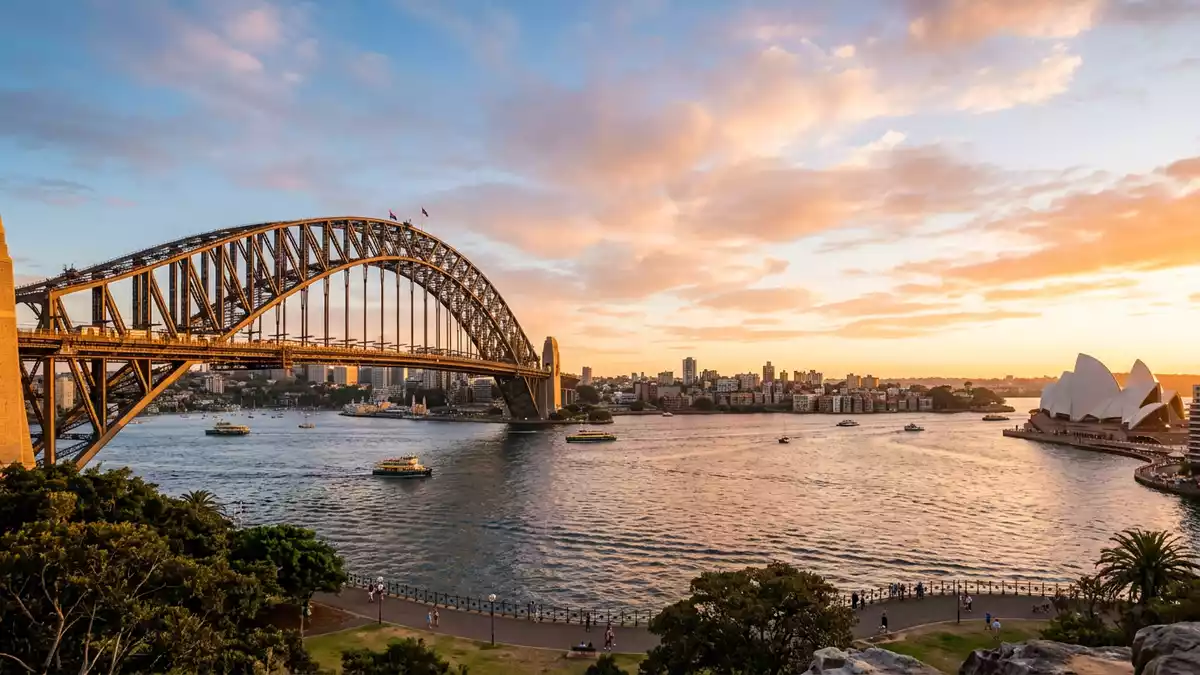
Sydney Harbour Bridge is the great steel arch that strides across Sydney Harbour, carrying road, rail and walkways between the city centre and the northern shore while framing one of Australia’s most recognisable waterfronts. Built in the early twentieth century and officially opened on 19 March 1932, it has become a defining structure for Sydney’s relationship with its harbour waters. With a total length of 1,149 m (3,770 ft) including its approaches and an arch span of about 503 m (1,650 ft), the bridge presents itself as a vast piece of engineering as well as a prominent outdoor space for everyday movement.
A steel arch linking two sides of the harbour
The defining feature of Sydney Harbour Bridge is its through arch of structural steel, rising to about 134 m (440 ft) above the water and carrying the deck across the main harbour channel between the central business district and the North Shore. The bridge crosses the harbour between the historic Rocks and Circular Quay precincts on the southern shore and Milsons Point near North Sydney on the northern side, making the span a direct connector between commercial streets and residential districts. The arch runs roughly north–south, positioned just west of the harbour inlet that leads towards the Sydney Opera House, so the bridge often appears together with the opera house in wide views across the water.between The Rocks and Milsons Point The steelwork of the arch carries both road lanes and rail tracks, as well as footpaths, giving the structure a role as a transport corridor as much as a landmark.
Along its deck, Sydney Harbour Bridge combines multiple transport modes on a single structure, including railway tracks, a highway with several traffic lanes, and pedestrian and cycle ways placed on the outer edges of the deck. The width of the bridge is recorded at about 48.8 m (160 ft), making room for these parallel routes across the water.railroad tracks, a highway, and two pedestrian walkways This arrangement lets trains run directly between the city centre and northern suburbs, while motor traffic uses a multi-lane roadway above the harbour. On the outer edges, people on foot and on bicycles share the bridge with vehicles, giving the arch a steady flow of everyday movement.
Building a twentieth-century engineering landmark
Plans for a crossing of Sydney Harbour date back to the nineteenth century, but the scheme that led to Sydney Harbour Bridge took shape in the early decades of the twentieth century as engineers and governments sought a single-span solution over the deep harbour waters. Construction began in the early 1920s, with the general period of building recorded from 1923 to 1932, and the project involved thousands of workers assembling large quantities of steel and other materials into the rising arch and its approaches.construction of the Sydney Harbour Bridge spanned almost a decade, from 1923 to 1932 The steelwork for the bridge totals over 50,000 tonnes according to official figures, reflecting the scale of the components needed to reach across the harbour and support the deck.53,000 tonnes of steel were used
Engineers arranged for the arch to be built simultaneously from both sides of the harbour, with the two halves advancing towards one another until they met near the centre of the span in 1930. Heavy cables anchored into the ground held the incomplete sections until the connection point was reached, after which the deck was installed between the granite-faced pylons and across the arch. The approach spans extended the total length of the bridge to 1,149 m (3,770 ft), providing continuous roadway and rail access from the surrounding street network to the main crossing.total length of bridge 1149 metres When Sydney Harbour Bridge was opened on 19 March 1932, celebrations marked the completion of a major public works project that reshaped travel patterns around Sydney Harbour.the bridge was opened to traffic on 19 March 1932
Experiencing the bridge from deck to pylons
For visitors, Sydney Harbour Bridge is not only a piece of infrastructure but also an accessible vantage point over the harbour and the city skyline. The pedestrian walkway on the eastern side of the deck offers long views towards the Sydney Opera House and down the harbour channel, while the western side cycleway and footpaths look out to Balmain and other inner suburbs. At both ends of the main span stand granite-faced pylons, built on massive concrete abutment towers that support the arch and frame the entrance to the bridge. These pylons rise to about 89 m above mean sea level and sit on bases roughly 68 m across, giving them a substantial presence as stone-clad markers of the crossing.granite facing used on pylons and piers Their detailing contrasts with the exposed steelwork of the arch, combining masonry surfaces with riveted girders and trusses.
Above the deck, the steel arch rises in a continuous curve, assembled from panels chained together with millions of hand-driven rivets. Official figures record about six million rivets in the bridge, along with heavy bearing pins and hangers that connect the arch to the deck and distribute loads. The arch can move slightly with changes in temperature, with an allowance of several centimetres for expansion and contraction built into its design.the arch may rise or fall 18 centimetres due to heating or cooling These technical details give a sense of the engineering behind the simple outline that appears against the sky. At its highest point the arch also carries an aircraft beacon, reaching a recorded height of about 141 m above mean sea level, helping mark the bridge for navigation by air as well as by water.height of aircraft beacon 141 metres
Visiting Sydney Harbour Bridge: what travellers from Western Europe should know
- Sydney Harbour Bridge spans Sydney Harbour between the Rocks and Circular Quay on the southern side and Milsons Point near North Sydney on the northern shore, and is reached on foot, by road or by rail from central Sydney and nearby suburbs.
- The bridge deck stands high above the harbour waters, and access to the pedestrian walkways involves stairways and ramps that rise from street level to the deck, so a visit to the bridge includes walking on inclined approaches and along extended paths exposed to the elements.
- The official language is English and the currency is the Australian dollar.
- Entry requirements depend on your nationality; UK travellers can check the FCDO travel advice at gov.uk/foreign-travel-advice, Irish travellers the Department of Foreign Affairs at ireland.ie.
Searching for Sydney Harbour Bridge on social platforms
These links open searches for Sydney Harbour Bridge on each platform.
Frequently asked questions about Sydney Harbour Bridge
Where is Sydney Harbour Bridge located in Sydney?
Sydney Harbour Bridge crosses the main harbour between the Rocks and Circular Quay on the southern side and Milsons Point near North Sydney on the northern shore, just west of the inlet beside the Sydney Opera House.
What can visitors expect when walking across Sydney Harbour Bridge?
Visitors walking across Sydney Harbour Bridge follow elevated paths along the deck with views over the harbour and city skyline, climbing via stairs or ramps from street level to the bridge and then continuing along extended, exposed walkways above the water.
What makes Sydney Harbour Bridge distinctive among large bridges?
Sydney Harbour Bridge is distinctive for its single steel through arch spanning about 503 m across Sydney Harbour, its width of roughly 48.8 m accommodating road, rail and footpaths side by side, and its prominent granite pylons framing the entrances to the crossing.


