
Sydney Harbour Bridge and its great steel arch over Sydney Harbour
Published on 09/01/2026 at 06:28 | Editorial responsibility: Rafael Müller, Editor-in-Chief AD HOC NEWS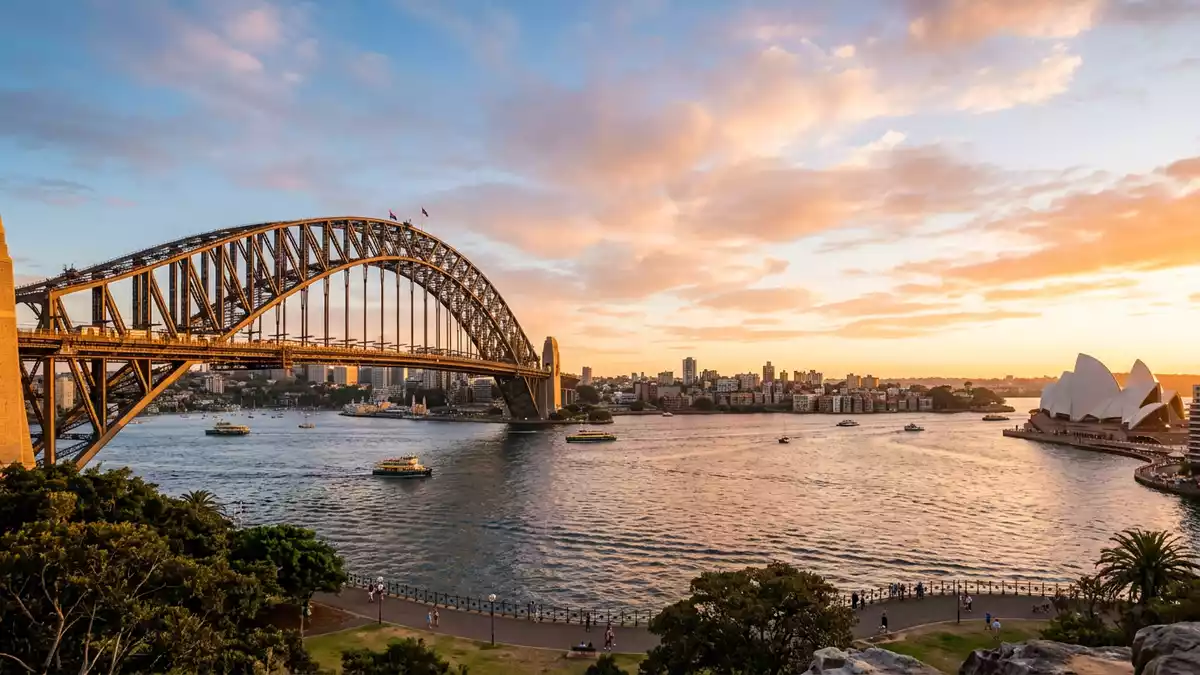
Sydney Harbour Bridge is the great steel arch that strides across Sydney’s Port Jackson, linking the historic waterfront at Dawes Point with Milsons Point on the northern shore. Completed in 1932, it has become as closely associated with Australia’s largest city as the harbour itself, its dark steelwork framing the water and skyline in a single sweeping span.
A steel arch that defines the harbour
The core of Sydney Harbour Bridge is a through-arch of structural steel, with the roadway and rail deck carried beneath it rather than running along the top. The arch connects Dawes Point on the south side of the harbour with Milsons Point on the north, creating a direct link between the city centre and the northern suburbs.steel arch spanning the harbour From the approaches at either end to the highest point of the arch, the bridge runs to a total length of about 1,149 m (3,770 ft), and at its crown the steel rises around 134 m (440 ft) above the water, giving deep clearance for shipping beneath.total length and height
The bridge deck carried under the arch is wide enough to take multiple road lanes, railway tracks, a cycleway and pedestrian paths side by side, a width of about 48.8 m (160 ft) that once made Sydney Harbour Bridge the widest long-span bridge in the world.deck width and configuration The arch itself reaches roughly 503 m (around 1,650 ft) between its bearings, placing it among the longest steel arch spans built, and earning the bridge a reputation as the tallest major steel arch structure because of the distance from the water to the top of the arch.arch span and status
Building an Australian engineering landmark
Construction of Sydney Harbour Bridge began in the early 1920s, with large-scale steelwork assembly starting after foundations and approach structures were in place. The bridge was officially opened to traffic on 19 March 1932, a date still closely tied to its identity and now used for formal heritage listings.opening on 19 March 1932 To create the arch, engineers designed two matching halves that were built outwards from each shore, meeting high above the harbour before the deck and services were completed.
The scale of the structure is reflected in the quantities of material recorded. More than 52,000 tonnes of structural steel were used in the bridge as a whole, with well over 39,000 tonnes in the arch, and the members are fastened together by about six million hand-driven rivets.steel tonnagerivets and steel for the build The four pylons that stand at the corners of the main span give the bridge a visual frame and help anchor the approaches, although the arch itself carries the primary loads.
Heritage status and everyday life on the bridge
Sydney Harbour Bridge is more than a piece of infrastructure; it is formally recognised as a place of national heritage significance in Australia. It is entered on the New South Wales State Heritage Register and was added to the National Heritage List in March 2007, in the “Historic” class, a listing that covers the steel arch, its approaches and associated parkland around Bradfield Highway at Dawes Point and Milsons Point.State and National Heritage listing
At the same time, the bridge continues to serve as a major transport artery across the harbour, carrying road vehicles, suburban and regional trains, cyclists and pedestrians between central Sydney and the north shore.multi-modal structure Walkways on the bridge give views along the arch and across to landmarks such as the Sydney Opera House and the city’s waterfront districts, while the steel itself, often nicknamed “The Coathanger”, reads as a piece of early twentieth-century engineering on a vast scale.nickname and harbour setting
Visiting Sydney Harbour Bridge: what travellers from Western Europe should know
- Sydney Harbour Bridge crosses Port Jackson between Dawes Point and Milsons Point, immediately north of Sydney’s central business district, and carries both road traffic and railway lines.
- The bridge deck is high above the harbour, with pedestrian paths reached by stairways and ramps, and the approaches involve gradients and flights of steps that may matter to less mobile visitors.
- The structure stands alongside central Sydney districts and faces the harbour, so views from the bridge take in the Sydney Opera House, Circular Quay and the wider harbour shoreline.
- The official language is English and the currency is the Australian dollar.
- Entry requirements depend on your nationality; UK travellers can check the FCDO travel advice at gov.uk/foreign-travel-advice, Irish travellers the Department of Foreign Affairs at ireland.ie.
Searching for Sydney Harbour Bridge on social platforms
These links open searches for Sydney Harbour Bridge on each platform.Frequently asked questions about Sydney Harbour Bridge
Where is Sydney Harbour Bridge and what does it connect?
Sydney Harbour Bridge crosses Port Jackson between Dawes Point near central Sydney and Milsons Point on the north shore, carrying road, rail and footpaths across the harbour.
What should visitors expect when walking on the bridge?
Pedestrians use elevated paths along the bridge deck, reached by stairs and ramps, with long views over the harbour, the Sydney Opera House and the city waterfront.
What makes Sydney Harbour Bridge distinctive among major bridges?
Its steel arch span of about 503 m and height of roughly 134 m above the water, combined with a very wide deck and formal heritage recognition, give the bridge a distinctive place among large steel arch structures.


