Suwon Hwaseong fortress: a planned walled city in stone and brick
Published on 09/04/2026 at 08:04 | Editorial responsibility: Rafael Müller, Editor-in-Chief AD HOC NEWS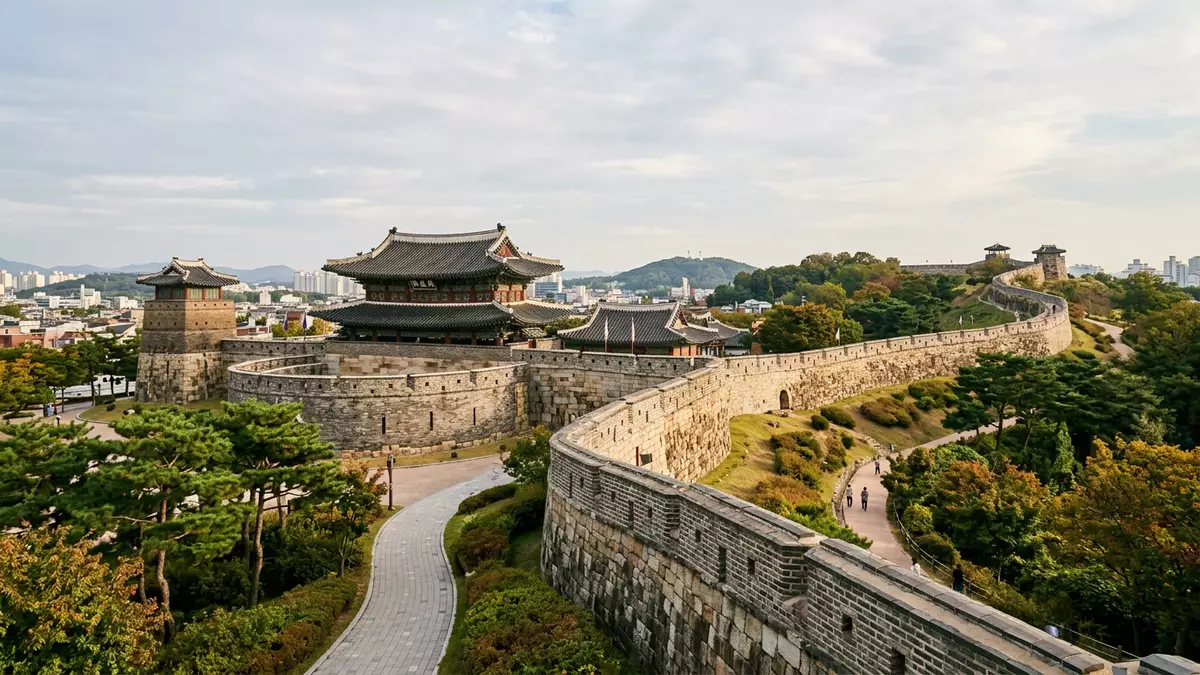
Suwon Hwaseong is a late eighteenth-century fortress that wraps a planned city and palace complex in stone and brick walls around the slopes of Paldalsan in Suwon, South Korea. Built under King Jeongjo of the Joseon dynasty in the 1790s, it combines traditional Korean forms with new military engineering to encircle a sizeable urban area.
A Joseon-era fortress planned as a city
The story of Suwon Hwaseong begins in the reign of King Jeongjo, the twenty-second ruler of the Joseon dynasty, who decided in 1789 to relocate the tomb of his father, Crown Prince Sado, to the Suwon area and establish a new township below Paldalsan. The fortress was then built to surround and protect this newly planned city, turning Suwon into an administrative centre enclosed by defensive walls.Hwaseong Fortress, Suwon, was built by King Jeongjo Construction records kept at the time show that the walls and associated facilities were built over a period from 1794 to 1796, an unusually rapid schedule for such an extensive fortification.records document the 32-month construction
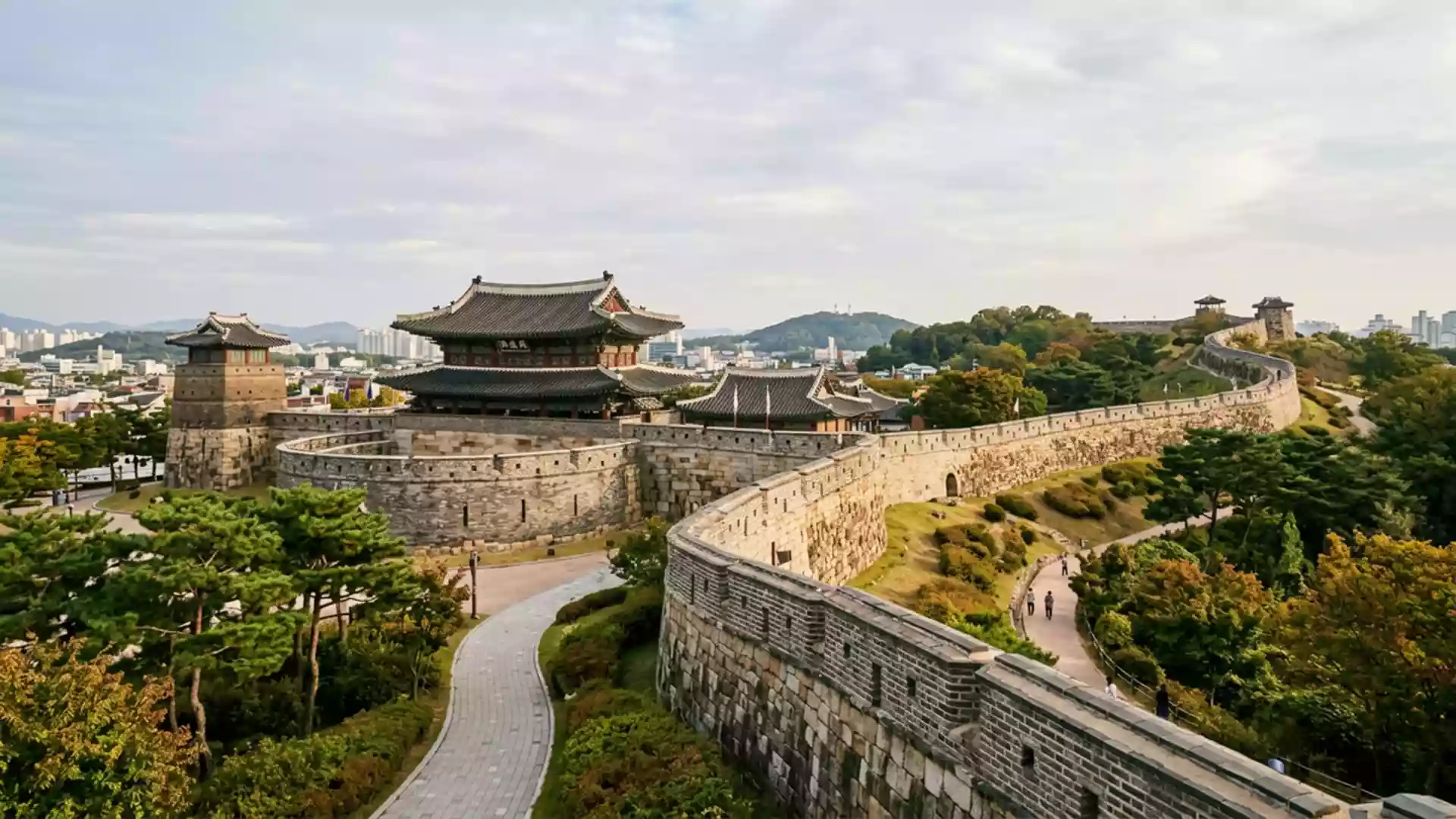
The fortress forms a complete circuit around the old centre of Suwon, following the contours of the hills and low ground rather than imposing a strict geometric plan. Its walls were designed as both a defensive perimeter and a boundary for the planned town within, with four main gates giving access at different points and a network of roads aligned with those gates. Within the enclosure lay the royal Hwaseong Haenggung palace, administrative buildings and residential quarters, making the fortress one of the few Korean walled cities whose urban layout and fortifications were conceived at the same moment.Hwaseong Fortress is a fortification surrounding the old city centre of Suwon
Walls, gates and watchtowers on the slopes of Paldalsan
Suwon Hwaseong is built in piled stone and brick, a combination that distinguishes it from many earlier Korean fortresses constructed primarily in stone. The walls extend for about 5.74 km (3.57 mi) in circumference and enclose an area of roughly 130 ha (321 ac), rising and falling with the topography as they cross streams and hills and loop around Paldalsan.the massive walls of the fortress, which are 5.74 km in length, enclose an area of 130 ha Along this circuit stand a series of bastions, command posts, turrets and platforms, designed to give defenders overlapping fields of view and fire in the age of cannon and firearms.
The main city gates form some of the most recognisable structures of Suwon Hwaseong. Each gate combines a stone base with a multi-storey wooden pavilion, creating a layered profile against the hillside. Between the gates, the wall incorporates guard posts and beacon towers, as well as floodgates where streams pass under the fortifications. On the upper slopes of Paldalsan, the walls provide elevated views across Suwon and towards the distant mountains, underlining the way the fortress was sited to control both the town and the surrounding approaches.the fortress walls, 4–6 m in height, stretch over a distance of 5.74 km to encompass an area of 130 ha
UNESCO World Heritage and meticulous records
Suwon Hwaseong is recognised as a cultural World Heritage Site and was inscribed on the UNESCO list in 1997 for its combination of architectural innovation and historical documentation.the Hwaseong Fortress, located in Suwon, was registered as a World Heritage site by UNESCO in 1997 The fortress also holds the status of National Treasure number 3 in South Korea, reflecting its importance within the country’s heritage system.Hwaseong Fortress, Suwon, designated as National Treasure number 3 The UNESCO inscription cites Hwaseong as an outstanding example of early modern military architecture that incorporates advanced features from both East Asian and Western fortification science.
Part of what makes Suwon Hwaseong distinctive is the survival of detailed construction records known as the Hwaseong Seongyeok uigwe, which document the planning and building of the fortress in words and illustrations. These records describe the organisation of labour, the materials used and the technologies applied, including mechanical devices adopted to speed up work on the slopes around Suwon.because a large portion of the original fortress was well preserved and the rest could be meticulously reconstructed from the extant original plans Combined with the preserved and restored structures on the ground, they make Hwaseong one of the best-documented fortress projects of the Joseon era, helping modern visitors and researchers understand how an eighteenth-century Korean walled city was conceived and realised.
Visiting Suwon Hwaseong: what travellers from Western Europe should know
- Suwon Hwaseong surrounds the historic centre of Suwon in Gyeonggi Province, south of Seoul, and can be reached by rail services from the capital to Suwon Station followed by local transport to the fortress area.
- The circuit of walls runs over hills and low ground, with sections involving stairways and slopes on Paldalsan as well as paved stretches through built-up streets.
- Within the walls lie the Hwaseong Haenggung palace complex and residential districts, so a visit combines fortifications, urban streets and landscaped courtyards in one walkable area.
- The official language is Korean and the currency is the South Korean won; entry requirements depend on your nationality, UK travellers can check the FCDO travel advice at gov.uk/foreign-travel-advice, Irish travellers the Department of Foreign Affairs at ireland.ie.
Searching for Suwon Hwaseong on social platforms
These links open searches for Suwon Hwaseong on each platform.Frequently asked questions about Suwon Hwaseong
Where is Suwon Hwaseong and what does it enclose?
Suwon Hwaseong surrounds the historic centre of Suwon in Gyeonggi Province, South Korea, enclosing urban streets, the Hwaseong Haenggung palace and administrative quarters.
What can visitors expect when walking the fortress?
Visitors encounter stone and brick walls, gates with wooden pavilions, watchtowers and slopes on Paldalsan, with sections of the circuit passing both hillside paths and built-up streets.
What makes Suwon Hwaseong distinctive among Korean fortresses?
Suwon Hwaseong combines a planned walled city, extensive eighteenth-century construction records and a World Heritage listing that recognises its early modern military architecture.