
Suwon Hwaseong and the walls that shape Suwon
Published on 08/28/2026 at 14:10 | Editorial responsibility: Rafael Müller, Editor-in-Chief AD HOC NEWS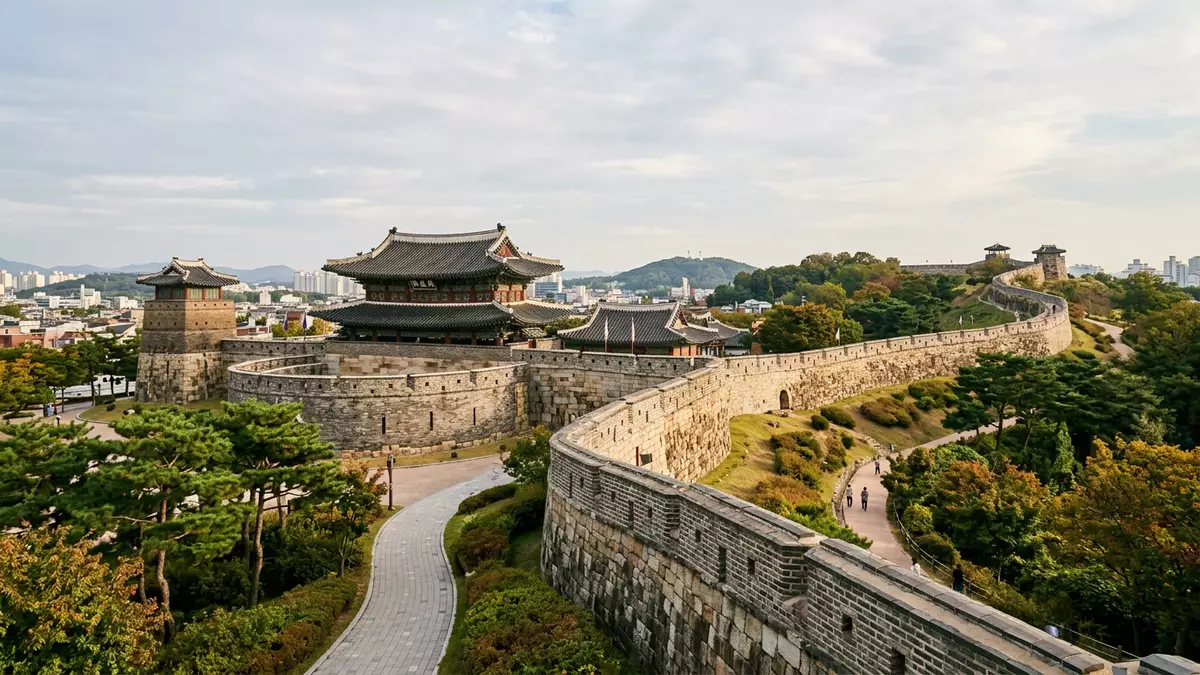
Suwon Hwaseong is the fortress that still wraps much of central Suwon in South Korea. Built under King Jeongjo of Joseon between 1794 and 1796, it brings stone, brick and water into one continuous circuit.
Walls, gates and a planned royal landscape
The fortress is linked to UNESCO World Heritage status and to the later history of Joseon planning. Its walls run for nearly 6 km and enclose the centre of Suwon, with four main gates and a range of defensive structures.
That circuit is the place’s strongest visual feature. The long walls, gates, bastions and artillery towers read as a single composition rather than separate monuments, and the stream through the centre adds another fixed line to the layout.
King Jeongjo, Joseon and the late eighteenth century
Suwon Hwaseong belongs to the reign of King Jeongjo, and the place is tied to the late eighteenth century. The fortress is a key work of the Joseon Dynasty, and its form reflects a period when military architecture and urban planning were closely linked.
Stone and brick give the walls a heavier look than the wooden pavilions that mark some of the gateways. The contrast between those materials is visible across the circuit, and it gives the fortress a layered character even without entering any individual building.
What survives inside the circuit
The enclosed area includes Suwoncheon, the main stream that runs through the fortress. The watercourse, gates and wall line make the site feel organised around movement, crossings and enclosure rather than around a single monumental building.
The heritage value of Suwon Hwaseong also lies in its mixture of elements: gates, towers, command posts and floodgates sit within the same defensible outline. That combination has made the place a major example of late Joseon fortification and city form.King Jeongjo appears here as a named historical figure, not just a distant royal title.
Visiting Suwon Hwaseong: what travellers from Western Europe should know
- The fortress sits in Suwon, south of Seoul, and the walls surround the city centre. Suwon Station and the surrounding city streets provide the usual access points.
- The circuit follows both flat ground and rising slopes. Some stretches involve steps, uneven surfaces and changes in height along the wall line.
- The four gates and several towers remain the most recognisable parts of the complex. The stream through the centre gives the site a clear east-west axis.
- English-language material about the fortress is available through heritage and tourism channels. The main name in English remains Suwon Hwaseong.
Searching for Suwon Hwaseong on social platforms
These links open searches for Suwon Hwaseong on each platform.
Frequently asked questions about Suwon Hwaseong
Where is Suwon Hwaseong?
It is in Suwon, in South Korea, and it surrounds much of the city centre. The fortress lies south of Seoul.
What can be seen on a visit?
The main walls, gates, towers and stream crossings are the clearest elements. The site reads as a fortified circuit with a strong urban setting.
What makes Suwon Hwaseong distinctive?
Its late Joseon date, UNESCO status and mix of stone, brick and timber make it stand out as a planned fortress landscape. The walls also keep the city’s centre within a single historic outline.


