
Suwon Hwaseong and the wall that follows the city
Published on 09/22/2026 at 08:53 | Editorial responsibility: Rafael Müller, Editor-in-Chief AD HOC NEWS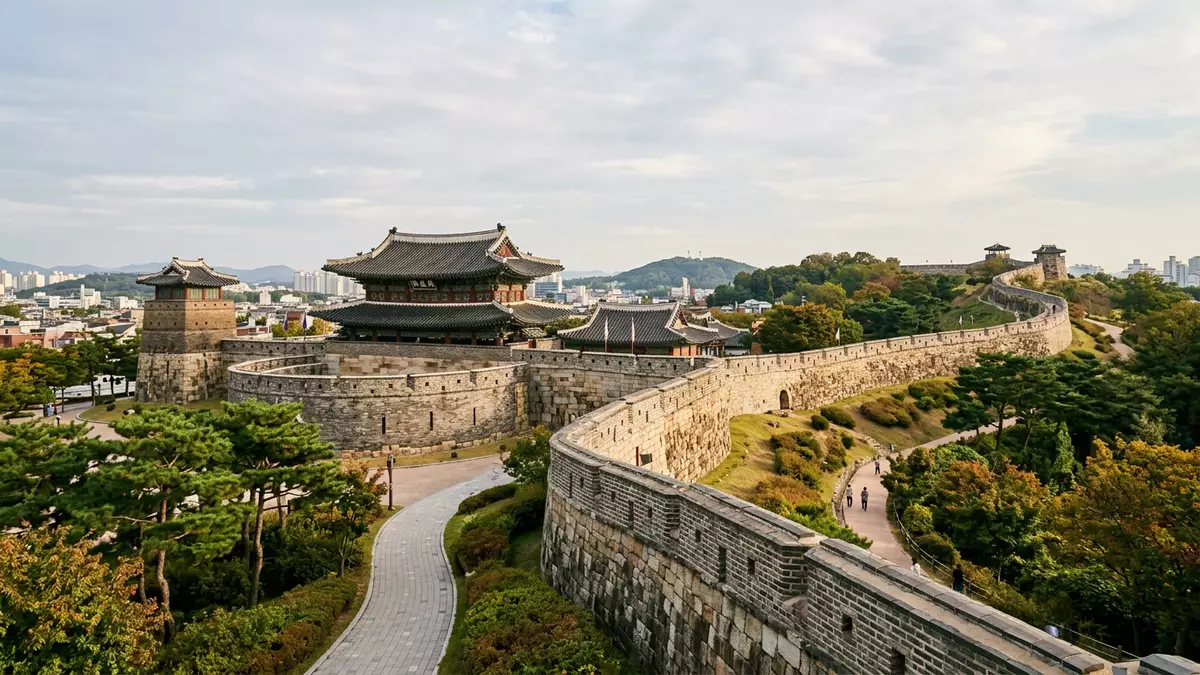
Suwon Hwaseong is a 5.74-kilometre fortress wall wrapped around the centre of Suwon in South Korea. Built from piled stone and brick between 1794 and 1796 under King Jeongjo of the Joseon Dynasty, it crosses hills, flat ground and the Suwoncheon stream. Its wall is not a detached monument: gates, platforms, towers, a palace and city streets remain closely connected within the historic enclosure.
Suwon Hwaseong: a fortress shaped across the city
The wall follows the land around Suwon instead of forming a simple geometric enclosure. It surrounds an area of 130 hectares and rises across the slopes of Paldalsan, with lower ground extending towards the stream. This changing setting gives the fortress its visible character: masonry climbs, bends, descends and meets urban roads.
The 5.74-kilometre fortress walls contain fired brick alongside stone. Their circuit includes gates, bastions, artillery towers, command posts, observation towers, secret gates, beacon facilities and floodgates. The arrangement belongs to late eighteenth-century military architecture, yet it also forms an urban boundary that remains legible across Suwon.
King Jeongjo and the Joseon frontier of power
King Jeongjo, the twenty-second ruler of Joseon, ordered Hwaseong during the late eighteenth century. Construction began in January 1794 and ended in September 1796, producing a fortified city with a royal palace inside its walls.
King Jeongjo’s fortress project was accompanied by detailed records, including the Hwaseong Seongyeok Uigwe. The record preserves information about plans, labour, materials and construction equipment. Jeong Yak-yong contributed technical ideas to the project through writings that brought together knowledge from East Asian and European sources.
Hwaseong Haenggung stands within the fortified area at the foot of Paldalsan. A haenggung was a detached palace used by a monarch away from the principal court. The Suwon palace combined royal accommodation with administrative spaces, linking the fortress to the political life of Joseon.
Four gates, waterworks and a palace inside
The principal gates mark the four cardinal directions. Janganmun faces north, Paldalmun faces south, Hwaseomun faces west and Changnyongmun faces east. Janganmun and Paldalmun are two-storey wooden gate buildings on stone bases, while Hwaseomun and Changnyongmun have single-storey gate structures.
The southern Paldalmun remains surrounded by modern streets, while the northern Janganmun connects the wall to the city’s central routes. At Hwahongmun, a water gate crosses the Suwoncheon. Its openings carry the stream beneath the fortification, while a pavilion rises above the watercourse.
The four principal gates are part of a larger defensive system. Bastions project from the wall, platforms support artillery positions, and observation structures provide elevated points along the circuit. The fortress therefore reads as a sequence of connected military spaces rather than as a wall alone.
Hwaseong received UNESCO World Heritage status in 1997. The designation covers the wall, gates and defensive structures, while the surrounding city remains an active part of Suwon. The combination of stone, brick, timber, water and urban streets gives the site its distinctive physical language.
Visiting Suwon Hwaseong: what travellers from Western Europe should know
- Suwon Hwaseong surrounds central Suwon in Gyeonggi Province. Suwon Station connects with Seoul Subway Line 1, and buses continue towards the fortress district.
- The circuit crosses Paldalsan and lower urban ground. Walking involves slopes, steps and uneven changes in level beside masonry, gates and streams.
- Named points along the circuit include Janganmun, Paldalmun, Hwaseomun, Changnyongmun, Hwahongmun and Hwaseong Haenggung.
- The official language is Korean and the currency is the South Korean won.
- Entry requirements depend on your nationality; UK travellers can check the FCDO travel advice at gov.uk/foreign-travel-advice, Irish travellers the Department of Foreign Affairs at ireland.ie.
Searching for Suwon Hwaseong on social platforms
These links open searches for Suwon Hwaseong on each platform.Frequently asked questions about Suwon Hwaseong
Where is Suwon Hwaseong?
Suwon Hwaseong surrounds the centre of Suwon in Gyeonggi Province, South Korea. The wall includes hills, streets, gates and the Suwoncheon stream.
What can visitors expect at Suwon Hwaseong?
The site combines a long wall circuit with gates, bastions, water facilities, watchtowers and Hwaseong Haenggung. The route includes slopes and changes in ground level.
What makes Suwon Hwaseong distinctive?
Its 5.74-kilometre wall joins piled stone, brick, timber gates, defensive structures and an urban centre. King Jeongjo completed the fortress in 1796 during the Joseon period.


