
Suwon Hwaseong and the stone walls of Joseon
Published on 09/23/2026 at 01:58 | Editorial responsibility: Rafael Müller, Editor-in-Chief AD HOC NEWS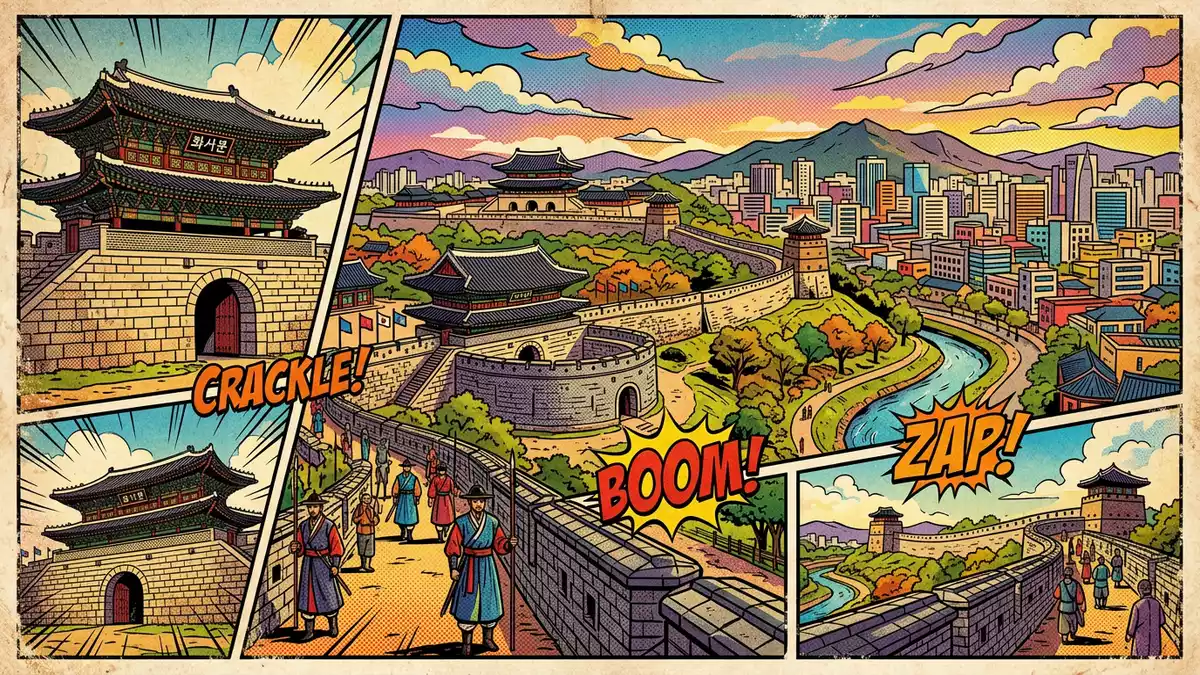
Suwon Hwaseong is a late-eighteenth-century fortress surrounding the historic centre of Suwon in South Korea. Its walls combine piled stone, fired brick, gates and military structures across a long route shaped by the terrain.
Suwon Hwaseong as a walled Joseon city
King Jeongjo of the Joseon dynasty ordered Hwaseong between 1794 and 1796. The fortress became part of Suwon’s planned urban landscape, enclosing streets, civic buildings and the royal complex associated with the city.
The name Hwaseong means “Brilliant Fortress”. Its surviving fabric belongs to the reign of Jeongjo, the twenty-second king of Joseon, and reflects the engineering culture of the late eighteenth century. The fortress was inscribed on the UNESCO World Heritage List in 1997 through its UNESCO World Heritage status.
Gates, bastions and changing materials
The walls extend for about 5.7 kilometres around Suwon. Stone courses form the main mass, while brick appears in defensive details, parapets and protective structures around the gates.
Janganmun Gate marks the northern side, and Paldalmun Gate stands in the south. Hwaseomun and Changnyongmun complete the principal gates at the other cardinal points. Their forms differ, with the northern and southern gates rising as two-storey wooden structures on stone bases.
Along the wall are observation towers, command posts, floodgates, beacon towers, bastions and concealed passages. The Suwoncheon stream passes through the enclosed area, adding water, bridges and a second line of movement to the fortified landscape.
Jeongjo, Suwon and the record of construction
Hwaseong is connected with Crown Prince Jangheon, Jeongjo’s father, whose remains were moved to the Suwon area. The fortress and its city setting belong to a period when royal authority, Confucian family duty and administrative reform were closely connected.
Construction began in January 1794 and concluded in September 1796. The work was recorded in the Hwaseong Seongyeok Uigwe, a detailed account of the fortress project. Its surviving documentation forms part of Hwaseong’s cultural significance, alongside the masonry and timber structures.
The completed fortress combined military architecture with an urban plan. This relationship remains visible in the roads passing through the gates, the wall route crossing Paldalsan, and the buildings gathered around the historic centre. The Suwon Hwaseong introduction records Jeongjo’s role and the construction period.
Hwaseong also belongs to the history of Joseon technical knowledge. Its design used stone and brick together, placed defensive installations along the circuit, and joined royal, civic and military spaces within one city. The result is a fortress that can be read as both a wall and an urban framework.
Visiting Suwon Hwaseong: what travellers from Western Europe should know
- Suwon Hwaseong surrounds central Suwon, south of Seoul. Suwon Station connects the city with the national railway and metropolitan rail network.
- The wall route crosses Paldalsan and includes gradients, steps and uneven masonry surfaces. Walking the circuit involves exposed sections and changes in elevation.
- Janganmun, Paldalmun, Hwaseomun and Changnyongmun mark the principal cardinal entrances. The gates connect the fortress with Suwon’s surrounding streets.
- The official language is Korean and the currency is the South Korean won.
- Entry requirements depend on your nationality; UK travellers can check the FCDO travel advice at gov.uk/foreign-travel-advice, Irish travellers the Department of Foreign Affairs at ireland.ie.
Searching for Suwon Hwaseong on social platforms
These links open searches for Suwon Hwaseong on each platform.
Frequently asked questions about Suwon Hwaseong
Where is Suwon Hwaseong?
Suwon Hwaseong surrounds the historic centre of Suwon in Gyeonggi-do Province, South Korea. Suwon lies south of Seoul.
What can visitors expect at the fortress?
The site includes a long wall route, gates, bastions, towers, floodgates and urban streets. Parts of the route cross Paldalsan and include steps and gradients.
What makes Suwon Hwaseong distinctive?
Its identity comes from the union of a Joseon royal city, a 5.7-kilometre fortress circuit and a documented construction period from 1794 to 1796.


