Suwon Hwaseong, a living Joseon fortress above Suwon
Published on 09/08/2026 at 22:24 | Editorial responsibility: Rafael Müller, Editor-in-Chief AD HOC NEWS
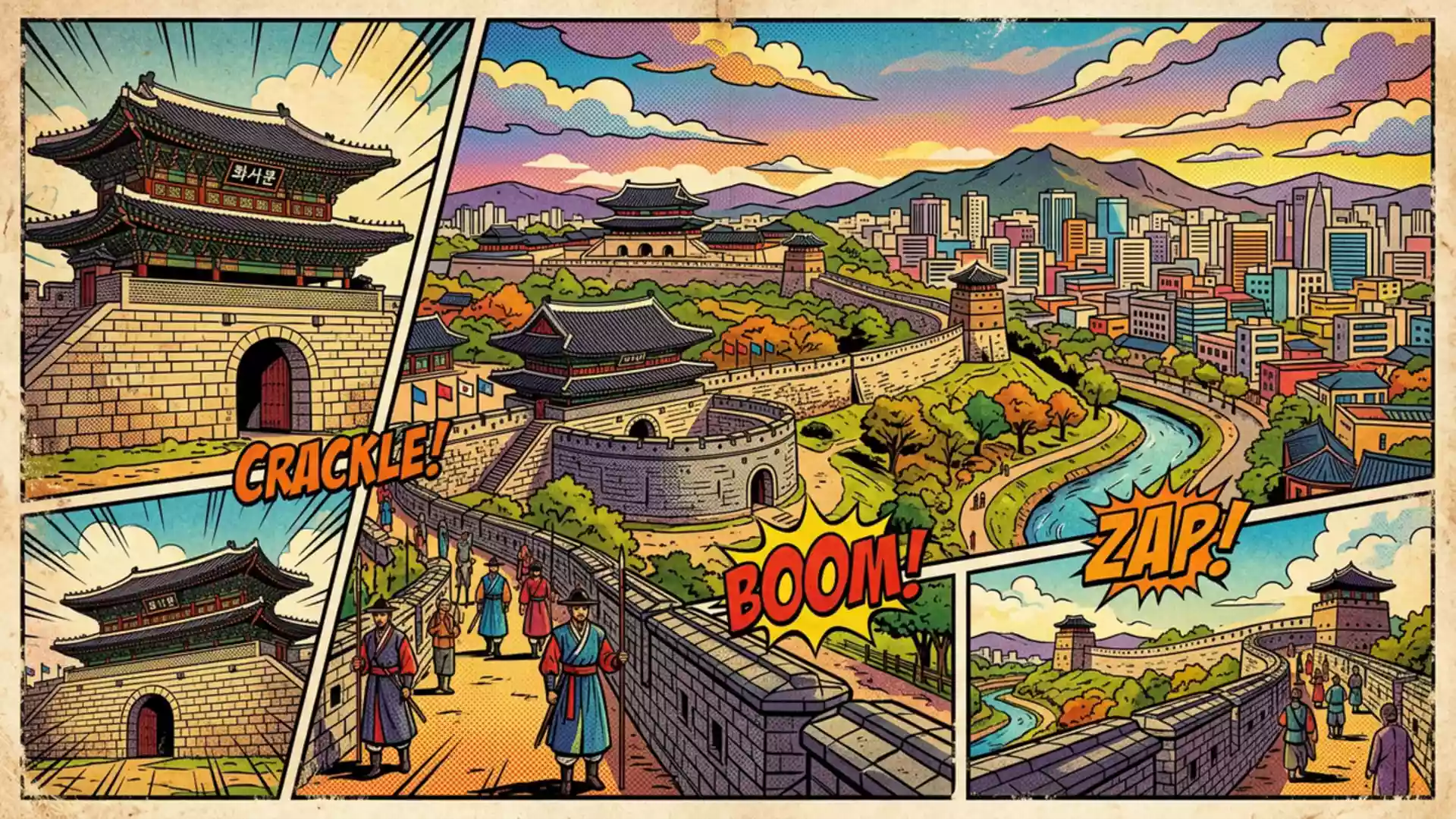
Suwon Hwaseong, also known as Hwaseong Fortress, wraps around central Suwon with a continuous line of late eighteenth-century walls, gates and watchtowers that still define the city’s outline. Commissioned by King Jeongjo of the Joseon dynasty and completed in 1796, it remains one of the clearest encounters with fortified urban planning from that period in Korea.
Joseon ambition in stone and brick
The fortress belongs to the Joseon dynasty, which ruled Korea from 1392 to 1910, and it was built on the orders of King Jeongjo, the 22nd monarch of that line.a piled-stone and brick fortress surrounds what is now the centre of Suwon in Gyeonggi Province, south of Seoul. Its walls follow the natural rises and dips of the terrain, so that the structure reads as much as a man-made ridge as a piece of military architecture.
Construction began in 1794 and was finished in 1796, an unusually short period for a project that encircles a large urban core.the fortress was built between 1794 and 1796 under King Jeongjo King Jeongjo relocated the tomb of his father, Crown Prince Sado, to the Suwon area and tied the new city and its fortifications to that act of remembrance.the fortress is closely associated with Crown Prince Sado’s relocated tomb The result is both a defensive perimeter and a statement of royal authority in masonry.
Walking the walls and main gates
The walls of Suwon Hwaseong trace a circuit of roughly 5.7 km (3.5 mi), enclosing hills, streets and low-lying ground in one continuous sweep.the walls stretch for approximately 5.7 kilometres They rise and fall in height, typically between about 4.9 and 6.2 m (16–20 ft), and incorporate stone foundations with brickwork above.the walls reach between 4.9 and 6.2 metres in height The route includes sections that crest a low summit at Paldalsan Mountain and drop back towards busier streets.
Along this line stand substantial gate complexes, pavilions and bastions. Four principal gates pierce the walls on the cardinal points, including Paldalmun to the south and Janganmun to the north, each accompanied by an elaborate superstructure of timber and tiled roofs.access to the walled city historically ran through four main gates Between them are command posts, observation points and fortified protrusions that look outwards over surrounding districts, giving a sense of how the fortress once controlled movement into and out of the city.
UNESCO World Heritage and city life
Hwaseong Fortress is recognised internationally as a World Heritage Site, having been inscribed on the UNESCO list in 1997.the site was inscribed on the UNESCO World Heritage List in 1997 The designation highlights its value as a late Joseon military work that drew on both Korean and imported engineering ideas, documented in contemporary manuals. It also underlines the rare survival of such a complete walled circuit around a functioning provincial city.
Within the perimeter stood Hwaseong Haenggung, a temporary palace used by King Jeongjo on visits to Suwon, and the fortress is interwoven with Suwon’s present-day streets and houses.the walls enclose much of central Suwon and its royal Hwaseong Haenggung palace Visitors encounter stretches of wall rising behind residential lanes, gates facing busy junctions and guard posts aligned with modern parks, giving a continuous sense of how eighteenth-century defences and contemporary city life occupy the same ground.
Visiting Suwon Hwaseong: what travellers from Western Europe should know
- Suwon Hwaseong stands in Suwon, in Gyeonggi Province in South Korea, south of Seoul, and is reached by onward travel from the capital’s main transport hubs.
- The circuit of walls includes stairways, sloping paths and sections that climb Paldalsan Mountain, so parts of a visit involve sustained walking on gradients and steps.
- The official language is Korean and the currency is the South Korean won.
- Entry requirements depend on your nationality; UK travellers can check the FCDO travel advice at gov.uk/foreign-travel-advice, Irish travellers the Department of Foreign Affairs at ireland.ie.
Searching for Suwon Hwaseong on social platforms
These links open searches for Suwon Hwaseong on each platform.Frequently asked questions about Suwon Hwaseong
Where is Suwon Hwaseong located?
Suwon Hwaseong encircles central Suwon in Gyeonggi Province, in South Korea, south of Seoul.
What can visitors expect when exploring the fortress?
Visitors encounter long sections of stone and brick wall, major gates such as Paldalmun and Janganmun, watchtowers, bastions and views over the surrounding cityscape.
What makes Suwon Hwaseong distinctive among Korean fortifications?
The fortress combines an almost complete walled circuit from the late eighteenth century with documented Joseon-era engineering and a rare level of integration into a living provincial city.