

Suomenlinna: a sea fortress across Helsinki’s islands
Published on 08/27/2026 at 12:56 | Editorial responsibility: Rafael Müller, Editor-in-Chief AD HOC NEWS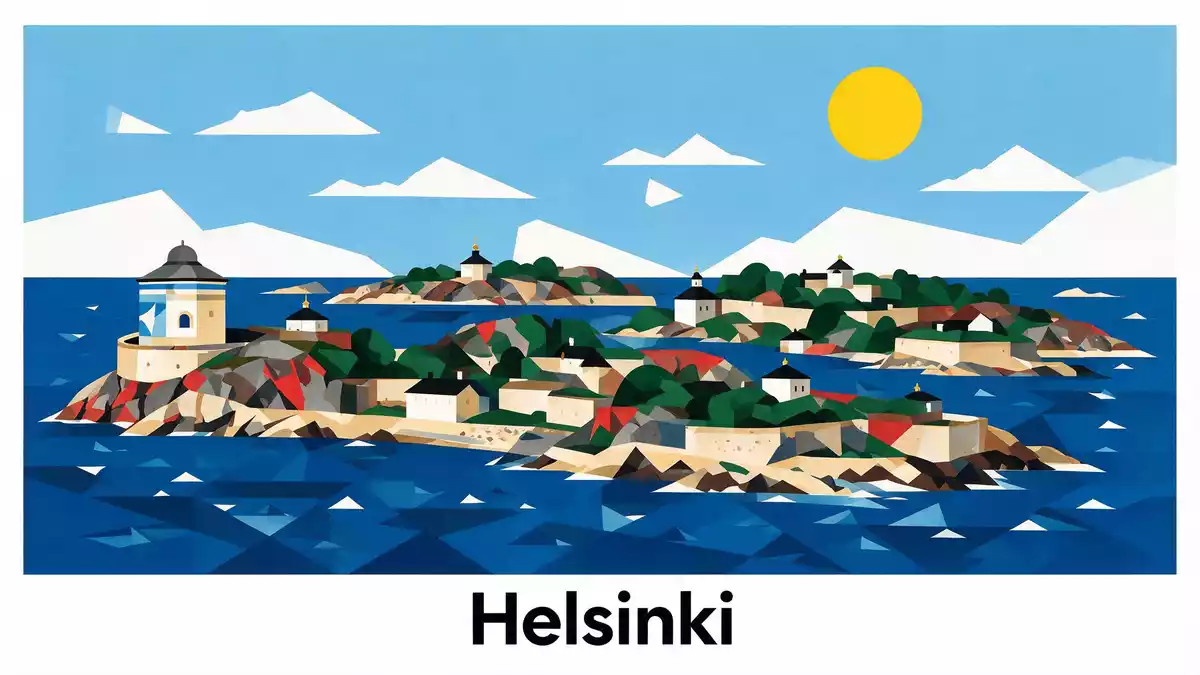
Suomenlinna turns a scatter of low Baltic islands off Helsinki into a continuous landscape of stone walls, earth ramparts and narrow streets. Begun in 1748 during the Swedish era and inscribed on the UNESCO World Heritage List in 1991, it combines an eighteenth?century sea fortress with a residential district that still forms an official part of Finland’s capital.
An eighteenth?century fortress on the water
Suomenlinna, also known by its Swedish name Sveaborg, is a sea fortress built on a group of islands at the mouth of Helsinki’s harbour in the Gulf of Finland. Construction of the fortifications began in 1748, when Finland formed part of the Kingdom of Sweden and the crown developed a maritime stronghold facing the Baltic approaches to the city.Construction of the fortress began in 1748 The work was directed by the Swedish officer Augustin Ehrensvärd, whose name still appears on monuments within the complex.Construction led by Augustin Ehrensvärd
The fortress spreads across several islands, tied together by bridges and causeways so that the defensive lines facing the sea run almost unbroken from one rock outcrop to the next.Situated on a group of islands off Helsinki Massive stone walls follow the contours of the islands, backed by earth ramparts and pierced by vaulted passages that link courtyards, bastions and casemates. From many points within the fortress, the visitor sees both the Baltic beyond and the skyline of central Helsinki on the mainland.
Layers of Swedish, Russian and Finnish history
Suomenlinna’s fabric carries the marks of three successive realms. Under Swedish rule in the eighteenth century, the complex took shape as a bastion fortress with an irregular outline, reflecting the Vauban?influenced military engineering of its time.A bastion fortress with an irregular shape Its bastions, ravelins and dry ditches form geometric patterns visible when walking along the tops of the ramparts, where the angular profiles of the defences step down towards the rocky shoreline.
Control of the fortress shifted in 1808–1809, during the conflict that made Finland an autonomous Grand Duchy within the Russian Empire, and the complex became a Russian naval base for more than a century.The fortress was surrendered to the Russian army in 1809 Barracks, storehouses and artillery positions from this period stand alongside earlier Swedish structures, forming a layered streetscape of stone, brick and timber. After Finland declared independence in 1917, the new republic took over the fortress in 1918 and adopted the Finnish name Suomenlinna, meaning “Castle of Finland”.The fortress was renamed Suomenlinna in 1918
A living district and World Heritage landscape
Suomenlinna has functioned as more than a museum of fortification. Over the twentieth century the Finnish Defence Forces maintained units in the fortress, and after the garrison departed in 1973 the complex developed as a mixed district of housing, workshops, cultural institutions and visitor services.Built over a period of three centuries and now a residential district of Helsinki Granite walls and earthworks frame courtyards where residential buildings stand beside former military structures, and public paths cross parade grounds that serve as communal open spaces.
The Fortress of Suomenlinna was inscribed as a cultural World Heritage Site in 1991, recognised as an outstanding example of eighteenth?century European military architecture in a coastal setting.Inscribed on the World Heritage List in 1991 The combination of bastion defences, naval docks, barracks and civilian quarters underlines how the islands evolved from a purely military base into a lived?in district of Helsinki, where ferries, low?rise housing, cafes and studios share space with gun positions and powder magazines.
Visiting Suomenlinna: what travellers from Western Europe should know
- Suomenlinna stands on islands south of central Helsinki, reached by ferries that run from the city’s harbour across the short stretch of the Gulf of Finland.
- The terrain combines paved lanes, cobbled paths and grassed ramparts, with slopes and flights of steps between different levels of the fortifications.
- On some sections of the walls the paths run close to drops towards the sea, and in wet weather the rock and grass surfaces can be slippery underfoot.
- The official language is Finnish and the currency is the euro.
Searching for Suomenlinna on social platforms
These links open searches for Suomenlinna on each platform.
Frequently asked questions about Suomenlinna
Where is Suomenlinna?
Suomenlinna stands on a group of islands off the southern shore of Helsinki in southern Finland, reached across the Gulf of Finland from the city’s harbour.
What should visitors expect on a visit?
Visitors encounter stone walls, earth ramparts, courtyards and narrow streets spread across several islands, with ferries, housing and services integrated into the old fortress.
What makes Suomenlinna distinctive?
Suomenlinna combines an eighteenth?century sea fortress, built from 1748 under Augustin Ehrensvärd, with a living district of Helsinki recognised as a UNESCO World Heritage Site.


