
Sumela Manastiri on a cliff above the Alt?ndere valley
Published on 09/22/2026 at 03:51 | Editorial responsibility: Rafael Müller, Editor-in-Chief AD HOC NEWS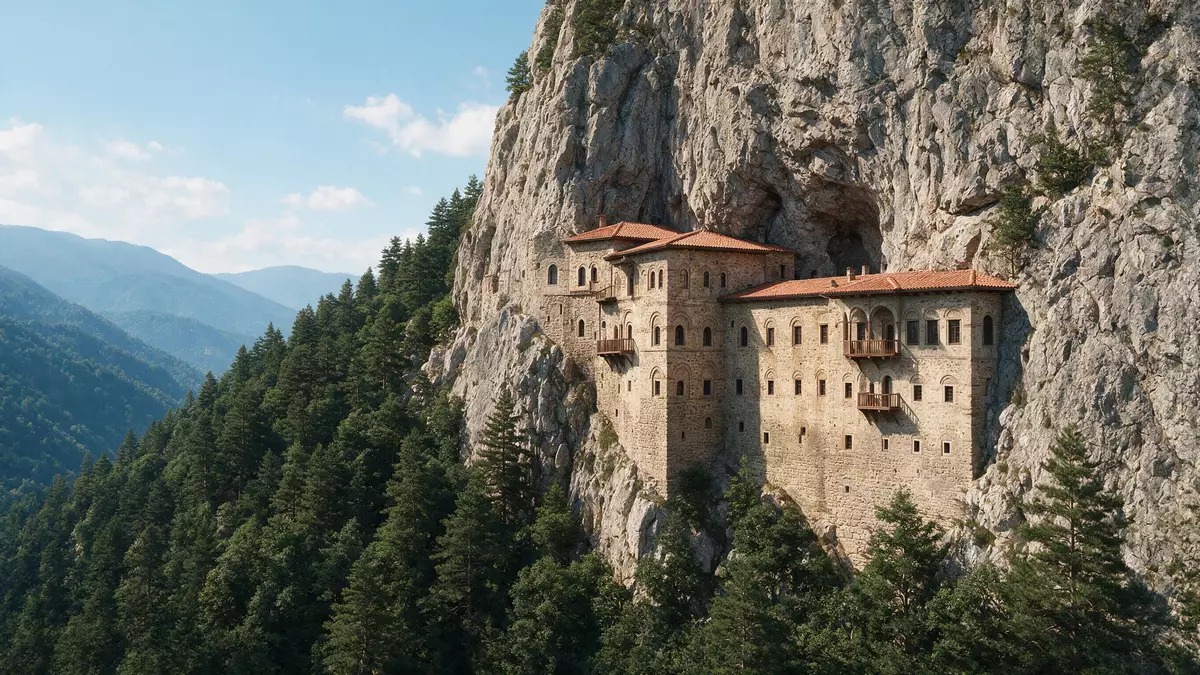
Sumela Manastiri rises from a steep cliff in Trabzon province, above the Alt?ndere valley, with rock, masonry and frescoed walls compressed into one vertical composition. The monastery is linked with the reign of Theodosius I and with Barnabas and Sophronios, names that anchor its long historical reach.
Sumela Manastiri and its cliffside setting
The monastery occupies the face of Karada?, the mountain also associated with its Greek name, Panagia Soumela. Its setting is the most immediate part of its identity: a religious complex attached to rock, looking across the valley rather than spreading across level ground.UNESCO tentative list
Sumela Manastiri is traditionally linked to the fourth century and to the reign of Theodosius I, with later phases under the Komnenos rulers of Trebizond. The form visible today belongs to a much longer sequence of rebuilding and enlargement, rather than a single building campaign.Turkish ministry history page
Layers of construction and painted interiors
The complex combines chapels, living quarters, retaining walls and external terraces in stone. That mixture gives Sumela Manastiri a layered appearance, with the rock face reading almost as part of the architecture.
Its frescoes are among the best-known interior features. Painted saints, framed niches and weathered surfaces give the monastery a strong visual link to its Orthodox past, while also showing the effects of age and exposure.Trabzon cultural history
From monastic centre to heritage landscape
Sumela Manastiri was used for centuries as an Orthodox monastery and remained part of the religious landscape of the region under Byzantine and Ottoman rule. Its later history includes abandonment after the 1923 population exchange, which left the cliffside complex as a historical site rather than an active monastic house.
The monastery belongs to the wider heritage of Trabzon, where the Black Sea hinterland preserves traces of the Empire of Trebizond, Byzantine religious culture and Ottoman administration. That layered regional context matters as much as the buildings themselves, because the site makes those overlapping periods visible in stone and paint.heritage recordhistorical overview
Visiting Sumela Manastiri: what travellers from Western Europe should know
- The monastery lies in the Maçka district of Trabzon province, facing the Alt?ndere valley. It is reached through the mountain landscape south of Trabzon.Maçka district
- The approach includes steep ground and a cliffside setting. The buildings sit high above the valley floor, and the setting is one of its defining features.cliff setting
- The official language is Turkish and the currency is the Turkish lira.
- The complex sits in a mountain landscape where rock, forest and altitude frame the site. That makes the surrounding terrain part of the visit rather than a background detail.mountain setting
Searching for Sumela Manastiri on social platforms
These links open searches for Sumela Manastiri on each platform.
Frequently asked questions about Sumela Manastiri
Where is Sumela Manastiri?
It stands in Trabzon province, in the Maçka district above the Alt?ndere valley. The monastery is built into a steep cliff in the Pontic mountain landscape.
What should a visit be expected to involve?
The site combines stone buildings, terraces and a mountain approach. The setting is elevated and uneven, with the complex attached directly to the cliff.
What makes Sumela Manastiri distinctive?
Its cliffside position and long monastic history make it immediately recognisable. The link between the rock face, the stone structures and the painted interiors gives it a strong visual identity.


