
Sumela Manastiri: a cliff-hanging monastery above Trabzon
Published on 08/30/2026 at 11:46 | Editorial responsibility: Rafael Müller, Editor-in-Chief AD HOC NEWS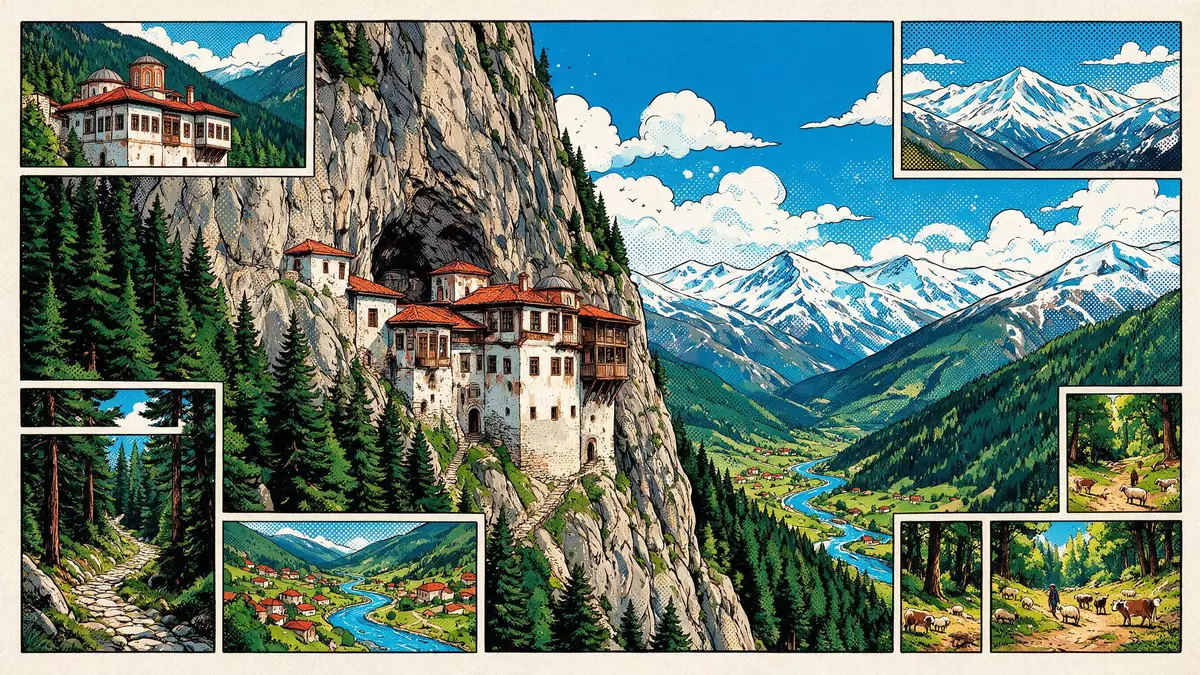
Sumela Manastiri is a former Greek Orthodox monastery turned museum, built into a steep cliff high above a forested valley in the Pontic Mountains south of Trabzon in Turkey. Rising at about 1,200 m (3,937 ft) above sea level on the slopes of Karada? Mountain near Maçka, it forms a compact stone complex that appears to hang from the rock face when seen from below.Pontic Mountains location
A monastery carved into a Black Sea cliff
Sumela Manastiri occupies ledges and recesses of a near-vertical cliff overlooking the Alt?ndere valley within Alt?ndere Valley National Park, a protected landscape of dense forest and steep ravines.Altindere National Park From a distance, the main buildings form a band of pale masonry set against dark rock, with retaining walls and terraced platforms catching the eye long before any detail of the architecture is visible. The monastery is reached by a path through the trees, where the sound of water from the valley below accompanies the climb.
The built ensemble includes several ranges of stone buildings, chapels, courtyards and service structures arranged on terraces cut into the mountainside.cliff monastery description Exterior walls follow the irregularities of the rock, with masonry bonded directly to the cliff and supported in places by buttressed foundations. Above, rocky overhangs shelter parts of the complex and create a dramatic backdrop to the façades, while below, the gorge drops sharply, emphasising the sense of height and isolation that characterises Sumela Manastiri.
Byzantine origins and Komnenian patronage
Sumela Manastiri traces its origins to the Byzantine period and is traditionally dated to the fourth century AD, when monastic life spread widely through the eastern Mediterranean.Byzantine-era foundation Historical accounts link its founding to the reign of Emperor Theodosius I in the late fourth century, giving the site a history of more than a thousand years of Christian worship in this remote corner of the Pontic range.Theodosius I period Over the centuries, the monastery complex expanded, with successive phases of rebuilding and extension reflecting changes in Byzantine and later regional power.
In the thirteenth century, after the establishment of the Empire of Trebizond, Sumela Manastiri benefited from imperial patronage under the Komnenos dynasty, particularly during the reign of Alexios III between 1349 and 1390.Alexios III Komnenos patronage Imperial edicts granted income to the monastery, supporting the construction of larger residential buildings and more elaborate decoration. Later centuries brought further restoration and expansion, especially in the eighteenth and nineteenth centuries, when new wings, staircases and service buildings were added and interior walls acquired extensive fresco cycles depicting biblical scenes and figures.
Architecture, frescoes and present-day museum
The core of Sumela Manastiri consists of a main church and auxiliary chapels, surrounded by monastic housing, kitchens, storerooms and an inner courtyard interconnected by stairways and narrow passages.monastic complex layout The principal church is partly embedded into the rock, with masonry walls meeting the cliff behind. Its interior and exterior surfaces carry frescoes that, despite damage and weathering, retain vivid colours and detailed iconographic compositions. Many depict scenes from the New Testament, ranks of saints and ornamental borders typical of late Byzantine and post-Byzantine painting.
After the population exchanges and political changes of the early twentieth century, Sumela Manastiri ceased functioning as a working monastery and its buildings eventually became a museum under Turkish cultural authorities.museum status and WHS tentative list Conservation programmes have stabilised the cliff-side structures and conserved the frescoes, while access paths and viewing areas have been organised to accommodate visitors. The monastery’s cliff-top position, combined with its long monastic history and layered architecture, makes it a key site for understanding the religious and cultural landscape of the eastern Black Sea region.
Visiting Sumela Manastiri: what travellers from Western Europe should know
- Sumela Manastiri lies in the Maçka district of Trabzon Province, on the slopes of Karada? Mountain within Alt?ndere Valley National Park south of Trabzon, and is reached by road into the park followed by an uphill walk through forested terrain from the vehicle drop-off point.
- The approach to the monastery involves mountain paths and stairways with a sustained gradient, and movement within the complex uses narrow passages and flights of steps between terraces at significant altitude.
- The official language is Turkish and the currency is the Turkish lira.
- Entry requirements depend on your nationality; UK travellers can check the FCDO travel advice at gov.uk/foreign-travel-advice, Irish travellers the Department of Foreign Affairs at ireland.ie.
Searching for Sumela Manastiri on social platforms
These links open searches for Sumela Manastiri on each platform.
Frequently asked questions about Sumela Manastiri
Where is Sumela Manastiri located?
Sumela Manastiri stands on a steep cliff in the Pontic Mountains within Alt?ndere Valley National Park in the Maçka district of Trabzon Province in north-eastern Turkey.
What should visitors expect during a visit?
Visitors follow mountain paths and stairways through forest to reach a stone monastic complex of terraces, chapels and courtyards built directly against the cliff at high altitude.
What makes Sumela Manastiri distinctive?
Sumela Manastiri combines a long Byzantine and Komnenian monastic history with dramatic cliff-side architecture, extensive fresco decoration and a setting above a deep valley in the Black Sea mountains.


