
Sultanahmet Camii and the architecture of cascading domes
Published on 09/23/2026 at 07:13 | Editorial responsibility: Rafael Müller, Editor-in-Chief AD HOC NEWS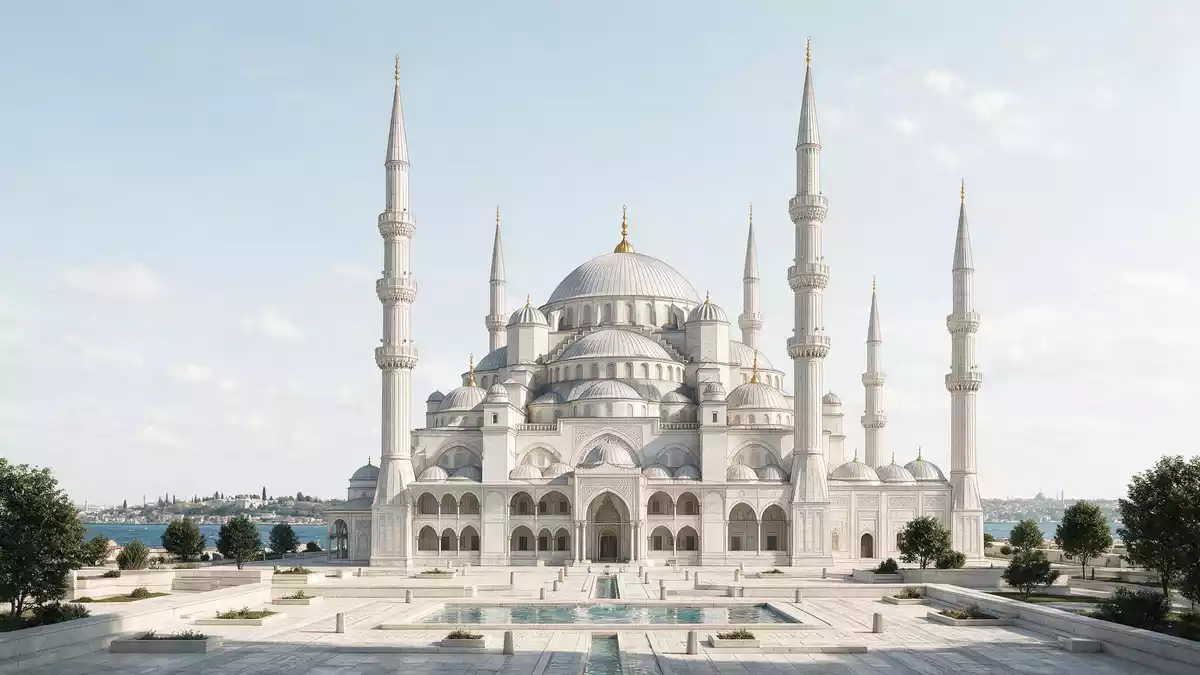
Sultanahmet Camii rises beside Istanbul’s historic Hippodrome, its central dome surrounded by descending half-domes and smaller domes. Built between 1609 and 1616 under Sultan Ahmed I, the Ottoman mosque is also known in English as the Blue Mosque.
Sultanahmet Camii: a skyline of domes and minarets
The building’s most visible feature is its layered roofline. A broad central dome sits above the prayer hall, while smaller domes and semi-domes descend towards the courtyard and surrounding walls. Six slender minarets frame the complex, giving the mosque a strongly vertical outline.
Sedefkâr Mehmed A?a served as architect. His work belongs to the classical Ottoman tradition, whose large imperial mosques combine a centralised prayer space, domed roofing, courtyards and tall minarets. The mosque’s construction between 1609 and 1616 places it in the early seventeenth century.
Blue Iznik tiles inside the imperial mosque
The name Blue Mosque comes from the interior, where blue Iznik tiles form a major part of the wall decoration. Their colours include shades of blue, turquoise and white, set among floral and geometric designs. The tiles belong to the visual language of Ottoman decorative art.
Stained-glass windows, painted surfaces and calligraphic panels add further layers to the interior. The prayer hall retains a clear relationship between its central dome, supporting arches and surrounding galleries. Lamps hang beneath the domed roof, while carpets cover the floor used for prayer.
The mosque is an active place of worship. Its religious function remains visible in the arrangement of the prayer hall, the direction of worship and the separation between the courtyard and the interior. The blue interior tilework provides the building’s familiar English name.
Sultan Ahmed I and the seventeenth-century Ottoman setting
Sultan Ahmed I commissioned the mosque during his reign from 1603 to 1617. Construction began in 1609 and produced a large religious complex with the mosque at its centre. The surrounding külliye included educational, charitable and funerary elements associated with imperial mosque foundations.
Sultanahmet Camii occupies the historic peninsula of Istanbul, near Hagia Sophia and the former Hippodrome. The location brings together Ottoman and Byzantine layers of the city’s architectural history. The mosque’s courtyard, ablution fountain and prayer hall form a connected sequence of monumental spaces.
The six minarets remain an important part of the building’s identity. Four stand around the prayer hall, while two are associated with the courtyard. Their arrangement extends the mosque’s composition beyond the domes and walls into the surrounding cityscape. The six-minaret design is recorded among its defining architectural features.
Sultanahmet Camii forms part of the Historic Areas of Istanbul, inscribed on the UNESCO World Heritage List in 1985. Its setting includes major monuments from the Byzantine and Ottoman periods, with the mosque occupying a prominent position beside the public spaces of Sultanahmet.
Visiting Sultanahmet Camii: what travellers from Western Europe should know
- Sultanahmet Camii stands in Istanbul’s Sultanahmet district, beside the former Hippodrome and close to Hagia Sophia. The T1 tram serves the historic peninsula.
- The approach crosses paved public spaces and the mosque’s courtyard. The prayer hall is reached through an entrance sequence that includes steps and changes between outdoor and indoor surfaces.
- The official language is Turkish and the currency is the Turkish lira.
- The mosque is an active place of worship. Visitors encounter a religious interior, a courtyard, ablution features and a prayer hall beneath the central dome.
Searching for Sultanahmet Camii on social platforms
These links open searches for Sultanahmet Camii on each platform.
Frequently asked questions about Sultanahmet Camii
Where is Sultanahmet Camii?
Sultanahmet Camii is in the Sultanahmet district on Istanbul’s historic peninsula. It stands beside the former Hippodrome, near Hagia Sophia.
What can visitors expect inside?
The interior contains blue Iznik tiles, stained-glass windows, calligraphic decoration and a prayer hall beneath a large central dome. The mosque remains an active place of worship.
What makes Sultanahmet Camii distinctive?
Its combination of cascading domes, blue tilework and six minarets gives the Ottoman mosque its recognisable architectural character. Sultan Ahmed I commissioned it, and Sedefkâr Mehmed A?a served as architect.


