
Sultanahmet Camii and its sea of blue Ottoman domes
Published on 08/21/2026 at 06:29 | Editorial responsibility: Rafael Müller, Editor-in-Chief AD HOC NEWS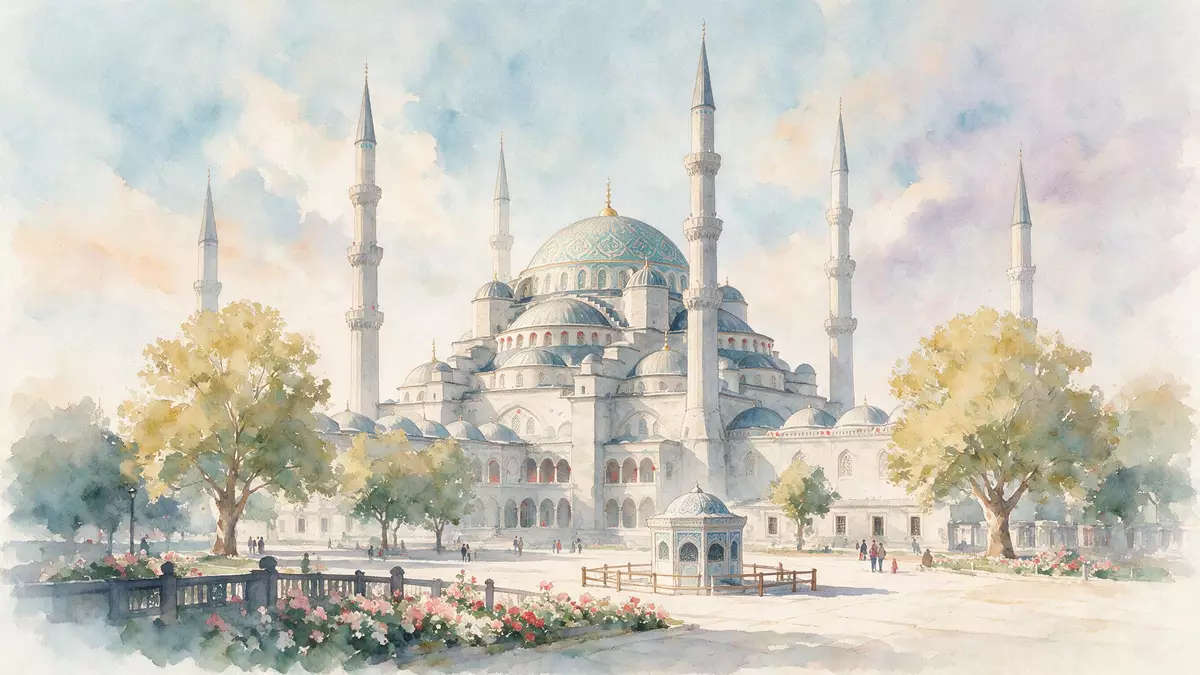
Sultanahmet Camii, widely known as the Blue Mosque or Sultan Ahmed Mosque, is an early seventeenth?century imperial mosque in Istanbul whose interior is lined with blue ?znik tiles and crowned by a high central dome framed by six slender minarets.early seventeenth?century mosque Commissioned by Sultan Ahmed I during his reign and completed between 1609 and 1616 under court architect Sedefkâr Mehmed A?a, it stands in the historic district of Fatih on Istanbul’s peninsula, directly facing Hagia Sophia across the former Byzantine Hippodrome.commissioned by Sultan Ahmed I
A mosque built as a cascading mountain of domes
The most striking feature of Sultanahmet Camii as it rises over the Sultanahmet district is its composition of domes and semidomes, led by a central dome about 43 m (141 ft) high and roughly 23.5 m (77 ft) across.dimensions of the central dome From the square beside the Hippodrome, the mosque appears like a stepped stone mountain, the main dome supported on four massive internal pillars and surrounded by smaller domes that descend towards the outer walls and courtyard.
This layered roofline is part of a long development in Ottoman mosque architecture, and Sultanahmet Camii is often described as a culmination of the classical period.classical Ottoman mosque design The architect Sedefkâr Mehmed A?a, a pupil of Mimar Sinan, used repeated semi?domes to buttress the main dome and to generate a continuous interior canopy, while outside these volumes form a sculpted skyline that mirrors the rolling hills of the historic peninsula.role of Sedefkâr Mehmed A?a
Blue tiles, stained glass and a vast prayer hall
Inside, Sultanahmet Camii is arranged around a single expansive prayer hall beneath the main dome, its floor covered with carpets and its walls lined with tens of thousands of handmade ceramic tiles from ?znik in shades of blue, turquoise and green.?znik tiles lining the interior These tiles carry floral and arboreal motifs, including stylised tulips and cypress trees, and above them the upper walls and vaults are painted with blue?toned patterns that continue the colour theme.
The hall is punctuated by a carved marble minbar positioned so that the imam’s voice carries across the space, and by a mihrab set in the qibla wall indicating the direction of Mecca.carved marble minbar Light enters through several hundred stained?glass windows set into the drum of the dome and the surrounding walls, their coloured panes filtering daylight over the tilework and stone. Hanging lamps and chandeliers are suspended low over the prayer area, creating a secondary horizontal layer below the soaring vaults and visually tying the high architecture to the ground plane.
Six minarets, a courtyard and the historic setting
Sultanahmet Camii is distinguished by six stone minarets, more than the four that are common on many Ottoman imperial mosques, arranged around the mosque and its outer precinct.six minarets From the tram stop at Sultanahmet, their vertical shafts frame views of the mosque’s domes as travellers cross the square towards the main courtyard.
The courtyard itself is almost as wide as the prayer hall and is enclosed by arcades, giving a layered transition from the surrounding streets into the interior.large central courtyard Around the mosque, the complex once known as the Sultan Ahmed külliye included structures such as a madrasa and other service buildings, integrating religious, educational and social functions within a single urban ensemble.Sultanahmet Camii complex The site sits beside Sultanahmet Square, on the footprint of the former Hippodrome of Constantinople, so the mosque’s outer walls stand within sight of ancient Roman monuments and Ottoman palace precincts.
Visiting Sultanahmet Camii: what travellers from Western Europe should know
- Sultanahmet Camii stands in the Fatih district on Istanbul’s historic peninsula, facing Hagia Sophia across Sultanahmet Square and beside the former Hippodrome.
- The mosque is reached on foot from Sultanahmet tram station on the Kabata?–Ba?c?lar line, with the route crossing open paving and a gentle gradient.
- Within the mosque the prayer hall is accessed by broad entrances, and visitors who explore the exterior encounter stone paving and steps between the square, courtyard and surrounding streets.
- The official language of Turkey is Turkish and the currency is the Turkish lira.
- Entry requirements depend on your nationality; UK travellers can check the FCDO travel advice at gov.uk/foreign-travel-advice, Irish travellers the Department of Foreign Affairs at ireland.ie.
Searching for Sultanahmet Camii on social platforms
These links open searches for Sultanahmet Camii on each platform.
Frequently asked questions about Sultanahmet Camii
Where is Sultanahmet Camii in Istanbul?
Sultanahmet Camii stands in the Fatih district on Istanbul’s historic peninsula, overlooking Sultanahmet Square beside the former Hippodrome and facing Hagia Sophia.
What should visitors expect inside the mosque?
Visitors enter a large carpeted prayer hall under a high dome, with blue ?znik tiles, stained?glass windows, a carved marble minbar and a mihrab set in the qibla wall.
What makes Sultanahmet Camii distinctive among Istanbul’s mosques?
Sultanahmet Camii is distinctive for its six minarets, its cascading arrangement of domes and semidomes, and its extensive blue tilework that gives the interior its name.


