
Sultan Qaboos Grand Mosque: sandstone geometry in Maskat
Published on 09/12/2026 at 10:02 | Editorial responsibility: Rafael Müller, Editor-in-Chief AD HOC NEWS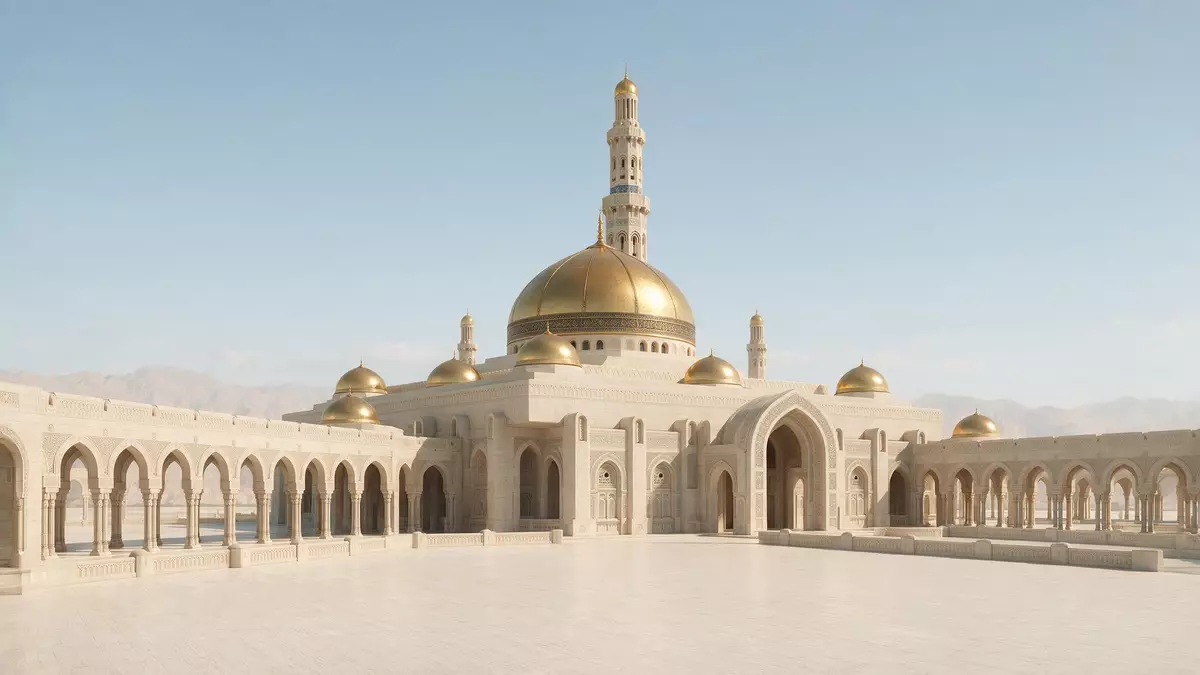
Sultan Qaboos Grand Mosque in Maskat is Oman’s principal Friday mosque, a contemporary Islamic complex completed in 2001 whose geometry and pale sandstone surfaces dominate the city’s western approach.
Sandstone, geometry and a vast urban site
The mosque stands in the Bausher district of Maskat, on a site that extends across about 416,000 square metres (102 acres) and reads almost as a self-contained precinct within the expanding capital.covers an estimated area of 416,000 square metres The complex itself occupies a smaller, rectilinear core within these grounds, framed by formal gardens, paved courtyards and long colonnades that mediate between the built structures and the surrounding roads.mosque complex occupying approximately 40,000 square meters
Construction followed a conceptual phase in the early 1990s and lasted for roughly six years, with inauguration taking place on 4 May 2001 under Sultan Qaboos bin Said.officially inaugurated on May 4, 2001 Iraqi architect Mohammed Saleh Makiya, working with London-based practice Quad Design, shaped the overall composition, while interior designer Edgard Bali developed the main prayer hall’s decorative programme.Quad Design with Mohamed Makiya (exterior); Edgard Bali (interior) The primary building material is Indian sandstone, specified in large quantities that give the mosque its luminous, almost white appearance under the Gulf light.30,000 tonnes of pink sandstone imported from India
The main prayer hall and its dome
At the heart of the complex lies the principal musalla, the main prayer hall reserved for men, laid out as a near-square space beneath a single dominant dome.The square musalla or main prayer hall The hall measures roughly 61 by 71 m in plan, a span that allows worshippers to gather on a single uninterrupted floor under the central canopy.The wide prayer hall measuring 61 x 71 meters Above, the dome rises around 50 m from the floor, forming a high internal volume ringed by layered muqarnas-like profiling and pierced by bands of windows that admit daylight to the patterned surfaces.features a central dome 50 meters in height
The floor of the main hall is covered by an enormous hand-woven carpet produced in Iran, stitched together as a single piece and frequently cited among the largest of its kind in the world.one of the largest single-piece hand-woven carpets globally Above it hangs a multi-tiered chandelier incorporating hundreds of thousands of cut crystals, suspended from the crown of the dome and forming a vertical counterpoint to the carpet’s horizontal expanse.a chandelier containing over 600,000 Swarovski crystals Together these two elements emphasise the hall’s scale and its role as the ceremonial centre of the complex, while the walls and columns carry marble cladding and inlaid stone that echo patterns seen in other Islamic traditions without copying any single precedent.
Minarets, courtyards and ancillary spaces
The mosque’s silhouette is defined by five minarets, a tall principal tower and four smaller ones at the corners of the main enclosure, an arrangement that explicitly evokes the Five Pillars of Islam.five minarets that define the mosque’s boundaries The tallest minaret reaches around 90 to 91.5 m, rising as a slender shaft above the surrounding buildings, while the four lateral towers are around 45 m high and mark the edges of the site.great minaret 90 metres tall and four lateral minarets, each 45 metres tall From ground level, these vertical elements are integrated with arcaded walkways and planted strips that lead visitors towards the central courtyard and the prayer halls.
Beyond the main musalla, the complex incorporates a separate women’s prayer hall, a library and a lecture theatre, each reached from the surrounding courtyards and cloisters.four main sections the main prayer hall women prayer hall library and the lecture theater Marble paving extends across tens of thousands of square metres, laid in geometric patterns that echo the mosque’s overall emphasis on ordered forms.entire pavement 24400 square metres formed by different types of marble The style as a whole has been described as contemporary Islamic, combining references to Ottoman, Persian and Omani traditions while remaining consistent with the restrained aesthetic associated with Ibadi Islam in Oman.completed in 2001 in a contemporary Islamic style
Visiting Sultan Qaboos Grand Mosque: what travellers from Western Europe should know
- Sultan Qaboos Grand Mosque stands in Maskat’s Bausher district along the main highway corridor that links the city centre with Maskat’s western suburbs and the international airport.
- The complex covers a large area with extensive paved courtyards, so a visit involves walking across marble surfaces and climbing staircases between the outer gardens and the main prayer halls.
- The grounds include manicured gardens and water features, and the mosque’s five minarets are visible from surrounding arterial roads, making the complex a useful orientation point within Maskat.
- The official language is Arabic and the currency is the Omani rial.
- Entry requirements depend on your nationality; UK travellers can check the FCDO travel advice at gov.uk/foreign-travel-advice, Irish travellers the Department of Foreign Affairs at ireland.ie.
Searching for Sultan Qaboos Grand Mosque on social platforms
These links open searches for Sultan Qaboos Grand Mosque on each platform.
Frequently asked questions about Sultan Qaboos Grand Mosque
Where is Sultan Qaboos Grand Mosque located?
Sultan Qaboos Grand Mosque is located in the Bausher district of Maskat, the capital of Oman, on a large site beside one of the city’s main highways.
What should visitors expect when entering the complex?
Visitors encounter extensive sandstone façades, marble courtyards, planted gardens and distinct men’s and women’s prayer halls, with the main square musalla and its high dome as the principal interior.
What makes Sultan Qaboos Grand Mosque distinctive among Oman’s religious buildings?
Its combination of a vast site, contemporary Islamic architecture, five tall minarets and monumental interior elements such as the single-piece carpet and crystal chandelier distinguish it within Oman’s mosque landscape.


