
Sultan Qaboos Grand Mosque, Maskat’s stone tapestry of faith
Published on 09/08/2026 at 20:08 | Editorial responsibility: Rafael Müller, Editor-in-Chief AD HOC NEWS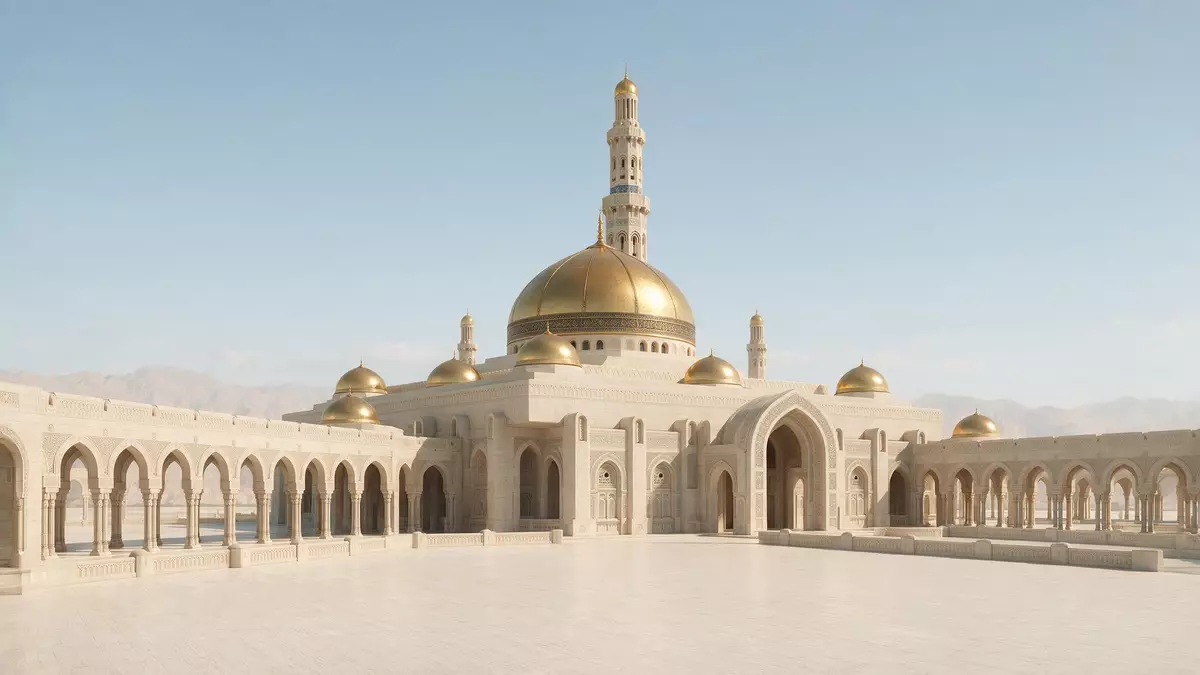
Sultan Qaboos Grand Mosque in Maskat is Oman’s principal Friday mosque, a contemporary Islamic complex where white sandstone, marble and geometric detail stretch across a vast plateau on the city’s south-western edge. Completed in 2001 as a national project under Sultan Qaboos bin Said, it brings together multiple Islamic artistic traditions in a single, carefully ordered space.
A grand square plan under a soaring central dome
The mosque occupies a large site in the Bawshar area of Maskat, with the overall grounds extending across about 416,000 m² (102 acres). At the core of this expanse sits a square prayer hall, laid out around a central dome that rises roughly 50 m (160 ft) above the floor, giving the main interior its defining volume.Square prayer hall and dome height Visitors enter the complex through high entrance arches, aligned on the principal minaret so that the tower stands framed at the far end of the paved forecourt.
Five minarets mark the edges of the mosque compound and underline the site’s symmetry. One stands significantly taller than the others, reaching about 91.5 m (300 ft), while four shorter towers rise to roughly 45 m (148 ft) at the corners of the main rectangular base.Principal and corner minarets The ensemble establishes a clear perimeter around the prayer halls, courtyards and gardens, with the tall central tower acting as a landmark visible across Maskat’s low-rise suburbs.
Sandstone, marble and crafted surfaces
Sultan Qaboos Grand Mosque is built largely from Indian sandstone, its pale walls catching the strong Omani light and setting a consistent tone for the entire complex.Sandstone walls and materials Across the forecourts and arcades, marble pavements are laid in geometric patterns, with different colours cut into precise bands and panels that emphasise the building’s orthogonal layout. The main approach axis is marked by sunken lines of dark marble converging visually on the principal minaret, a subtle device that draws attention along the spine of the site.
Inside, white and dark grey marble clads the lower walls, while carved plaster, timber and ornamental tile work articulate the higher surfaces.Interior marble wall cladding The main prayer hall is dominated by a vast hand-woven carpet, covering more than 4,000 m², and a central chandelier constructed from Swarovski crystal elements, both executed as single, continuous pieces rather than collections of smaller items.Large carpet and crystal chandelier Together they sit within a restrained palette, their fine detail set against the clean lines of the hall’s arches and columns.
Capacity, layout and the work of named architects
The complex was commissioned by Sultan Qaboos bin Said in the 1990s, with construction beginning in December 1994 and taking a little over six years before the inauguration on 4 May 2001.Commissioning and completion dates The Iraqi architect Mohammed Saleh Makiya led the design in collaboration with the London-based practice Quad Design, while interior work drew on specialists including Edgard Bali.Architects and designers Their scheme arranged the site around four main components: the central prayer hall, a separate women’s prayer hall, a library and a lecture theatre.
The main musalla is dimensioned to hold over 6,500 worshippers, with the adjoining women’s hall accommodating around 750. Arcades, courtyards and landscaped areas provide further prayer space, taking the overall capacity of the mosque complex to about 20,000 people for major gatherings.Main hall and overall capacity Beyond worship, the library and lecture facilities support religious and cultural education, framing the mosque as a centre of learning as well as prayer.
Visiting Sultan Qaboos Grand Mosque: what travellers from Western Europe should know
- Sultan Qaboos Grand Mosque stands in the Bawshar district of Maskat, south-west of the city centre, reached by road from Maskat’s coastal thoroughfares and international airport.
- The complex covers a broad, level site with extensive paved courtyards; visits involve walking over large marble surfaces and ascending steps between the external areas and the prayer halls.
- Within the grounds, the mosque is separated from surrounding streets by landscaped buffers and low walls, with the five minarets providing clear visual reference points for orientation.
- The official language of Oman is Arabic and the currency is the Omani rial.
- Entry requirements depend on your nationality; UK travellers can check the FCDO travel advice at gov.uk/foreign-travel-advice, Irish travellers the Department of Foreign Affairs at ireland.ie.
Searching for Sultan Qaboos Grand Mosque on social platforms
These links open searches for Sultan Qaboos Grand Mosque on each platform.
Frequently asked questions about Sultan Qaboos Grand Mosque
Where is Sultan Qaboos Grand Mosque located?
Sultan Qaboos Grand Mosque stands in the Bawshar district of Maskat, in north-eastern Oman, on elevated ground south-west of the city’s coastal centre.
What should visitors expect inside the mosque complex?
Visitors encounter wide marble forecourts, arcaded walkways, landscaped areas and large prayer halls, including a central dome space with a vast carpet and crystal chandelier.
What makes Sultan Qaboos Grand Mosque distinctive among Omani religious sites?
Its combination of a square main hall under a tall dome, five minarets, extensive sandstone and marble work and a clear integration of multiple Islamic artistic traditions gives the complex its particular character.


