
Sultan Qaboos Grand Mosque and its marble geometry in Maskat
Published on 08/30/2026 at 12:42 | Editorial responsibility: Rafael Müller, Editor-in-Chief AD HOC NEWS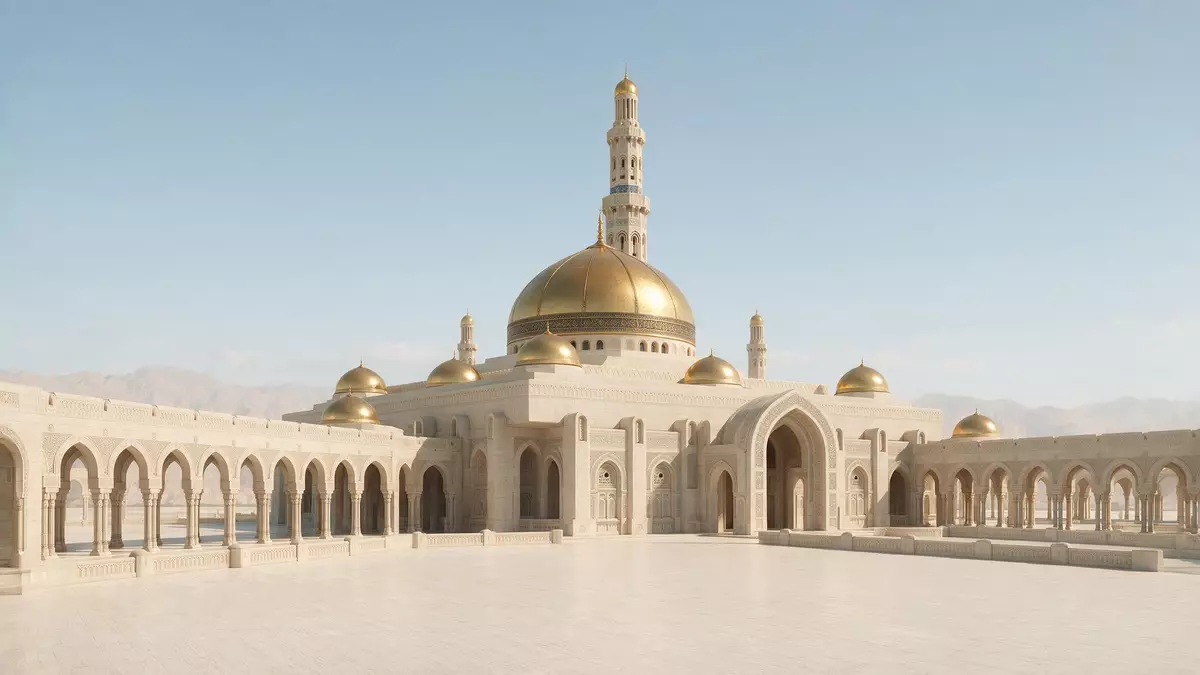
Sultan Qaboos Grand Mosque in Maskat is Oman’s principal congregational mosque, completed in 2001 and laid out as a monumental marble complex defined by a domed main prayer hall and five slender minarets.Completed in 2001 the mosque presents contemporary Islamic architecture on a vast site, with sandstone and marble surfaces catching the desert light.
Marble, minarets and a square plan
The Sultan Qaboos Grand Mosque stands in the Bausher district of Maskat, on a site whose grounds extend across hundreds of thousands of square metres and include formal gardens, paved courtyards and arcaded walkways.Site covering 416,000 square metres The complex rests on a rectangular base punctuated at its corners by four minarets and dominated by a taller central minaret, together forming a set of five towers that mirror the five pillars of Islam.Five minarets marking the corners
The main prayer hall follows a square plan beneath a central dome rising around 50 m (164 ft) above the floor, giving the building its distinctive profile alongside the principal minaret.Square hall with central dome Exterior surfaces are clad in Indian sandstone and expanses of white and red-brown marble, with geometric stonework and carved details lending depth to otherwise restrained elevations.White and red-brown marble cladding The mixture of smooth planes and carved niches gives the mosque a clear, legible geometry when seen from a distance, while close views reveal fine workmanship in stone and tile.
A contemporary Islamic interior of carpet and chandelier
Inside, the main musalla, or men’s prayer hall, occupies a wide square space defined by marble columns, carved wooden ceilings and a dome whose inner surface is richly patterned.Main prayer hall features The hall can accommodate several thousand worshippers and forms the core of a complex whose overall capacity reaches around 20,000 people when the courtyards and exterior prayer areas are included.Total capacity around 20,000
The floor of this main hall is covered by a single Persian carpet weighing 21 tonnes, woven in Iran and assembled on site around supporting columns to create an unbroken surface of floral motifs and medallions.21-tonne Persian carpet Above it hangs a gold-plated chandelier trimmed with hundreds of thousands of Swarovski crystals, rising through the centre of the dome and echoed by dozens of smaller chandeliers around the hall.Gold-plated Swarovski chandelier Together the carpet, marble panelling and crystal lighting create a highly controlled interior, combining contemporary engineering with traditional Islamic decorative themes.
Architectural influences and auxiliary spaces
The mosque’s design was awarded after a competition in 1993, with the exterior architecture by Quad Design working with Iraqi architect Mohamed Saleh Makiya and interior work by Edgard Bali.Architects and competition Construction began in December 1994 and continued for more than six years before the mosque’s inauguration in May 2001 under Sultan Qaboos bin Said.Inauguration in May 2001 The overall style is described as contemporary Islamic, drawing on Persian, Ottoman, Mughal Indian, Egyptian and Omani traditions while maintaining a coherent, understated character across the complex.Blend of Islamic traditions
Beyond the main prayer halls, the mosque includes a library and educational spaces, as well as colonnades framing gardens with water channels that echo the layout of classical Islamic gardens.Gardens and auxiliary spaces Decorative programmes throughout the complex mix calligraphic panels, geometric tilework and carved plaster, linking interior rooms with exterior courtyards in a controlled sequence of spaces that highlight different aspects of Omani craftsmanship.
Visiting Sultan Qaboos Grand Mosque: what travellers from Western Europe should know
- Sultan Qaboos Grand Mosque stands in the Bausher district, south-west of Maskat’s central areas, beside a major arterial road that connects different parts of the city.
- The complex is expansive and largely paved, with broad stairways, long colonnades and sizeable garden areas; a visit entails substantial walking on stone and marble surfaces.
- The terrain is level within the courtyards, but reaching the interior involves steps at the main entrances, and the minaret towers are set on elevated bases above the surrounding gardens.
- Maskat lies on Oman’s coast; the official language is Arabic and the currency is the Omani rial.
- Entry requirements depend on your nationality; UK travellers can check the FCDO travel advice at gov.uk/foreign-travel-advice, Irish travellers the Department of Foreign Affairs at ireland.ie.
Searching for Sultan Qaboos Grand Mosque on social platforms
These links open searches for Sultan Qaboos Grand Mosque on each platform.
Frequently asked questions about Sultan Qaboos Grand Mosque
Where is Sultan Qaboos Grand Mosque located?
Sultan Qaboos Grand Mosque is in the Bausher district of Maskat, the capital of Oman, on a large site beside one of the city’s main roads.
What should visitors expect inside the mosque complex?
Visitors encounter extensive marble courtyards, formal gardens, a square domed main prayer hall with a vast Persian carpet, and interior spaces decorated with Islamic geometric and calligraphic motifs.
What makes Sultan Qaboos Grand Mosque distinctive among modern mosques?
The mosque combines a five-minaret composition, a square domed prayer hall, one of the world’s largest single-piece carpets and a monumental crystal chandelier within a contemporary Islamic design rooted in Omani traditions.


