
Sule Pagoda at the octagonal heart of Yangon
Published on 09/19/2026 at 14:01 | Editorial responsibility: Rafael Müller, Editor-in-Chief AD HOC NEWS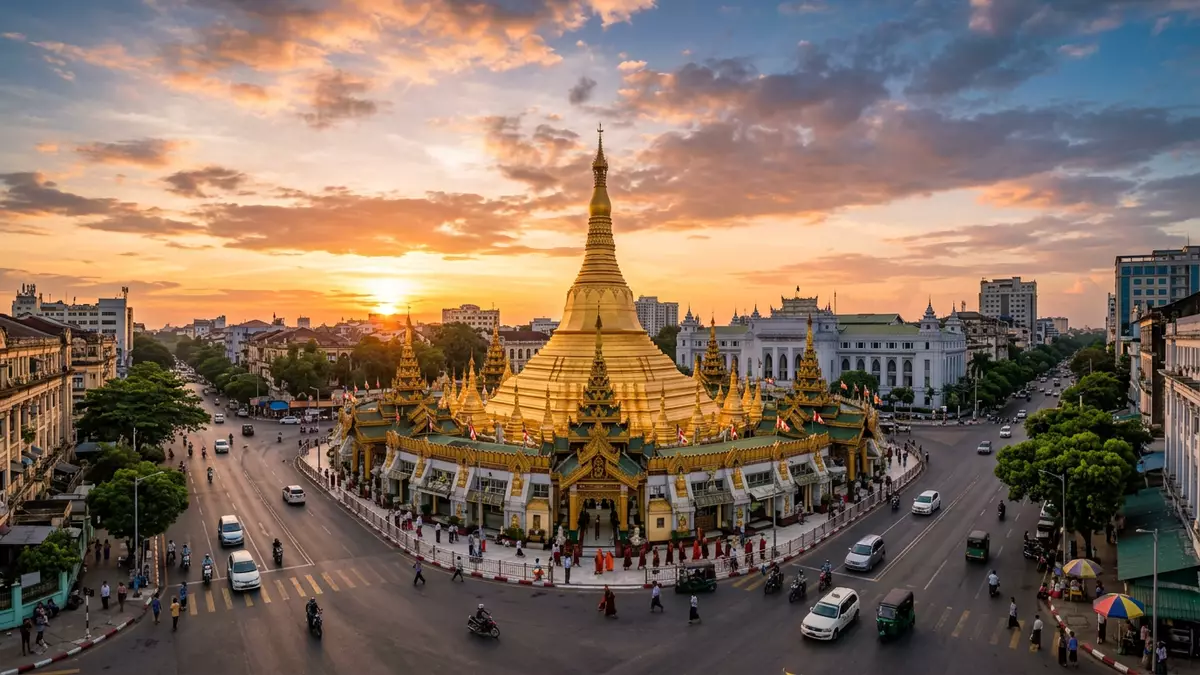
Sule Pagoda is a Buddhist stupa in Yangon whose gilded tower rises from an octagonal island at a major crossroads, giving the shrine an unusual role as both temple and urban landmark. Tradition links the pagoda to the time of the historical Buddha in the fifth century BC, while accounts of fifteenth-century works under Queen Shin Sawbu describe an enlargement that still shapes much of what visitors see in its present proportions.Tradition connects the shrine with the time of the Buddha
Golden stupa at Yangon’s crossroads
Sule Pagoda stands at the junction of Sule Pagoda Road and Maha Bandula Road in Kyauktada Township, a roundabout at the centre of Yangon’s downtown street grid.Sule Pagoda is located in the center of Yangon The shrine’s central position means that its golden stupa is framed by civic buildings such as the Yangon City Hall and the High Court, with the open space of Maha Bandula Park nearby.
The pagoda’s core structure is a stupa with an octagonal base that narrows as it rises, sheathed in gold-coloured surfaces that catch the light above the traffic circulating around it.The Sule Pagoda has an octagonal pagoda shape Around the main tower stand smaller shrines and prayer halls, closely packed on the traffic island yet oriented towards the central stupa, so that worshippers share space with the flow of buses and cars circling the roundabout.
From early legend to colonial city centre
Myanmar Buddhist tradition describes Sule Pagoda as one of Yangon’s oldest religious monuments, associated with a hair relic of the Buddha brought to the region by merchant brothers and enshrined here.Myanmar tradition says the pagoda houses a hair relic of the Buddha The shrine is traditionally dated to the fifth century BC rather than to a specific year, placing it deep in the era in which accounts situate the life of Siddhartha Gautama.Sule Pagoda is traditionally dated to the fifth century BC
The present proportions of the stupa are linked with Queen Shin Sawbu, a fifteenth-century Mon ruler whose enlargement works are described in accounts of mid-fifteenth-century building phases.The pagoda itself was enlarged to its present size by Queen Shin Sawbu Centuries later, in the nineteenth century, British colonial planners rebuilt Rangoon, as Yangon was then known, on a grid pattern and chose Sule Pagoda as the centre point of the downtown plan, laying out streets that radiate and intersect around the stupa.The British redesigned downtown Yangon with Sule Pagoda at its center
Sule Pagoda as a civic and spiritual space
Because Sule Pagoda stands in the middle of the downtown grid, it has taken on civic functions alongside its religious role. It has served as a gathering point for major political movements, including the pro-democracy uprising in 1988 and the Saffron Revolution in 2007, when demonstrators used the pagoda’s forecourt and surrounding streets as a rallying space.Sule Pagoda has played a key role in Myanmar’s history These episodes sit alongside the daily rhythm of worship, where visitors remove their footwear, circle the stupa and pause at planetary posts aligned with the days of the week.
The pagoda complex includes prayer halls, small shrines and covered walkways that frame views of the central tower and the surrounding cityscape. From the platform around the stupa, Yangon’s colonial and post-independence buildings appear in a ring beyond the traffic island, underlining how the shrine functions both as a place of devotion and as a geographic marker for the city’s civic centre.
Visiting Sule Pagoda: what travellers from Western Europe should know
- Sule Pagoda stands on a traffic island at the junction of Sule Pagoda Road and Maha Bandula Road in Kyauktada Township, in the heart of downtown Yangon.
- The approach from the surrounding pavements involves crossing busy streets and then climbing a set of steps to reach the main platform around the stupa.
- In the immediate vicinity of the pagoda lie Yangon City Hall, the former High Court building and Maha Bandula Park, making it part of a compact cluster of civic landmarks.
- For this site the official language is Burmese and the currency is the Myanmar kyat.
Searching for Sule Pagoda on social platforms
These links open searches for Sule Pagoda on each platform.Frequently asked questions about Sule Pagoda
Where is Sule Pagoda located in Yangon?
Sule Pagoda stands in Kyauktada Township at the junction of Sule Pagoda Road and Maha Bandula Road, forming a roundabout in central downtown Yangon.
What should visitors expect on a visit to Sule Pagoda?
Visitors encounter a gilded stupa surrounded by shrines and prayer halls on a raised platform, reached by steps from the pavements around the busy traffic circle.
What makes Sule Pagoda distinctive among Yangon’s temples?
The combination of an ancient Buddhist stupa, fifteenth-century enlargement under Queen Shin Sawbu and its role as the centre point of Yangon’s colonial street grid gives Sule Pagoda an unusual blend of spiritual and civic significance.


