

Suchitoto, El Salvador’s hilltop colonial town above Lake Suchitlán
Published on 08/28/2026 at 21:15 | Editorial responsibility: Rafael Müller, Editor-in-Chief AD HOC NEWS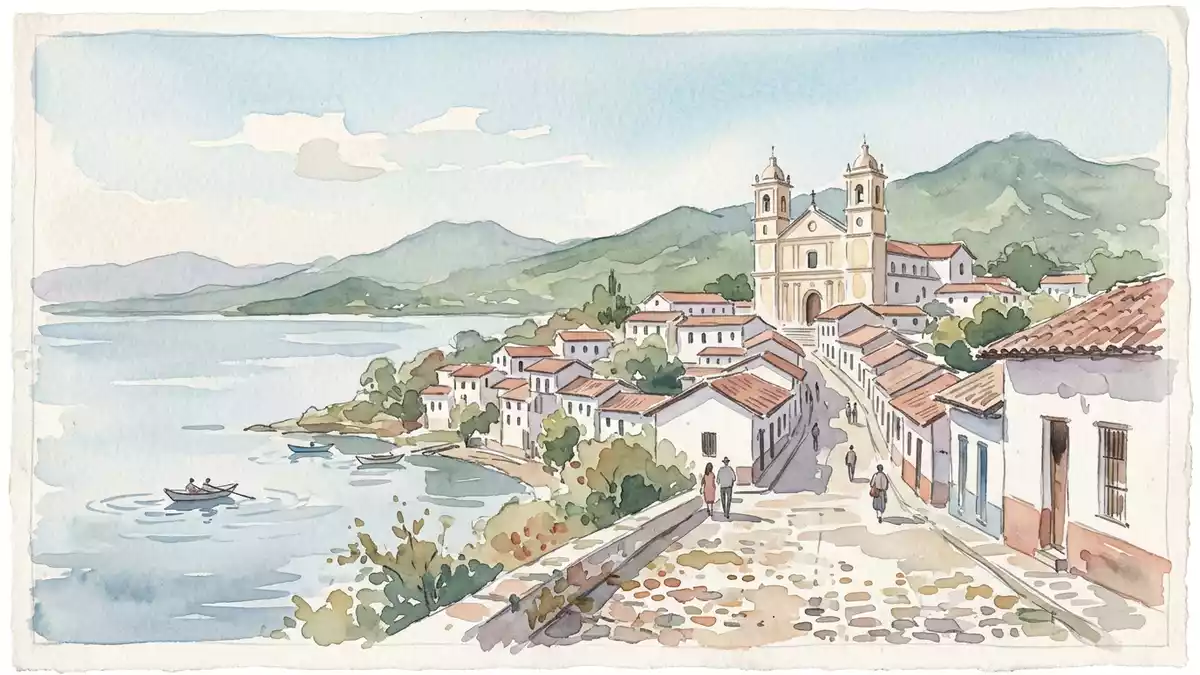
Suchitoto in central El Salvador is a hilltop colonial town where cobbled streets, whitewashed houses and a compact historic centre look out over the broad waters of Lake Suchitlán. Set in the Cuscatlán Department between the Lempa River and the Guazapa volcano, the town carries traces of pre-Columbian settlement, early Spanish colonisation and a later revival as a cultural hub, all within a walkable grid of streets and squares.Suchitoto is a district in the Cuscatlán Department
A colonial hill town above an artificial lake
Suchitoto occupies rising ground north-east of San Salvador, climbing a hillside that falls away towards the northern shore of Lake Suchitlán, El Salvador’s largest reservoir.Lago Suchitlán was formed behind the Cerrón Grande hydroelectric dam on the Lempa River in 1976 From the streets near the central square, views open towards the lake’s convoluted shoreline and the low hills on its far side, giving the town a constant visual link to the water below.
The town’s name comes from Nahuatl, usually translated as “place of flowers and birds”, reflecting the region’s indigenous roots and its position in a landscape of vegetation and birdlife.The name is commonly rendered as place of flowers and birds Long before Spanish rule, the plateau here was a settled area, and in 1528 the municipal territory became the site of an early Villa de San Salvador, a first Spanish foundation later moved and abandoned.The town of San Salvador was founded in Suchitoto’s territory in 1528 That early episode places Suchitoto within the initial phase of Spain’s expansion through Central America.
A preserved colonial centre of cobblestones and terracotta roofs
At street level, Suchitoto’s character rests on its colonial grid layout, cobblestone paving and low one- and two-storey houses with tiled, terracotta roofs.The historic centre is known for cobbled streets and terracotta roofs Straight streets meet at right angles in the classic Spanish “damero” pattern, focusing civic life on a central square lined with arcades, cafés and municipal buildings. This layout gives walking through town a sense of rhythm: sequences of façades with wooden doors, barred windows and internal courtyards reveal themselves block by block.
Suchitoto’s colonial architecture is not monumental so much as consistently scaled. Houses rarely rise high, and the church and civic buildings share similar materials, so the whole centre feels unified rather than dominated by a single structure. Within this fabric, details vary: some houses carry brightly painted façades, others expose plaster and brick; many roofs extend over the pavement to shelter doorways from the strong Central American sun.
Santa Lucía: a nineteenth-century church as architectural anchor
The most recognisable landmark in Suchitoto is the Church of Santa Lucía on the town’s main square, a white church whose present form dates from the mid-nineteenth century.The current Santa Lucía church was built between 1853 and 1857 It replaced an earlier temple destroyed by fire, and its construction was promoted by Presbítero Cayetano Bosque, with architect Pío José Araujo responsible for the design.Its construction was led by Cayetano Bosque and Pío José Araujo The church’s façade combines baroque and rococo influences, with multiple columns, decorative panels and a stepped outline against the sky.
Santa Lucía’s rectangular basilical plan extends back from the square, housing three naves separated by classical columns and rising to a height of around 29 m (95 ft) at the main façade.The church measures about 68 m by 24 m, with a 29 m-high façade Outside, six columns support the principal portico, while small domes incorporate porcelain plates as ornament, an unusual detail within Salvadoran church architecture. A four-faced clock mounted on the upper part of the bell tower marks time above the square, reinforcing the building’s role as both religious and civic reference point.
Cultural life and the lakeside landscape
Suchitoto’s image as a cultural town grew strongly after the end of the Salvadoran civil war in the late twentieth century, when artists, theatre practitioners and filmmakers began using its streets and houses as locations and venues.Since the end of the civil war the town has developed into an important tourist site Among the figures associated with this trajectory is filmmaker Alejandro Cotto, whose work and initiatives helped bring festivals and performances to the town, linking its colonial setting with contemporary cultural production.Alejandro Cotto is closely tied to Suchitoto’s arts scene
Below the town, Lake Suchitlán spreads along the Lempa valley as a broad artificial reservoir edged by inlets, islands and patches of vegetation.Lake Suchitlán is El Salvador’s largest lake Boat tours explore this flooded landscape, passing remnants of the pre-dam valley and areas where birdlife congregates on branches and shorelines. From Suchitoto’s hillside position, the combination of water, distant terrain and human settlement gives the town a layered setting unusual for a settlement of its size in El Salvador.
Visiting Suchitoto: what travellers from Western Europe should know
- Suchitoto lies in the Cuscatlán Department of central El Salvador, north-east of San Salvador and above the northern shore of Lake Suchitlán, reached overland from the capital.
- The historic centre stands on sloping ground, with cobblestone streets and some steep sections between the upper grid of streets and viewpoints towards the lake.
- The town’s core is compact, and walking between the central square, Santa Lucía church and nearby streets involves short distances along paved, often uneven surfaces.
- The official language is Spanish and the currency is the United States dollar.
- Entry requirements depend on your nationality; UK travellers can check the FCDO travel advice at gov.uk/foreign-travel-advice, Irish travellers the Department of Foreign Affairs at ireland.ie.
Searching for Suchitoto on social platforms
These links open searches for Suchitoto on each platform.
Frequently asked questions about Suchitoto
Where is Suchitoto in El Salvador?
Suchitoto is a town and district in the Cuscatlán Department of central El Salvador, north-east of San Salvador on a hillside above Lake Suchitlán.
What can visitors expect when walking through Suchitoto?
Visitors encounter a compact colonial centre with cobblestone streets, low terracotta-roofed houses, a grid of right-angled streets and the prominent white façade of Santa Lucía church.
What makes Suchitoto distinctive among Salvadoran towns?
Its combination of preserved colonial architecture, the nineteenth-century Santa Lucía church, the cultural scene linked to figures such as Alejandro Cotto and its viewpoint over Lake Suchitlán gives Suchitoto a particular character.


