
Su Nuraxi: Sardinia’s basalt towers and Bronze Age village
Published on 09/19/2026 at 22:02 | Editorial responsibility: Rafael Müller, Editor-in-Chief AD HOC NEWS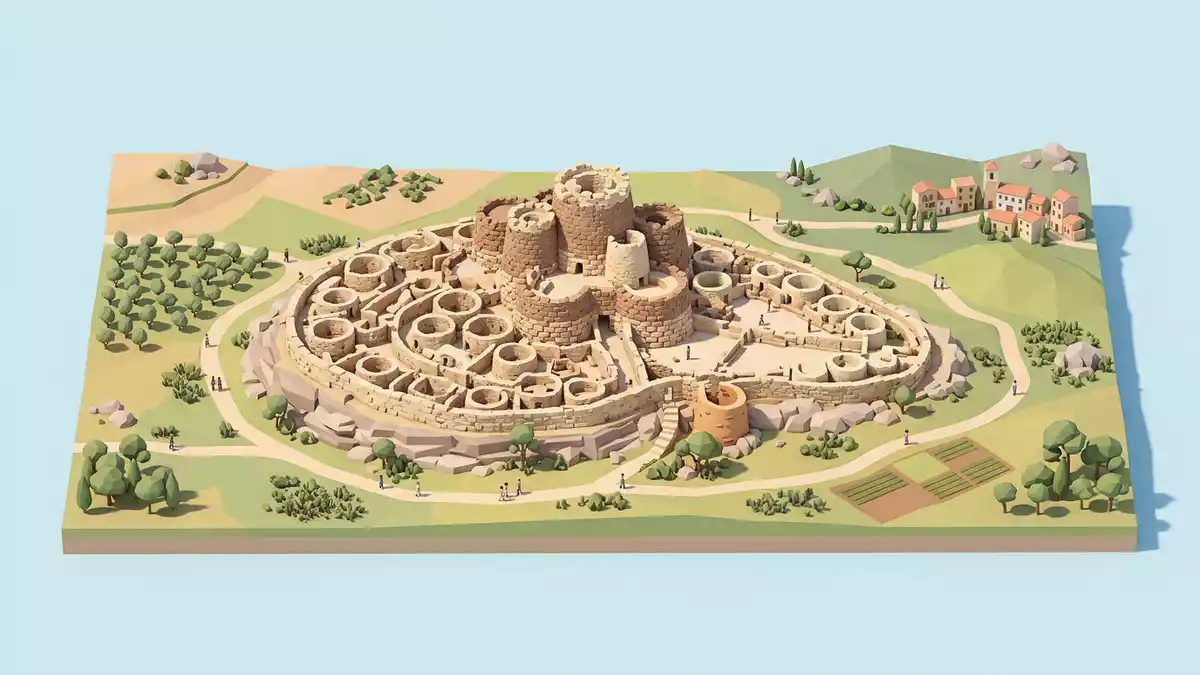
South of Barumini in Sardinia, Su Nuraxi rises from a low hill as a compact fortress of dark basalt and a surrounding prehistoric village, built by the Nuragic civilisation in the Bronze Age. Recognised as Su Nuraxi di Barumini on the UNESCO World Heritage List since 1997, the site condenses centuries of occupation into one dense cluster of towers, walls and stone huts.
Basalt towers on a Sardinian hill
Su Nuraxi stands on an elevated position above the plains of Marmilla, a landscape of cultivated fields and gentle hills in the south-central interior of Sardinia. From the approach road near Barumini the complex appears as a dense knot of stone, its main tower and attached bastion clearly separated from the village buildings that spread around it.The elevated position of Su Nuraxi places it above a fertile plain, and that vantage point remains evident in the way the towers overlook the surrounding countryside.
The heart of the site is the nuraghe itself, a massive central tower of basalt built in the second millennium BC and originally standing more than 18 m (59 ft) high, ringed by a bastion of four corner towers linked by thick walls.The Su Nuraxi nuraghe consisted of a central tower with internal chambers and a spiral staircase, an arrangement still legible in the surviving masonry. Narrow passages run between the towers and open into small internal courtyards, giving the complex the character of a stone labyrinth built upwards and outwards from a single core.
A Bronze Age village around the fortress
Around the bastion lies a compact village of prehistoric stone houses, built against the outer walls and radiating from the nuraghe in irregular rings. Excavations have revealed clusters of huts organised around courtyards, with low basalt walls that once supported conical roofs in lighter materials. Archaeological studies describe Su Nuraxi as a settlement with a central tower dating to the seventeenth century BC and a village occupied between the thirteenth and sixth centuries BC, reflecting several phases of Nuragic life on the site.Su Nuraxi is described as a settlement with both fortress and village elements.
The layout shows how the Nuragic community gathered around the defensive core, adapting the slopes of the hill with terraces and enclosing walls that define lanes and small open spaces. Later phases introduced additional structures and reconfigurations as the community changed over centuries, and traces of use extend beyond the Bronze Age into periods associated with Carthaginian influence and subsequent Roman contact.UNESCO notes that the Barumini complex was extended and reinforced in the first half of the first millennium BC under external pressure, and that long chronology is visible in the overlapping building phases.
Nuragic architecture and UNESCO recognition
Su Nuraxi belongs to the tradition of nuraghi, the distinctive tower complexes that characterise the Nuragic civilisation of Sardinia. The towers take the form of truncated cones built from carefully cut basalt blocks, with corbel-vaulted internal chambers accessed by narrow doorways and internal stairways.The complex consists of defensive towers in the form of truncated cones and provides one of the clearest examples of this prehistoric architectural type. At Su Nuraxi, the central tower and bastion are surrounded by later additions, making the site unusually complete in its range of structural elements.
Excavated in the 1950s by Sardinian archaeologist Giovanni Lilliu, Su Nuraxi became a key site for the study of Nuragic architecture and society.The excavation in the 1950s by Giovanni Lilliu revealed a sequence of building phases and everyday artefacts that linked the towers and houses to specific periods. In 1997 the complex was inscribed on the UNESCO World Heritage List as Su Nuraxi di Barumini, recognised as a particularly important and well-preserved Nuragic complex on the island.The World Heritage listing identifies the site as the best-known example of Bronze Age nuragic defensive architecture.
Visiting Su Nuraxi: what travellers from Western Europe should know
- Su Nuraxi stands near the town of Barumini in the south-central interior of Sardinia, reached by road routes that cross the Marmilla region from larger Sardinian towns.
- The archaeological area occupies a hilltop with uneven basalt surfaces, stone steps and narrow passages inside the towers, so visits involve walking on sloping ground and climbing confined stairways.
- The surrounding countryside is agricultural, and from the outer walls the view extends over cultivated fields and low hills across the Marmilla plain.
- The official language is Italian and the currency is the euro.
Searching for Su Nuraxi on social platforms
These links open searches for Su Nuraxi on each platform.
Frequently asked questions about Su Nuraxi
Where is Su Nuraxi?
Su Nuraxi is a Nuragic archaeological complex near Barumini in the south-central interior of Sardinia, Italy, on a hill overlooking the Marmilla plain.
What can visitors expect at Su Nuraxi?
Visitors encounter a dense basalt fortress with a central tower and bastion, surrounded by a prehistoric village of stone houses and lanes on a sloping hilltop.
What makes Su Nuraxi distinctive among Sardinian sites?
Su Nuraxi is distinctive for its well-preserved nuraghe with multiple towers, its extensive Bronze Age village and its recognition as a UNESCO World Heritage site.


