
Su Nuraxi’s stone labyrinth above the Barumini plain
Published on 08/30/2026 at 12:12 | Editorial responsibility: Rafael Müller, Editor-in-Chief AD HOC NEWS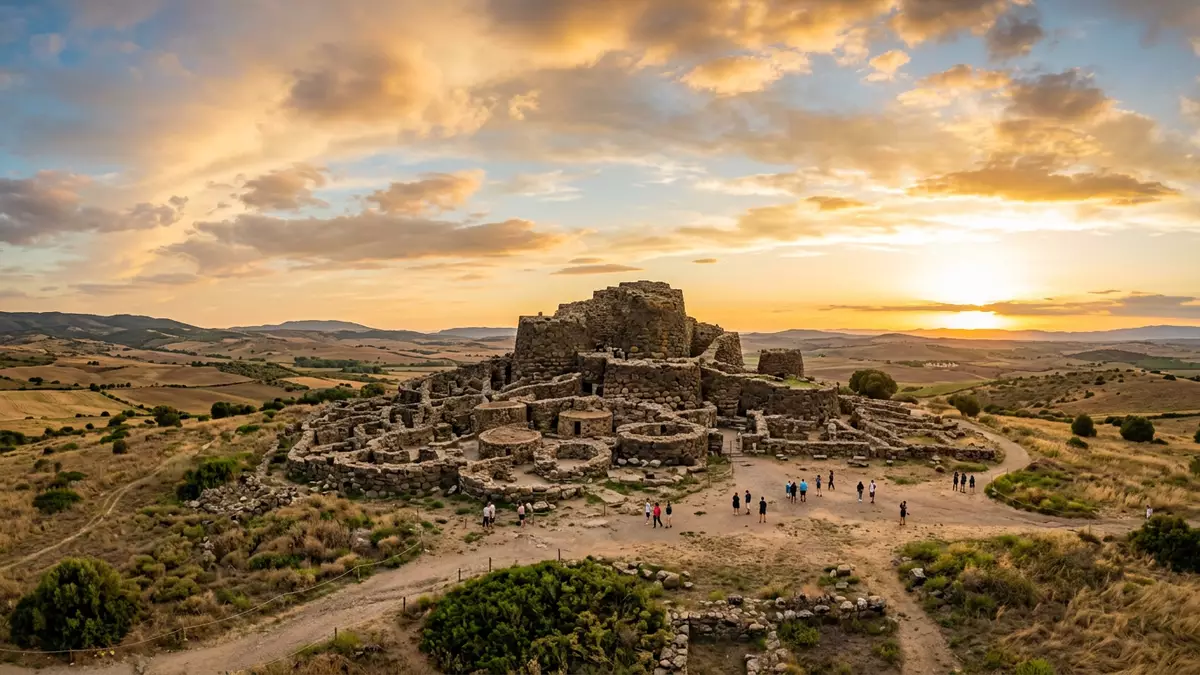
South of the central Sardinian plateau, Su Nuraxi near Barumini is a Bronze Age nuragic stronghold whose clustered stone towers and surrounding village form a dense archaeological labyrinth above the plain.
Stone towers from the Nuragic civilisation
Su Nuraxi is a Nuragic archaeological site on Sardinia, Italy, a fortified settlement built on an elevated spur west of Barumini overlooking a wide agricultural plain.elevated position west of Barumini The complex belongs to the Nuragic civilisation, a Bronze Age culture characterised by massive stone towers known as nuraghi that dot the island.
The heart of Su Nuraxi is a central nuraghe whose main tower once rose to more than 18 m (59 ft), built of dressed basalt blocks laid without mortar.central tower originally over 18.5 metres Around this core are subsidiary towers linked by thick walls, creating a compact bastion with internal courtyards and passages.
A long-lived settlement in stone
Archaeological excavations in the mid twentieth century under Giovanni Lilliu revealed that Su Nuraxi’s construction and occupation span many centuries, beginning in the second millennium BCE.excavations led by Giovanni Lilliu The nuraghe complex itself is dated to the Middle and Late Bronze Age, with later phases of reinforcement and modification under external pressures.
A village of stone houses grew around the bastion, forming a dense settlement that remained inhabited into the first millennium BCE and saw reuse in Punic, Roman and early medieval times.occupation between the sixteenth and sixth centuries BC Walking through the site today, the layout of rooms, lanes and meeting spaces emerges from the low walls, mapping the daily life of a community clustered around its defence towers.
UNESCO recognition and the surrounding landscape
Su Nuraxi di Barumini is inscribed on the UNESCO World Heritage List, recognised as the pre-eminent example of Sardinia’s nuragic defensive complexes and a major testament to prehistoric architecture.World Heritage listing in 1997 The designation highlights the way the stone towers, corbel-vaulted chambers and surrounding village together convey a complete fortified settlement.
The site lies near the Parco della Giara and above the Marmilla region’s rolling fields, with the towers and bastion occupying a prominent ridge in the rural landscape.nuragic archaeological site in Barumini From the higher points of the complex, the view across the surrounding countryside underlines the strategic siting that once made Su Nuraxi a focal point for its territory.
Visiting Su Nuraxi: what travellers from Western Europe should know
- Su Nuraxi stands west of Barumini in southern Sardinia, Italy, reached along local roads that climb gently towards the ridge above the town.
- The archaeological area is characterised by uneven stone surfaces, narrow passageways and stairways within the towers, demanding sure footing and care on the basalt blocks.
- The complex lies near the Parco della Giara and the wider Marmilla region, where low hills and agricultural land surround the site’s elevated position.
- The official language is Italian and the currency is the euro.
Searching for Su Nuraxi on social platforms
These links open searches for Su Nuraxi on each platform.
Frequently asked questions about Su Nuraxi
Where is Su Nuraxi and what kind of site is it?
Su Nuraxi is a Nuragic archaeological complex west of Barumini in southern Sardinia, Italy, consisting of a fortified nuraghe and surrounding village remains.
What can visitors expect when exploring Su Nuraxi?
Visitors encounter massive basalt tower walls, internal chambers, courtyards and low house foundations, moving through an intricate network of stone passages on uneven terrain.
What makes Su Nuraxi distinctive among Sardinian nuraghi?
Su Nuraxi combines a large multi-tower bastion, extensive village and prominent siting above the Marmilla plain, and is recognised as a UNESCO World Heritage Site.


