
Su Nuraxi, a Bronze Age stone fortress above Barumini
Published on 09/07/2026 at 21:56 | Editorial responsibility: Rafael Müller, Editor-in-Chief AD HOC NEWS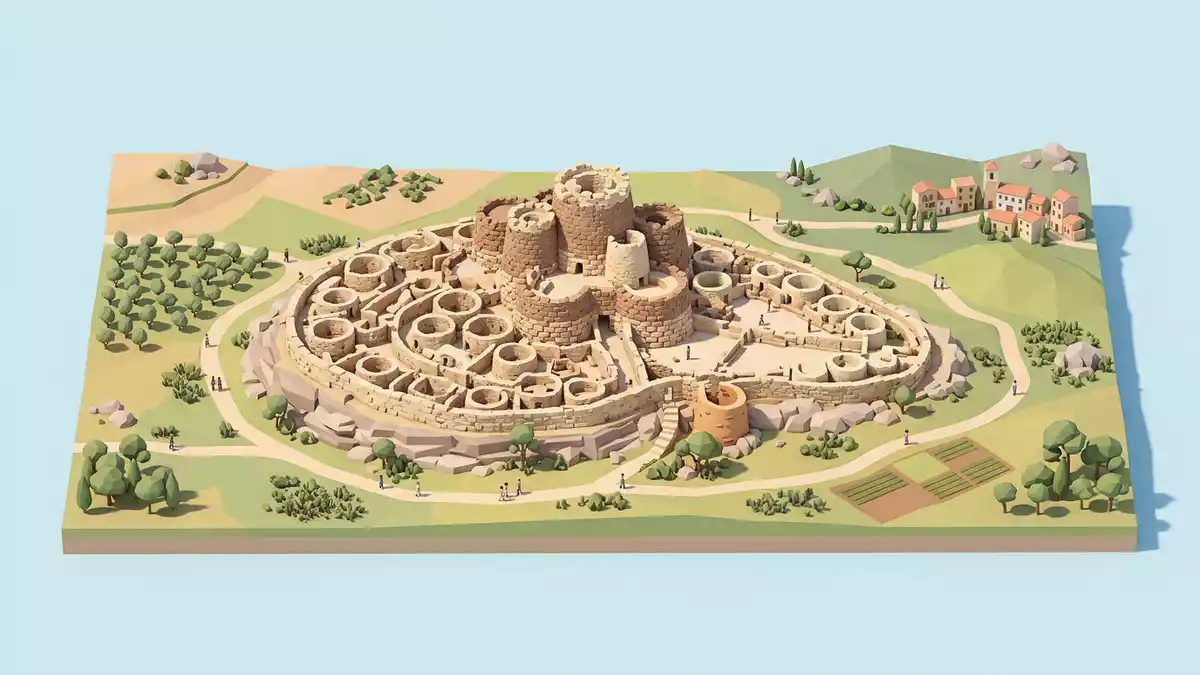
On a low hill west of Barumini in Sardinia rises Su Nuraxi, a Bronze Age stone fortress surrounded by a maze of dwellings that charts more than two thousand years of island history in basalt. Recognised as a UNESCO World Heritage Site in 1997, it is the most studied Nuragic complex in Sardinia and a compact introduction to the civilisation that covered the island in towers between the Middle Bronze Age and late antiquity.
A basalt stronghold from the Bronze Age
Su Nuraxi is a Nuragic archaeological site in southern Sardinia, Italy, built in basalt quarried from the nearby Giara plateau and set on a rise overlooking the Marmilla landscape.Su Nuraxi, made of basalt The heart of the site is a central tower raised in the Middle Bronze Age, surrounded by four corner towers linked by a thick stone bastion, forming a compact defensive cluster in dressed blocks of volcanic rock.circular defensive towers in truncated cones
The main tower and its satellites belong to the family of nuraghe structures that characterise Sardinia’s Bronze Age, and at Su Nuraxi their plan can be seen with unusual clarity in the exposed masonry and internal chambers. Corbelled rooms rise within the towers, creating enclosed spaces stacked in stone that once formed the core of a fortified residence and lookout over the surrounding territory.a seventeenth century BC nuraghe The complex was expanded and reinforced in the first half of the first millennium BC, when external pressures on Sardinia brought new layers of construction to the bastion and its entrance passages.extended and reinforced in the first half of the 1st millennium
A village clustered around the fortress
Around the basalt towers spreads a dense village of stone huts, wells and cisterns, reached by paths that wind between low walls and circular foundations.a labyrinth of 50 huts, wells and cisterns The settlement developed from about the thirteenth century BC and remained inhabited into the first centuries BC, creating a stratified plan in which changes of layout and building style can be read in the masonry. The dwellings cluster close to the central bastion, forming rings of domestic structures that reflect the draw of the fortress at their centre.
Archaeological excavation in the 1950s under Sardinian archaeologist Giovanni Lilliu exposed the full extent of the village and its relationship to the nuraghe, revealing an area that covers thousands of square metres on the Barumini hillside.excavated in the 1950s by Giovanni Lilliu The exposed plan shows domestic clusters, open courtyards, water management features and later re-use of earlier structures, illustrating how a Nuragic stronghold turned into a more complex settlement over successive generations.
World Heritage status and Sardinian context
Su Nuraxi is the only archaeological site in Sardinia inscribed on the UNESCO World Heritage List, recognised in 1997 as the finest and most complete example of a Nuragic defensive complex and village.Su Nuraxi di Barumini on the UNESCO List Its basalt towers and surrounding village compress a long arc of Sardinian history from the sixteenth century BC to the early medieval period, linking Bronze Age Nuragic construction, later Phoenician and Carthaginian contact and eventual incorporation into the Roman sphere.over two thousand years of history
The site stands just outside the small town of Barumini, in the Marmilla region of central-southern Sardinia, near the basalt plateau of the Giara and within a landscape dotted with other nuraghe remains.the most imposing of the thirty Barumesi nuragic sites It forms part of a wider archaeological belt that includes additional Nuragic structures and later rural churches, making Barumini a focus for visitors interested in the island’s pre-Roman heritage.
Visiting Su Nuraxi: what travellers from Western Europe should know
- Su Nuraxi lies about 1 km west of Barumini in central-southern Sardinia, reached by local roads that connect the town with the surrounding Marmilla countryside.
- The archaeological area is set on a low hill above the plain, with stone paths, uneven basalt surfaces and stairways inside the towers that require steady footing.
- The site stands near the Giara plateau, and the exposed stone structures and hilltop position mean that visits involve walking in open terrain with limited shade.
- The official language is Italian and the currency is the euro.
Searching for Su Nuraxi on social platforms
These links open searches for Su Nuraxi on each platform.
Frequently asked questions about Su Nuraxi
Where is Su Nuraxi located?
Su Nuraxi stands on a hill just west of Barumini in the Marmilla region of central-southern Sardinia, Italy, close to the basalt plateau of the Giara.
What can visitors expect to see at Su Nuraxi?
Visitors encounter a basalt nuraghe with central and corner towers linked by a bastion, surrounded by an extensive stone village of huts, wells and cisterns on the hillside.
What makes Su Nuraxi distinctive among Nuragic sites?
Su Nuraxi combines a well-preserved fortress core, a large surrounding settlement and clear stratification spanning more than two millennia, and is the only Sardinian archaeological site inscribed as a UNESCO World Heritage Site.


