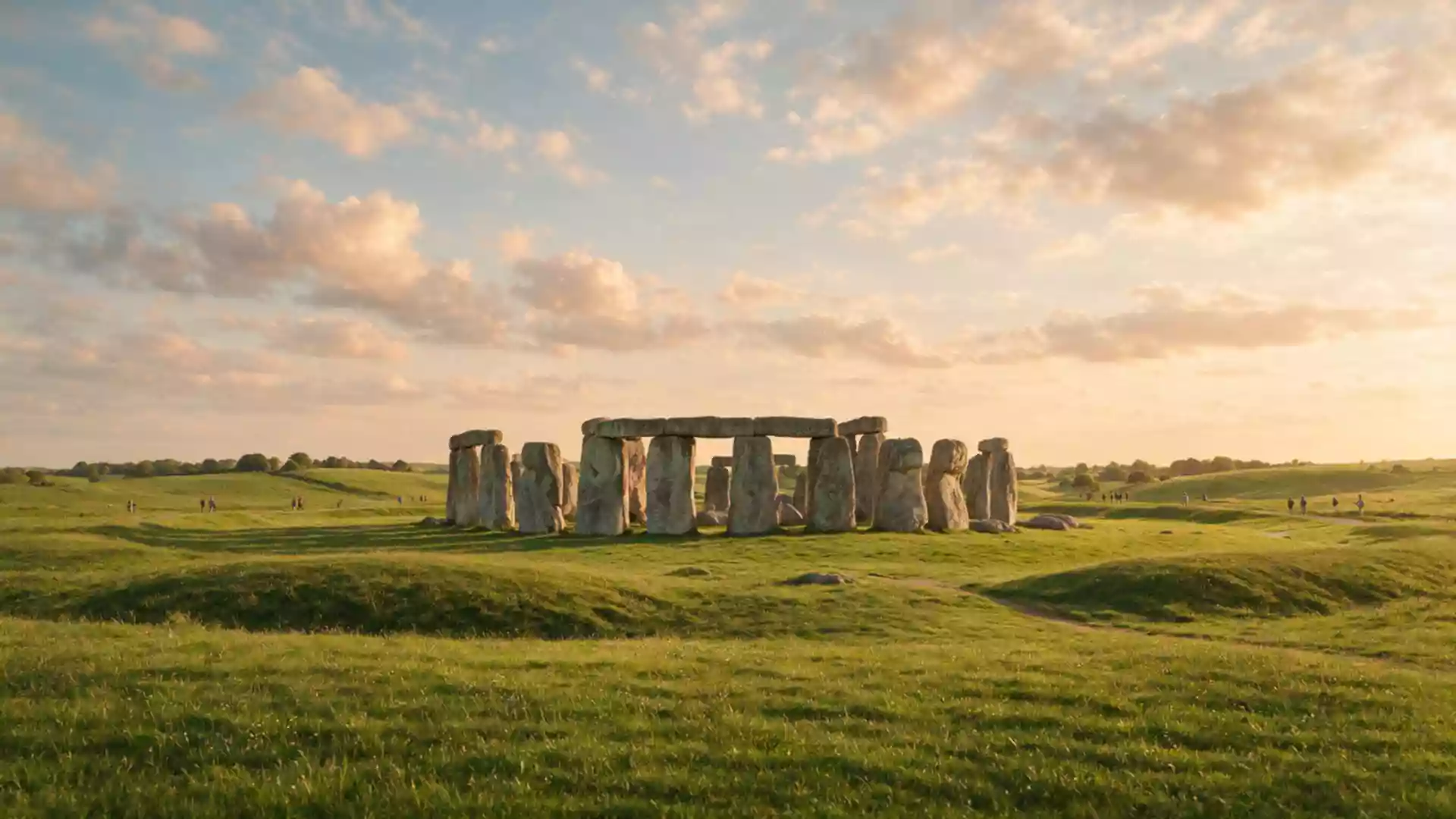
Stonehenge’s great stone circles on the chalk of Amesbury
Published on 08/31/2026 at 11:31 | Editorial responsibility: Rafael Müller, Editor-in-Chief AD HOC NEWS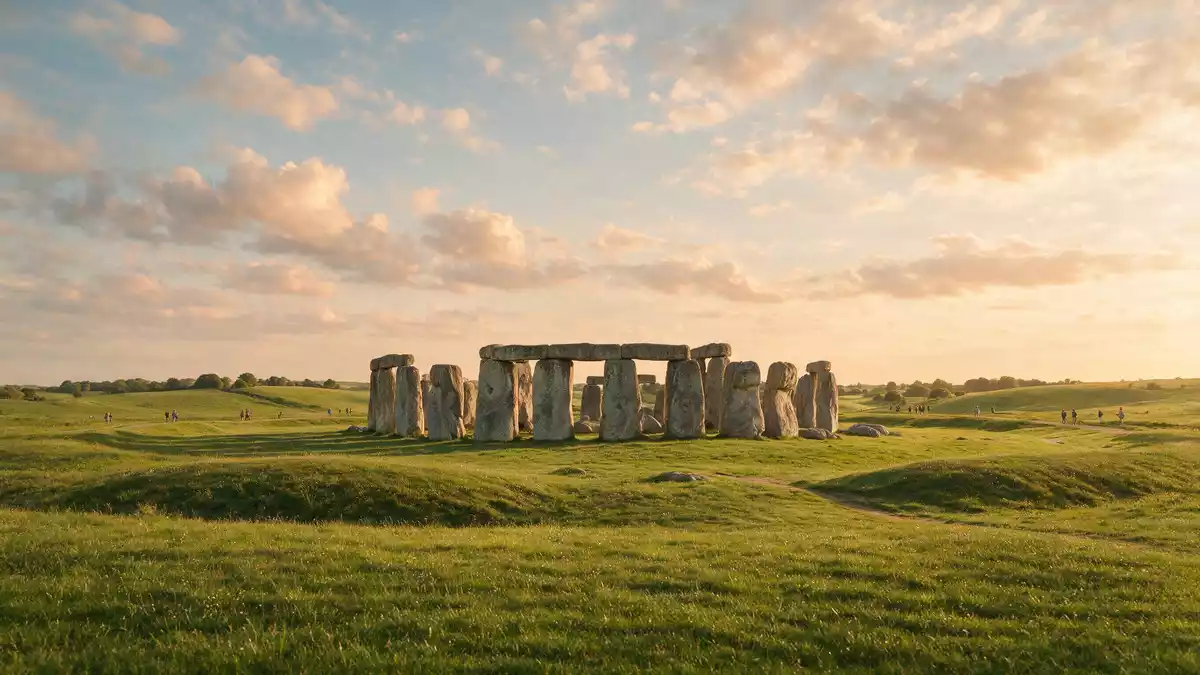
Stonehenge stands on the open chalk downs near Amesbury in southern England, a ring of massive stones that has shaped this landscape since the Neolithic period. Its great circles of sarsen and bluestone, raised in successive phases between the early third and mid-second millennium BC, still mark a carefully ordered space on Salisbury Plain.
Circles of stone on Salisbury Plain
Stonehenge is a prehistoric monument in Wiltshire, set on Salisbury Plain west of Amesbury and north of Salisbury, amid rolling chalk downland used for pasture and arable fields.prehistoric monument in Wiltshire The site lies a short distance from the valley of the River Avon, where Amesbury grew up, and forms part of a wider landscape of barrows, cursuses and related earthworks that extend across the plain.wider landscape of barrows
The monument centres on a series of stone circles and settings arranged within a circular earthwork. An encircling bank and ditch defines the outer boundary, enclosing a relatively flat interior, while the stones stand towards the middle, aligned with a formal entrance. The setting sits on gently sloping ground of chalk bedrock covered by thin soils, giving the grass a pale, dry quality in summer and opening long views across the surrounding downs.
From earthwork to megalithic circle
Archaeological excavations show that Stonehenge developed over many centuries, in distinct construction stages that together span roughly 2,000 years of activity between about 3,700 and 1,600 BC.activity between about 3,700 and 1,600 BC The earliest phase took the form of a circular earthwork with a ditch and bank, created around 3,000 BC and enclosing a ring of pits known as the Aubrey Holes.created around 3,000 BC
Later in the third millennium BC, builders began to introduce timber and then stone into the interior of the henge, transforming the simple earthwork into a complex megalithic structure. By the middle of the millennium, great sarsen stones from the Marlborough Downs had been set upright in a ring, with smaller bluestones brought from western Britain arranged in circles and arcs inside.great sarsen stones from the Marlborough Downs Further reconfigurations continued into the second millennium BC, when additional pits and settings were added and earlier arrangements altered, before major building activity ceased by around 1,500 BC.
Sarsen uprights and bluestone rings
The most striking feature of Stonehenge is the outer ring of sarsen megaliths, each a tall block of sandstone dressed into regular forms and topped by horizontal lintels fixed with mortise-and-tenon joints.outer ring of sarsen megaliths Within this ring, a horseshoe of even larger sarsen trilithons rises towards the centre, their paired uprights supporting further lintels and creating deep frames that catch the sky and distant horizon.
Inside and around the sarsen structures stand smaller bluestones, igneous rocks that differ clearly from the pale local chalk and from the sarsen blocks. These stones, arranged in an inner circle and an inner horseshoe, trace a second, more compact set of paths and boundaries, echoing the larger forms around them.smaller bluestones Together, the earthwork, sarsen ring, trilithons and bluestone settings form a layered monument in which circles, arcs and straight alignments overlap.
Stonehenge in a wider ceremonial landscape
Stonehenge does not stand alone; it forms part of a broader Neolithic and Bronze Age ceremonial landscape that includes avenues, burial mounds and other henges scattered across the chalk of Wiltshire.broader Neolithic and Bronze Age ceremonial landscape Monument complexes such as those at Avebury share similar periods of construction and use, with overlapping practices of gathering, burial and commemoration.
This landscape has been recognised as of outstanding universal value and is inscribed on the World Heritage List as “Stonehenge, Avebury and Associated Sites”, a cultural property recorded since 1986.inscribed on the World Heritage List The designation emphasises not only the monument itself, but also the surrounding chalkland with its long sequence of Neolithic and Bronze Age construction, making Stonehenge one focus within a network of prehistoric places spread across southern Britain.
Visiting Stonehenge: what travellers from Western Europe should know
- Stonehenge lies north of Salisbury and west of Amesbury on Salisbury Plain in southern England, reached by road from Amesbury and other Wiltshire towns.
- The monument stands on open chalk downland with grassy surfaces and gentle slopes, and paths around the stone circle involve walking over uneven ground.
- Low earth banks and shallow ditches around the henge form part of the visit route, so footwear suited to grass and soil is important, particularly in wet weather.
- The official language is English and the currency is the pound sterling.
Searching for Stonehenge on social platforms
These links open searches for Stonehenge on each platform.
Frequently asked questions about Stonehenge
Where is Stonehenge in relation to Amesbury?
Stonehenge stands on Salisbury Plain in Wiltshire, a short distance west of Amesbury and north of Salisbury, amid open chalk downland and farmland.
What can a visitor expect to see at Stonehenge?
Visitors encounter a circular earthwork enclosing rings and arcs of huge sarsen stones and smaller bluestones, set within a broad landscape of prehistoric monuments.
What makes Stonehenge distinctive among prehistoric sites?
Stonehenge combines a carefully constructed sarsen circle and trilithon horseshoe with bluestone settings, all raised within an early henge earthwork on the chalk of Wiltshire.