
Stone Town’s coral streets and Swahili heritage in Sansibar
Published on 09/16/2026 at 12:51 | Editorial responsibility: Rafael Müller, Editor-in-Chief AD HOC NEWS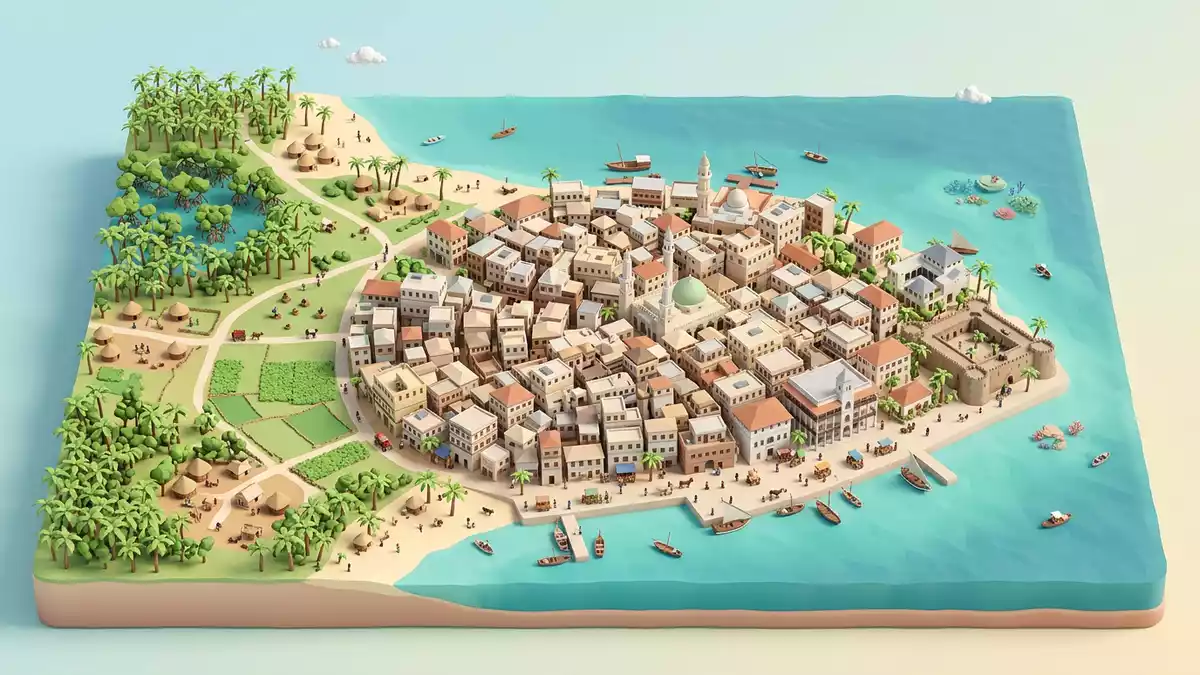
Stone Town in Sansibar, on the island of Unguja in Tanzania, is the historic core of Zanzibar City and a recognised UNESCO World Heritage site. Its dense streets of coral stone houses, merchant residences and religious buildings show how Swahili, Arab, Indian and European influences blended along the East African coast in the nineteenth century.
Coral stone, carved doors and a Swahili coastal layout
Stone Town occupies a low peninsula on the western side of Unguja that projects into the Indian Ocean, with the historic quarters pressed between the harbour and the line of the former creek to the east.triangular promontory The historic fabric consists of closely built houses and civic buildings, many constructed from coral ragstone and lime plaster, arranged along lanes that twist inland from the seafront.coral ragstone and limestone
Most of the architecture dates to the nineteenth century, when Zanzibar developed as an urban centre and stone buildings began to replace earlier mud and thatch structures.stone buildings were built in significant numbers Facades facing the streets carry the famous Zanzibari doors, made of hardwood and framed by heavy lintels, panels and inscriptions. Upper floors project slightly over the lanes, with rows of windows and enclosed balconies looking down to the busy ground level. Towards the seafront, the town opens into wider spaces facing the harbour, where important public buildings and open waterfront terraces stand along the shore.
Layers of trade, empire and religion
Archaeological work and historical research indicate that settlement on this peninsula began many centuries before the urban nineteenth-century expansion, with Swahili communities present by the eleventh century and occupation traces beneath the later fort.Swahili people have lived along a coral peninsula In the early sixteenth century the Portuguese Empire established a presence on Zanzibar, and foundations of the Old Fort, also known as Ngome Kongwe, date to this period.foundation of the city’s oldest building, Old Fort
During the seventeenth century political control shifted to the Sultanate of Oman, which developed Stone Town further as a centre of maritime trade. In the nineteenth century the town became the capital of the Sultanate of Zanzibar, at the height of the clove and slave trades along the Western Indian Ocean routes.capital of the Sultanate of Zanzibar Omani rulers, merchants from the Indian subcontinent and local Swahili elites commissioned palaces, large houses, mosques and churches, creating a built landscape that carries Arabic inscriptions, Indian decorative patterns and Swahili spatial traditions within the same streets.palaces and residences along and behind the sea front
UNESCO recognition and conservation challenges
Stone Town was inscribed on the UNESCO World Heritage List in 2000 as a cultural site under criteria ii, iii and vi, recognising it as an outstanding example of a Swahili coastal trading town and a material record of cultural fusion.Stone Town of Zanzibar is a fine example The protected urban area covers around 96 ha, with an additional buffer zone around the conservation core that includes reclaimed port land and later neighbourhoods.Area 96 ha
The conservation area retains its dense street pattern and many prominent nineteenth-century buildings, but age, climate and development pressures affect the fabric. International and local bodies work on safeguarding programmes for the stone houses, fortifications and waterfront structures, including documentation, restoration projects and management plans for the historic core.Stone Town Conservation Area Within these streets, churches, mosques, civic buildings and former palaces stand close together, and the mix of religious and secular architecture reflects the layered history of trade, empire and Swahili urban life.
Visiting Stone Town: what travellers from Western Europe should know
- Stone Town forms the old quarter of Zanzibar City on the western shore of Unguja, reached by flights to Zanzibar’s airport and onward travel into the city.
- The historic area is compact but built on uneven coral ground, with narrow lanes, steps, alleyways and occasional steep gradients that require attention on foot.
- Several landmarks stand close together along the seafront and around Darajani, so moving between the harbourfront terraces, the Old Fort and nearby religious buildings involves short urban walks.
- Swahili is widely spoken and English is commonly used; the official language of Tanzania is Swahili and the currency is the Tanzanian shilling.
- Entry requirements depend on your nationality; UK travellers can check the FCDO travel advice at gov.uk/foreign-travel-advice, Irish travellers the Department of Foreign Affairs at ireland.ie.
Searching for Stone Town on social platforms
These links open searches for Stone Town on each platform.
Frequently asked questions about Stone Town
Where is Stone Town and what is its setting?
Stone Town is the old quarter of Zanzibar City on Unguja island in Tanzania, set on a coral peninsula projecting into the Indian Ocean.
What should visitors expect when walking through Stone Town?
Visitors encounter narrow lanes, coral stone buildings, carved wooden doors, waterfront terraces and a close mix of religious and civic architecture within a compact historic area.
What makes Stone Town distinctive compared with other coastal towns?
It combines a Swahili port layout with nineteenth-century architecture that records African, Arab, Indian and European influences, recognised through its UNESCO World Heritage inscription.


