
Stone Town’s coral streets and carved doors of Sansibar
Published on 08/29/2026 at 16:33 | Editorial responsibility: Rafael Müller, Editor-in-Chief AD HOC NEWS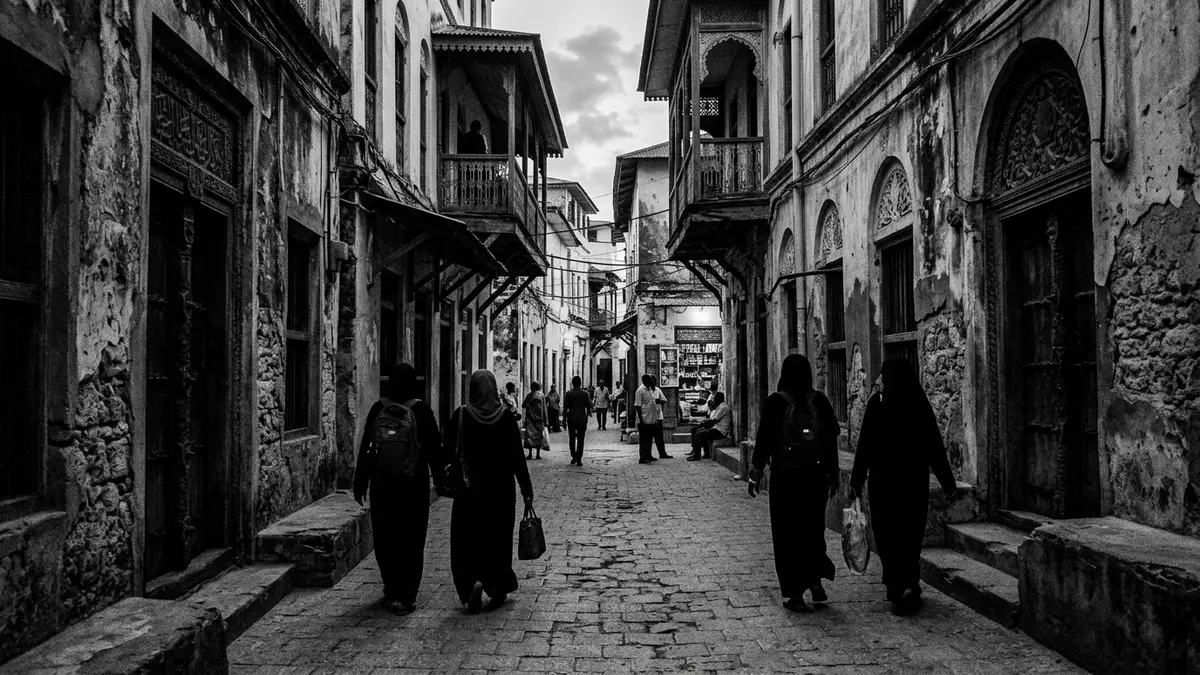
Stone Town in Sansibar, on the island of Unguja off Tanzania, is the historic quarter of Zanzibar City and a renowned example of a Swahili coastal trading town. Its dense network of coral-stone alleys, merchants’ houses and religious buildings largely dates from the eighteenth and nineteenth centuries, when the town served as the capital of the Sultanate of Zanzibar and a major Indian Ocean trading port.
Coral ragstone, alleys and Swahili townscape
Stone Town occupies a coral peninsula on the western coast of Unguja, facing the channel that separates the archipelago from mainland Tanzania. Its historic core grew into an urban settlement over several centuries of maritime trade, with the town’s present limits largely defined by the early twentieth century.coral peninsula on the western coast The buildings are constructed mainly from coralline ragstone cut from local reefs, combined with mangrove timber and thick lime mortar, then plastered and lime-washed to create pale facades that weather in the sea air.coralline ragstone and mangrove timber
Walking through Stone Town means moving along narrow passageways where houses and shops stand close together, their upper storeys overhanging the street. Many residential buildings combine commercial rooms on the ground level with living spaces above, an arrangement typical of Swahili trading settlements on the East African coast.fine example of Swahili coastal trading towns The town’s plan weaves between quarters such as Shangani and Malindi, linking bazaar streets, waterfront terraces and market areas, while the seafront remains lined with civic structures and former palaces that face the harbour.
Carved doors, palaces and places of worship
One of the most distinctive features of Stone Town is the concentration of large carved wooden doors set into otherwise plain masonry walls. These doors often carry intricate geometric and floral patterns, sometimes combined with Qur’anic calligraphy or brass studs, and mark the entrances to merchant houses and important residences.large and ornately carved wooden doors Together with the baraza stone benches found outside many houses, they create a continuous rhythm of thresholds and informal meeting places along the streets.
Among the major monuments, the Old Fort, also known as Ngome Kongwe, stands near the waterfront on the site of a former Portuguese church, its thick coral walls enclosing a courtyard used for gatherings and performances.Old Fort built on the site of a Portuguese church Nearby, the former ceremonial palace known as the House of Wonder, commissioned by Sultan Barghash in the nineteenth century, dominates the seafront with its layered verandas and grand proportions.House of Wonder built by Sultan Barghash Religious buildings include St Joseph’s Roman Catholic Cathedral and Christ Church Anglican Cathedral, mosques such as the Malindi Bamnara Mosque, and structures like the Jamat Khana associated with the Ismaili community, all reflecting the diverse faiths that have coexisted in the town.
Trade, slavery and UNESCO World Heritage status
Stone Town took shape as a major hub of Indian Ocean commerce during the eighteenth and nineteenth centuries, when it served as the capital of the Sultanate of Zanzibar and a centre for the spice trade, particularly cloves. At the same time it was deeply connected to the slave trade, with markets and traders linking the East African interior to buyers across the ocean. The area around the former slave market, where Christ Church Anglican Cathedral was later built, preserves memorials and structural remains that mark this history and the subsequent efforts to end the trade.slave trade hub and later memorials
The town’s architecture and layout express a long fusion of African, Arab, Persian, Indian and European influences within the Swahili culture, visible in building materials, decorative elements and the arrangement of streets and public spaces.complex fusion of Swahili, Indian, Arab and European influences In recognition of this cultural significance and of its relatively intact townscape, Stone Town of Zanzibar was inscribed on the UNESCO World Heritage List in 2000 under criteria that highlight its role in cultural exchanges, its testimony to Swahili traditions and its association with the history and suppression of the slave trade.inscribed on the World Heritage list in 2000
Visiting Stone Town: what travellers from Western Europe should know
- Stone Town forms the historic quarter of Zanzibar City on Unguja, off the coast of Tanzania, and is reached via Zanzibar’s main port or airport from regional hubs.
- The old streets are narrow and paved, with frequent steps and uneven surfaces; many routes through the core zone require walking along alleyways without vehicle access.
- The seafront area combines open terraces and gardens with historic buildings, while inland quarters contain denser housing and market lanes, so distances on foot between sights remain short but involve frequent turns.
- The official language is Swahili and the currency is the Tanzanian shilling.
- Entry requirements depend on your nationality; UK travellers can check the FCDO travel advice at gov.uk/foreign-travel-advice, Irish travellers the Department of Foreign Affairs at ireland.ie.
Searching for Stone Town on social platforms
These links open searches for Stone Town on each platform.Frequently asked questions about Stone Town
Where is Stone Town and what is its setting?
Stone Town is the historic core of Zanzibar City on Unguja, part of the Zanzibar archipelago off the coast of Tanzania, occupying a coral peninsula on the island’s western shore.
What should visitors expect when exploring Stone Town?
Visitors encounter a compact maze of coral-stone alleys lined with merchants’ houses, carved doors, mosques, churches and small shops, with the seafront marked by former palaces, fortifications and open terraces.
What makes Stone Town distinctive among coastal cities?
Stone Town stands out for its Swahili architecture that blends African, Arab, Persian, Indian and European influences, its carved doors and baraza benches, and its concentration of historic buildings linked to centuries of Indian Ocean trade and the history of the slave trade.


