
Stone Town’s coral maze of Swahili history
Published on 08/27/2026 at 19:03 | Editorial responsibility: Rafael Müller, Editor-in-Chief AD HOC NEWS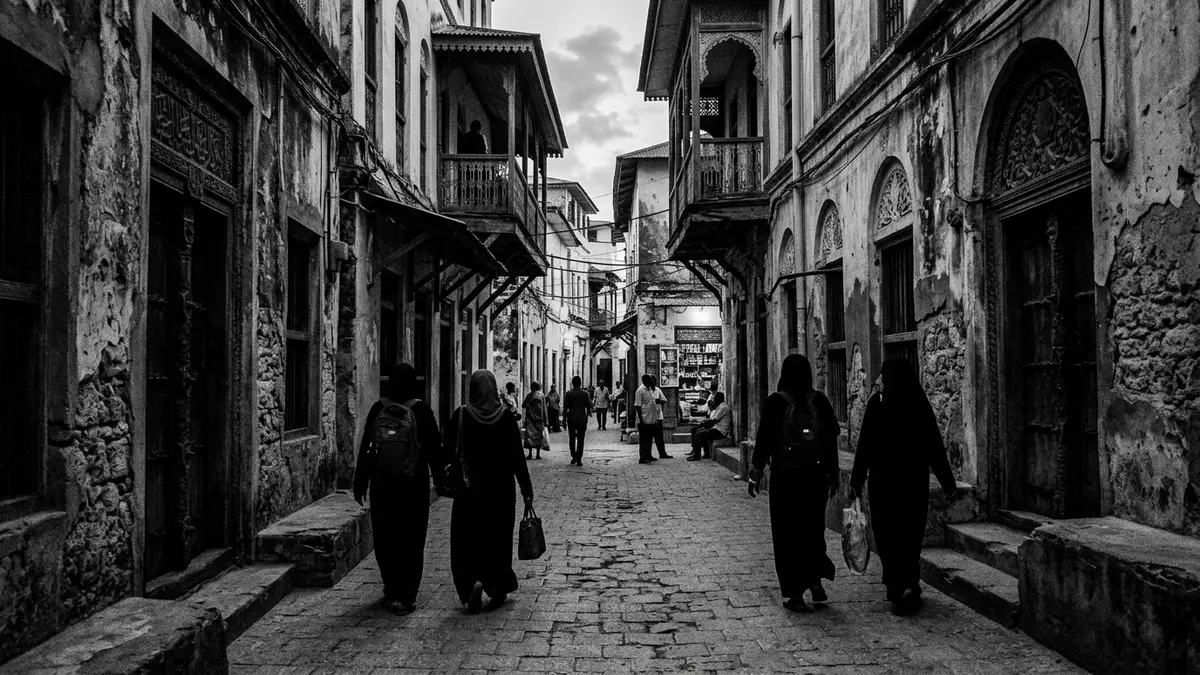
Stone Town in Sansibar, on the island of Zanzibar in Tanzania, is a dense historic quarter built in coral stone along the western shore of the Indian Ocean. Its streets and buildings form a compact Swahili port city whose architecture reflects centuries of contact between Africa, Arabia, India and Europe, a fusion recognised in its inscription as a UNESCO World Heritage Site in 2000.
Coral stone, carved doors and Swahili streets
The core fabric of Stone Town is built largely from coralline ragstone and mangrove timber, set in thick lime mortar and finished with lime plaster that gives the town a warm, weathered appearance.coralline ragstone and mangrove timber These materials are characteristic of Swahili coastal towns along East Africa and tie Stone Town physically to the reef and shoreline on which it stands.coral peninsula on the western coast
The historic lanes are narrow and twisting, with houses that rise closely along both sides so that upper storeys almost touch above head height. Many townhouses have projecting balconies and covered verandas facing the street, creating shaded corridors lined with carved timber balustrades. At ground level, robust walls present a continuous street edge, punctuated by elaborately worked wooden doors whose frames and lintels carry floral patterns, calligraphy and studded metal bosses.large and ornately carved wooden doors
Sultans, merchants and a maritime crossroads
Stone Town developed as a Swahili settlement on a coral peninsula with a recorded history of coastal trade stretching back many centuries.Swahili people have lived along a coral peninsula In the early modern period the island came under the Portuguese Empire, which established fortifications on the waterfront and helped anchor the town within Indian Ocean trading routes.Portuguese Empire was the first European power
A decisive shift came in the nineteenth century, when the Sultanate of Oman moved its capital to Stone Town under Sultan Sayyid Said and developed the town as the administrative and commercial centre of its realm.moved its capital to Stone Town in 1840 From 1890 Stone Town lay within a British protectorate, and over that period its palaces, civic buildings and trading houses made it a hub for the spice trade and the Indian Ocean slave trade.former capital of the Sultanate of Zanzibar These layers are visible in the dense mix of mosques, churches, warehouses and residences packed into the peninsula.
Monuments along the seafront and inland streets
Along the waterfront, several prominent landmarks frame the outline of Stone Town against the sea. The Old Fort, also known as Ngome Kongwe, stands near the harbour as one of the earliest substantial stone structures in the town.Old Fort also called Ngome Kongwe Nearby stands the House of Wonders, or Beit el Ajaib, a large ceremonial palace associated with Sultan Barghash that became a landmark of late nineteenth-century architecture in Zanzibar.House of Wonder a large ceremonial palace
Inland, religious and civic monuments mark the transition from Omani rule to British administration and missionary activity. Christ Church Anglican Cathedral stands on the site of the former slave market and incorporates a memorial to David Livingstone and the abolition of the slave trade.remains of the last slave market St Joseph’s Roman Catholic Cathedral rises with its twin towers above the surrounding roofs, while mosques such as the Malindi Bamnara Mosque and the Jamat Khan for the Ismaili community add further layers to the skyline and street life.St. Joseph’s Roman Catholic Cathedral
Living heritage in a Swahili coastal town
Stone Town was inscribed on the UNESCO World Heritage List in 2000 as an outstanding example of a Swahili coastal trading town whose urban fabric and townscape remain largely intact.inscription as a UNESCO World Heritage Site in 2000 The majority of its major buildings date from the eighteenth and nineteenth centuries, when Swahili, Arab, Indian and European communities created a characteristic mixture of architectural forms, street patterns and public spaces.major buildings date from the 18th and 19th centuries
Across the district, houses with internal courtyards, arcaded verandas and rooftop terraces stand alongside former palaces, dispensaries and bathhouses. Buildings such as the Old Dispensary, the Hamamni Persian Baths and the Royal Cemetery illustrate how medical, social and ceremonial functions were built into the dense townscape.Old Dispensary; the Hamamni and other Persian baths Together, these structures frame a coastal city that remains closely tied to the Indian Ocean and to the Swahili cultural world.
Visiting Stone Town: what travellers from Western Europe should know
- Stone Town forms the historic core of Zanzibar City on the western coast of Unguja island in Tanzania, facing the Zanzibar Channel in the Indian Ocean.
- The district is compact and largely walkable, with narrow lanes, occasional uneven paving and some streets that accommodate both pedestrians and vehicles.
- Many historic houses include internal staircases and upper-level verandas, and visiting monuments such as churches or former palaces can involve climbing steps and moving through enclosed passages.
- The official language is Swahili and the currency is the Tanzanian shilling.
- Entry requirements depend on your nationality; UK travellers can check the FCDO travel advice at gov.uk/foreign-travel-advice, Irish travellers the Department of Foreign Affairs at ireland.ie.
Searching for Stone Town on social platforms
These links open searches for Stone Town on each platform.
Frequently asked questions about Stone Town
Where is Stone Town and what kind of place is it?
Stone Town is the historic old quarter of Zanzibar City on the island of Unguja in Tanzania, forming a Swahili coastal port city on the western shore.
What should visitors expect when walking through Stone Town?
Visitors encounter narrow lanes, coral-stone houses with carved doors and verandas, and a mix of mosques, churches and former palaces set close together.
What makes Stone Town distinctive among historic cities?
Stone Town stands out for its dense Swahili urban fabric, coral-stone construction and visible blend of African, Arab, Indian and European architectural traditions along the Indian Ocean.


