
Stone Town’s coral labyrinth on the Swahili coast
Published on 09/10/2026 at 19:58 | Editorial responsibility: Rafael Müller, Editor-in-Chief AD HOC NEWS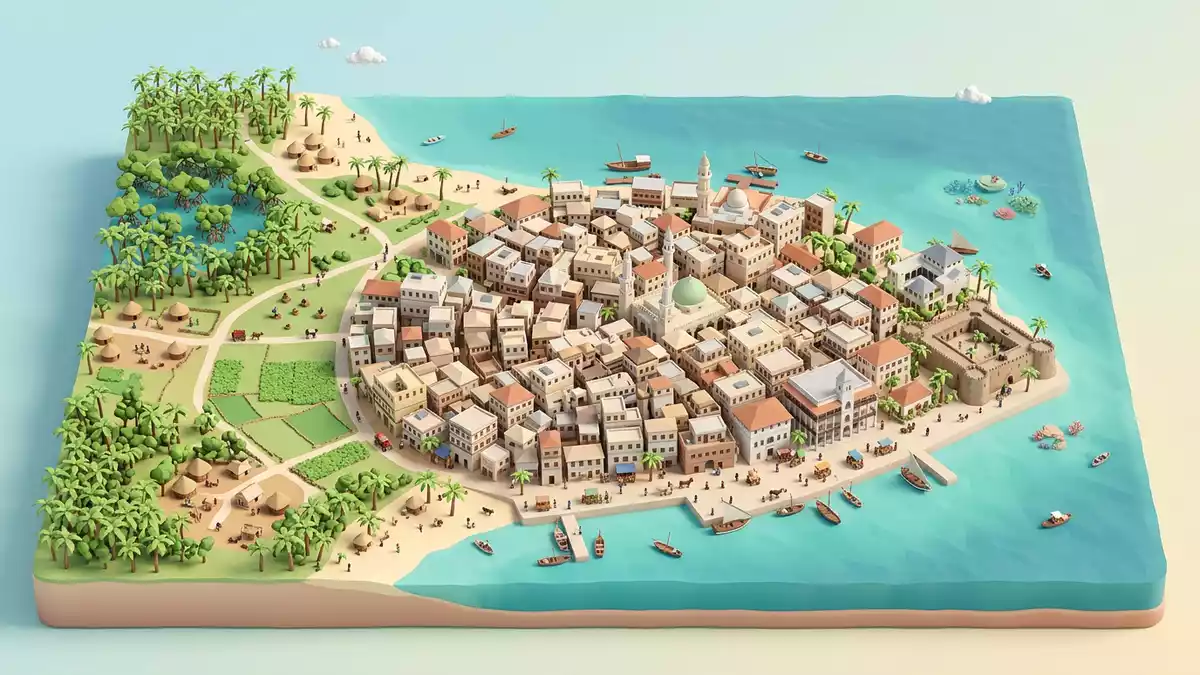
Stone Town in Sansibar is the historic quarter of Zanzibar City on the island of Unguja, facing the Indian Ocean off the coast of Tanzania. Its densely built streets and coral houses form a Swahili trading town that became the capital of the Sultanate of Zanzibar in the nineteenth century and was inscribed as a UNESCO World Heritage Site in 2000.
Coral stone streets shaped by the Indian Ocean
Stone Town occupies the western shore of Unguja, built close to a natural harbour that linked the island to the trading routes of the Indian Ocean. Much of the historic fabric rises from coral ragstone and limestone, materials quarried from reefs around Zanzibar and used for walls, arcades and facades.coral ragstone and limestone The result is a pale, textured architecture that weathers in the maritime climate.
The street pattern is compact, often narrowing into passageways that are difficult for vehicles and lined with houses, small mosques and former merchant residences. Many buildings date from the second half of the nineteenth century, when the Sultanate under leaders such as Seyyid Said and his successors based its power in Zanzibar.second half of the nineteenth century Stone Town’s urban grain, with plots pressed together and upper floors projecting above the lanes, reflects centuries of adaptation to limited ground space near the waterfront.
Swahili architecture and carved doors
Stone Town’s architecture shows a clear fusion of Swahili, Arab, Persian, Indian and European influences, visible in its houses, religious buildings and civic landmarks.fusion of influences Many townhouses have elaborately carved wooden doors, some with brass studs, set into heavy walls of coral stone. Above them, verandas and galleries carry wooden balustrades, while interior courtyards provide private open space away from the street.
Among the larger structures are the Old Fort, whose foundations date to the Portuguese presence in the early sixteenth century and whose present form reflects seventeenth-century Omani control, and a ceremonial palace once used by the sultans.Old Fort foundations Later buildings such as Christ Church Cathedral, raised on the site of the former slave market, and large mosques illustrate how different faiths and communities built in coral, lime and timber within the same compact town.Christ Church Cathedral over the slave market
Trade, memory and World Heritage status
For many centuries, Stone Town was part of a maritime trading network that connected East Africa to Arabia, Persia, India and beyond, exchanging ivory, spices such as cloves, and enslaved people across the Indian Ocean.Indian Ocean trading network In the nineteenth century it served as the capital of the Sultanate of Zanzibar and a centre for commerce under Omani and later British influence.capital of the Sultanate of Zanzibar
The Stone Town of Zanzibar was inscribed as a UNESCO World Heritage Site in 2000 for its well-preserved urban fabric and as a physical record of Swahili coastal civilisation, cultural fusion and the history of the slave trade.inscribed as a UNESCO World Heritage Site in 2000 Its streets, coral houses, mosques, churches, palaces and market spaces together give a material impression of Swahili culture shaped by African, Arab, Indian and European worlds over more than a millennium.material impression of Swahili culture
Visiting Stone Town: what travellers from Western Europe should know
- Stone Town forms the old quarter of Zanzibar City on the island of Unguja, reached by flights to Abeid Amani Karume International Airport and by ferries serving the harbour.
- Within Stone Town many streets are narrow and paved, with uneven surfaces and steps; walking between sights often means moving through tight alleyways rather than broad roads.
- Stone Town lies at sea level on Zanzibar’s west coast, where humidity can be high; shaded courtyards and interior passages provide relief from direct sun.
- The official languages of Tanzania include Swahili and English, and the currency is the Tanzanian shilling.
Searching for Stone Town on social platforms
These links open searches for Stone Town on each platform.
Frequently asked questions about Stone Town
Where is Stone Town located?
Stone Town is the old quarter of Zanzibar City on the island of Unguja, lying on the western side of the Zanzibar archipelago off mainland Tanzania.
What can visitors expect when walking through Stone Town?
Visitors encounter coral-built houses, mosques, churches and historic forts along narrow streets, with carved wooden doors and enclosed courtyards giving a layered Swahili character.
What makes Stone Town distinctive among coastal towns?
Stone Town is distinctive for its coral architecture, compact plan and its role as a Swahili coastal trading centre shaped by African, Arab, Indian and European influences over many centuries.


